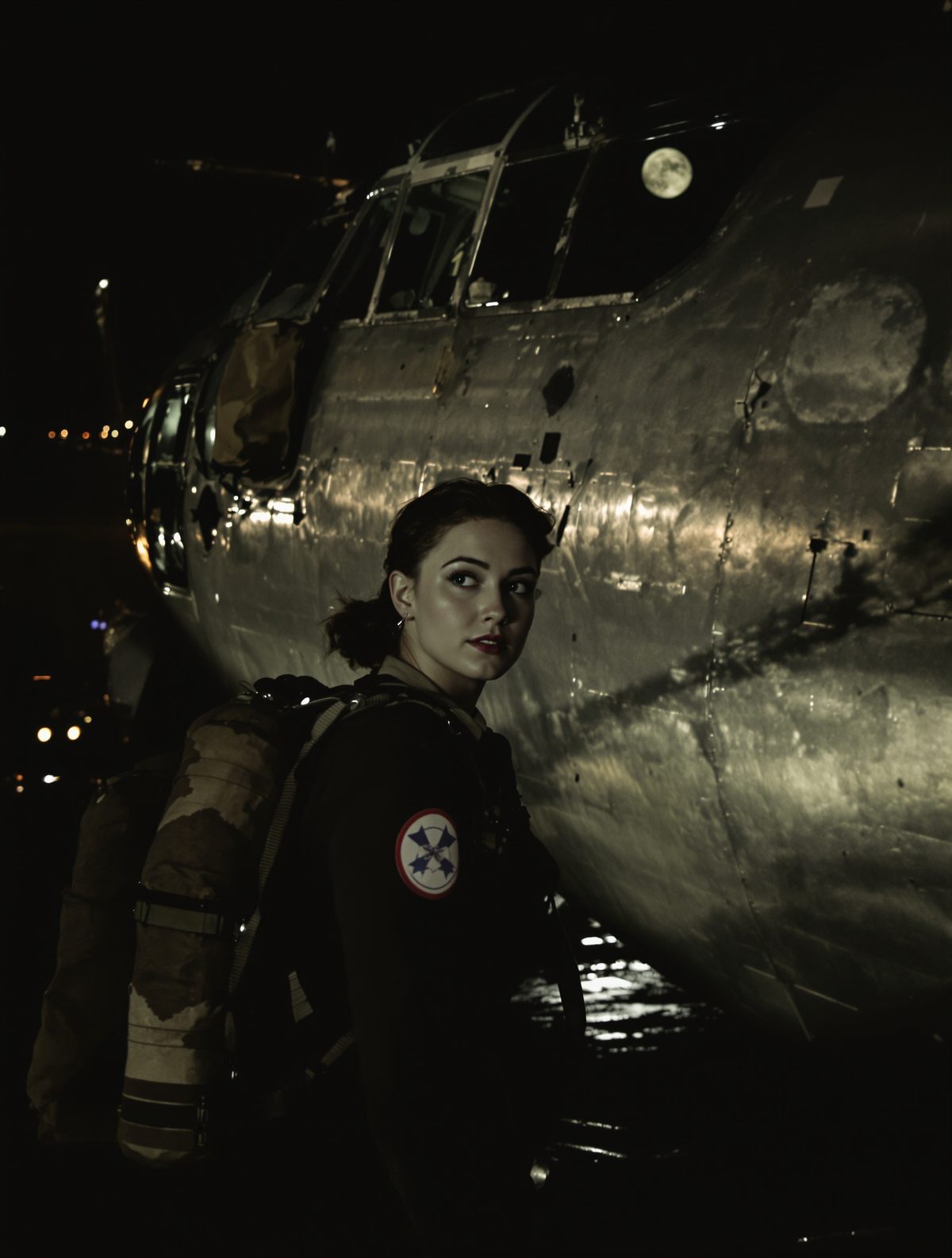
The Lysander aircraft bucked and weaved through the darkness above occupied France, its single engine straining against the February night. Inside the cramped fuselage, a 23-year-old woman from Stockwell checked her parachute straps one final time. Violette Szabo—widow, mother, and one of Churchill's most dangerous secret weapons—was about to drop into a world where discovery meant torture and death. She had volunteered for this. Three times she would make this terrifying leap. Only twice would she return.
The Making of a Secret Agent
Violette Bushell hadn't set out to become a spy. Born in Paris to an English taxi driver father and French mother, she grew up speaking both languages fluently—a skill that would prove deadly useful. In 1940, at just 19, she met Étienne Szabo, a handsome French Foreign Legionnaire on leave in London. They married within weeks, a wartime romance that burned bright and brief.
By 1942, Étienne was dead, killed fighting with the Free French in North Africa. Violette was left alone with their infant daughter Tania, consumed by grief and a burning desire for revenge against the Nazi regime that had torn her world apart. When a mysterious recruitment officer approached her at her husband's memorial service, she didn't hesitate. The Special Operations Executive (SOE)—Churchill's "Ministry of Ungentlemanly Warfare"—had found their newest recruit.
What followed was six months of the most intense training imaginable. At secret facilities across Scotland, Violette learned to kill silently with her bare hands, to blow up railway lines, to resist interrogation, and to become invisible in plain sight. She mastered the Sten gun so completely that she could strip and reassemble it blindfolded. Her instructors noted her "remarkable accuracy" with small arms and her complete fearlessness under pressure. But perhaps most remarkably for 1943, she was training alongside men as an equal—something virtually unheard of in the British military.
Read next: The Day a British Stretcher-Bearer Refused an Order to Save Lives
First Drop: The Salesman Circuit
On April 5, 1944, Violette made her first operational jump into France. Code-named "Louise," she parachuted near Cherbourg to assist the "Salesman" circuit—a network of French Resistance fighters preparing for the D-Day landings just two months away. Her mission was simple in concept, terrifying in execution: reorganize scattered Resistance groups and coordinate sabotage operations behind German lines.
For three weeks, she lived in a world of constant danger. By day, she cycled through Norman villages, posing as a secretary from Caen. Her cover story was meticulously crafted—she carried forged identity papers, ration cards, even a fictional employer's letter. But it was her fluent French and intimate knowledge of Parisian culture that truly sold the deception. German patrols passed her on country roads, never suspecting that the demure young woman on the bicycle carried detailed maps of their fortifications in her underwear.
By night, she transformed into something far more dangerous. Using coded BBC radio messages—innocuous phrases like "the cat sat on the mat"—she coordinated weapons drops and planned railway sabotage. The statistics from her first mission were staggering: her network destroyed six railway bridges, derailed fourteen trains, and cut telephone communications across a 30-mile radius. When she was finally extracted by Lysander aircraft on May 30, the Germans still had no idea who had been orchestrating the chaos.
Behind the Lines: A Deadly Game of Cat and Mouse
Violette's second mission began just three months later, on June 7, 1944—the day after D-Day. This time, she parachuted into the Limousin region of central France with a chilling briefing: the 2nd SS Panzer Division "Das Reich" was moving north toward Normandy, and her job was to slow them down at any cost.
What followed was perhaps the most audacious intelligence operation of the war. Working with local Resistance leader Jacques Poirier, Violette helped coordinate attacks that turned the division's journey into a nightmare. Instead of the expected three days to reach Normandy, it took them seventeen. Railway lines were blown, bridges destroyed, fuel dumps sabotaged. German officers later described facing "an invisible army" that struck without warning and vanished into the countryside.
But the mission came at a terrible cost. On June 10, driving through the village of Salon-la-Tour with fellow agent Staunton, their car was spotted by a German patrol. In the firefight that followed, Violette's Sten gun jammed. As Staunton fled to safety, she held off an entire SS squad with just her Colt .32 automatic until her ammunition ran out. Witnesses later described her "extraordinary courage" as she continued firing even when surrounded.
The Final Sacrifice
Captured alive, Violette faced months of interrogation at Fresnes prison in Paris. Despite torture and isolation, she revealed nothing about her networks or fellow agents. SS records, discovered after the war, show their frustration at her complete silence. One interrogator wrote: "The subject maintains an absolute refusal to cooperate despite intensive questioning."
In August 1944, as Allied forces approached Paris, Violette was transported to Ravensbrück concentration camp in Germany along with two other female SOE agents—Denise Bloch and Lilian Rolfe. For months, they endured the horrors of the camp while maintaining the fiction that they were simple criminals, not Allied agents. Fellow prisoners later testified to their remarkable solidarity, sharing meager food rations and caring for the sick despite their own suffering.
Read next: The Day a Army Chaplain Gave His Coat to a Dying Stranger
On January 27, 1945—just months before Germany's surrender—the three women were taken to a small wood near the camp and executed by single gunshots to the back of the head. Violette Szabo was 23 years old. She would never see her daughter grow up, never witness the liberation of France she had died to achieve.
Legacy of the Forgotten Warriors
Violette's story might have died with her, buried in classified files and official secrecy. But in 1946, her courage was finally recognized when she became one of only four women to receive the George Cross, Britain's highest civilian award for bravery. The citation read simply: "She showed the most conspicuous courage and steadfastness despite the torture inflicted on her."
Yet the full truth of what she accomplished remained hidden for decades. Recently declassified SOE files reveal the staggering impact of her operations: the intelligence she gathered helped save an estimated 2,000 Allied lives during the Normandy campaign. Her sabotage work delayed German reinforcements at the most critical moment of the war in Western Europe.
Perhaps most remarkably, Violette was part of a forgotten army of women who fought in the shadows of World War II. Of the 39 female agents sent into occupied France by SOE, thirteen never returned. They came from every background imaginable—shop girls and debutantes, housewives and students—united only by their determination to defeat fascism. In an era when women couldn't even serve in combat roles, they were parachuting behind enemy lines as equals to any man.
Today, as we debate women's roles in combat and intelligence work, it's worth remembering that 23-year-old widow from South London who jumped from a bomber into Nazi-occupied France not once, but three times. Violette Szabo proved that courage knows no gender, that heroism can emerge from the most ordinary circumstances, and that sometimes the greatest victories are won by those who never live to see them. Her daughter Tania grew up without her mother, but with the knowledge that Violette Szabo had helped liberate a continent. In the end, perhaps that was sacrifice enough.