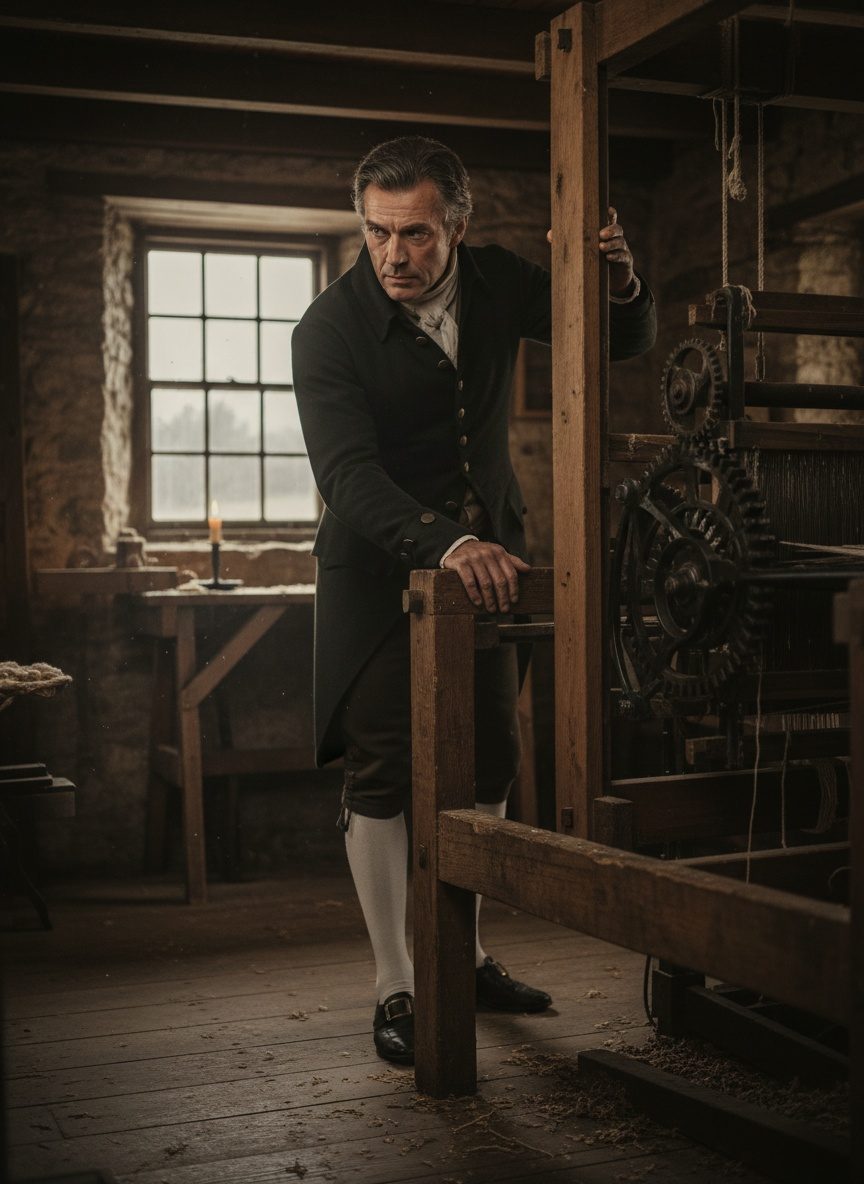
Edmund Cartwright was a country vicar and a clergyman first and foremost. An unlikely candidate to revolutionize the textile industry, Cartwright succeeded where many predicted failure.
A Vicar's Vision
In the year 1784, nestled in the serene English countryside of Yorkshire, Edmund Cartwright sat in contemplation—a not uncommon pose for a man of the cloth. However, this time, his thoughts had drifted far from sermons and scripture. They were entangled in threads and looms, spurred by an enigma within the weaving industry: how to mechanize the complex and manual process of weaving. Cartwright, with no formal engineering background nor any experience on the loom, dared to envision a solution that would defy convention. His leap of imagination would set the stage for a seismic shift in textile production.
What drove Cartwright was an encounter not with the mill workers, but with an idea that mechanization in weaving could echo the earlier innovations in spinning. The spinning jenny and water frame transformed yarn production, yet the weaving process lagged. Skepticism reigned among textile merchants who found the concept of a power loom an impossibility. However, for Cartwright, the challenge was not in the possible, but in the necessary!
Drawing Designs in Deep Waters
By the following year, Cartwright was not merely pondering but had taken a bold plunge. He devised an initial design—an ungainly contrivance that most skilled engineers might immediately dismiss. Swapping pulpit for parish workshop, he set about building his brainchild, immersing himself in unfamiliar territory. The wooden contraption seemed rickety and rudimentary, but its principles were revolutionary. Cartwright’s machine harnessed power to drive the shuttle, a task that had always required human hands.
Read next: The Day a Mill Owner Kept Paying Wages He Could Not Afford
With every listless clatter and glitch of his early machine, Cartwright refined his design. His tenacity was matched only by his willingness to learn through trial and error, an aspect rarely chronicled in textbooks. His innovations were conceived in solitude, in a makeshift workshop far from the roaring fires of any industrial forge. Yet, the simplicity of his surroundings was deceiving. In that modest setting, a new era was noisily being stitched together.
Sneers and Skepticism
News of Cartwright’s power loom rippled through the weaving circles, greeted often by waves of disbelief and laughter. To seasoned weavers, the vicar’s invention was an affront to tradition. The very notion that a clergyman could solve a riddle that had stumped experienced tradesmen was laughable. They had reason to doubt; the intricacies of weaving required dexterity and understanding that many believed could not be replicated by machine.
Yet not all voices scoffed. While the merchants across Britain cast his idea aside, a few forward-thinking souls recognized its potential. Cartwright’s invention symbolized more than mere machinery; it hinted at a revolution in the making. The Industrial Revolution was in its infancy, and though few saw it coming, Cartwright was nudging it forward, one wooden beam at a time.
From Skepticism to Standard
Despite the initial derision, Cartwright’s vision began to gain traction. By the decade’s end, the tide of skepticism had ebbed, giving way to broader acceptance. The power loom, initially relegated to the speculative dustbin, was now being installed in factories across England. The transformation was rapid and unyielding; what had started as an experiment was now an industrial cornerstone.
Factories burst into life with the hum and clatter of Cartwright’s mechanized looms. The manual labor once required was now supplemented and often supplanted by machines that worked tirelessly and with unprecedented consistency. A new era beckoned—a time when machines would augment human capacity and reshape the landscape of labor. Cartwright’s looms symbolized progress, a step forward into the unknown possibilities of the machine age.
The Looming Legacy
Cartwright’s journey from contemplative cleric to industrial innovator is more than just a story of invention. His tale exemplifies the power of perseverance and the transformative potential of ideas birthed from unlikely sources. The power loom did not just change weaving; it laid the groundwork for the mass production that typifies modern industrial society. By mechanizing the loom, Cartwright helped lay the threads for a fabric of society enriched by enterprise and innovation.
The lesson of Edmund Cartwright is that disruption often comes from the periphery; that game-changers sometimes emerge from unheralded origins. His power loom was not merely a machine; it was a declaration that those willing to venture where others fear to tread can alter the course of history. Today, the faint echoes of Cartwright’s machinery can be heard in the whir of automated factories and the hum of industry worldwide. And though his name might not be etched in textbooks, his legacy is woven into the very fabric of modernity.