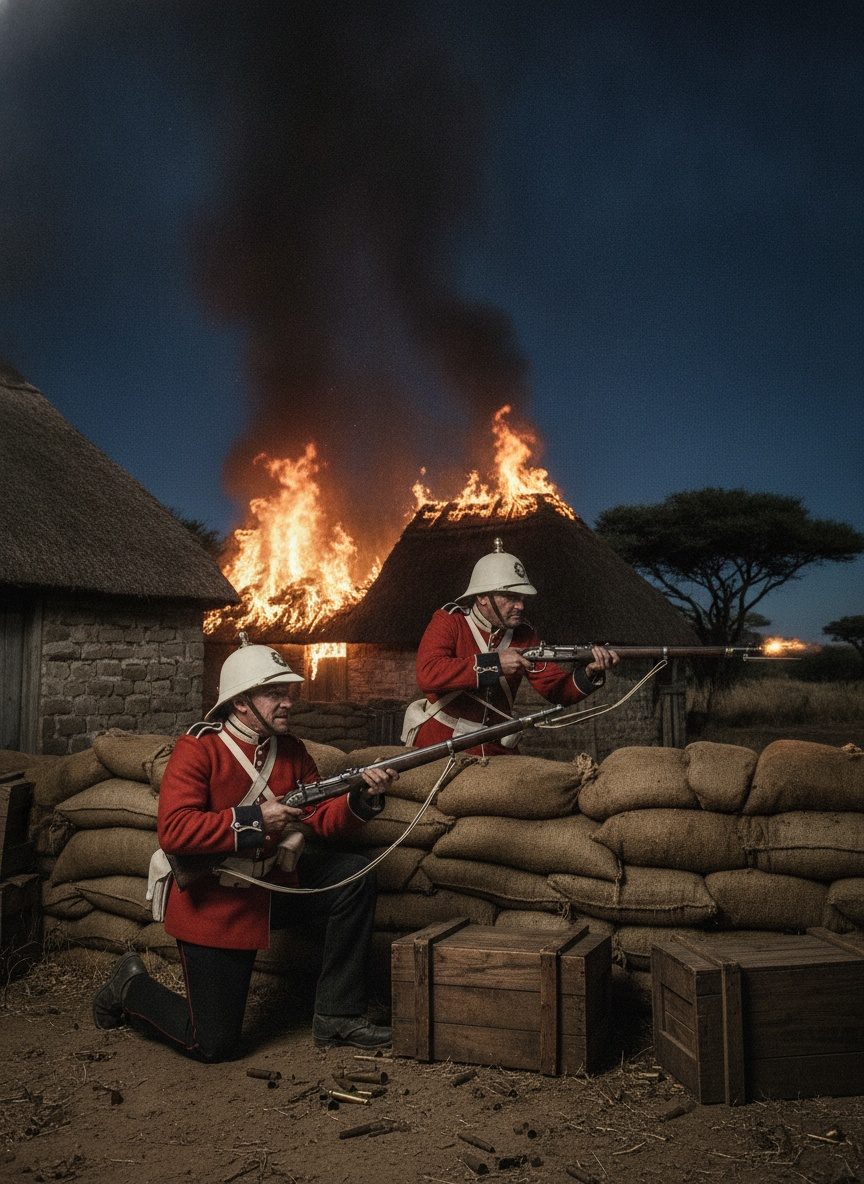
The crack of rifles echoed through the dry African night as Private James watched the flickering shadows dance across the improvised barricades. Voices of wounded men merged with the war chants of thousands charging toward them, creating a symphony of chaos that threatened to choke his resolve. With every muscle tensed, he gripped his weapon tighter, feeling the wood and metal tremble with each heartbeat. He was no more than a mere boy, thrust into a man's war on the night watch at Rorke’s Drift, determined to hold a line that should have already fallen into the swarming mass of Zulu warriors.
This was January 22nd, 1879. The sun had barely dipped below the horizon when whispers of disaster swept through the ranks. The distant battle cries from iSandlwana carried news of a devastating British defeat, and like a tide swelling ominously, panic approached with dreadful certainty. Yet, amid the growing dread, a sense of shared purpose flickered to life among the men of the small mission station. It was in this charged atmosphere that strategy brewed, as less than half of two hundred soldiers barricaded themselves with crates of biscuits and bales of mealie bags, crafting a last bastion of survival against the approaching terror.
The men huddled around their commanding officers, their faces a wash of grime and sweat illuminated by lantern light. A hurried council of war took shape. Lieutenant Chard, an engineer with scant experience in battle, now found himself at the helm of their strategy, alongside Lieutenant Bromhead. Their plans were simple but audacious: fortify the hospital and the storehouse, and create a tenuous line of defense from the makeshift walls. Whatever raw courage they summoned that night was invisible; the apparent appearance was one of grim determination as the specter of fifteen hundred wounded and sick loomed large in their minds.
The Zulu warriors, nearly four thousand strong, stormed with unparalleled ferocity born of millennia steeped in enduring tradition and martial ethos. Each warrior seemed a formidable force, body adorned with fierce adornments and unwavering eyes that peered with resolve across the torn landscape. Their chants filled the night as they descended, their movements a choreographed assault orchestrated by battlefield instincts honed through generations. It was a churning ocean of spears and shields, and yet, what would lead them to return again and again against an anvil of coordinated volleys from the disciplined redcoats?
Read next: The Day a Widow's Son Lit Up the Victorian Night
Private William Jones found his post in the very heart of the brittle line. Born of humility, he carried an equal measure of fear and fortitude into battle, the kind prototype of bravery that is both naive and profound. Amidst interludes of silence punctuated by shouts and cries, it was Jones who shared an extraordinary bond forged with youth and fellow adversity. His story is lesser-known, an unsung thread within a grander tapestry, but no less critical. Next to him, young James stumbled over a loose stone and exchanged a quick, nervous glance. In those eyes, Jones saw not a boy but a soldier forged in battle—humanity's tender, unyielding flicker.
The first charge met the unyielding discipline of the British line, each crack of the rifle a counterpoint to the throbbing war chants that demanded a leap into the maelstrom. Fallen warriors fed the land, but each wave ebbed only to swell again, fierce and unrelenting. Hours dragged into an eternity where the passage of time became irrelevant, only survival was marked by the interval between assaults. Courage was inexorably married to fatigue. Sprinklings of men emerged as heroes, some earning renown with deeds witnessed by none save those fending off death themselves.
As dawn teased the horizon, the barrage gradually ebbed. The Zulu forces, unmatched in spirit and tactical genius but battered from the relentless pace, broke away like a tide retreating to the very heart of the ocean. Below the dimmed horizon, news circulated that the warriors retreated, exhausted. In a disbelieving collective sigh, the defenders of Rorke’s Drift realized their astonishing defiance had rewritten a fate of certain destruction. As if climactic consent had wavered, eleven Victoria Crosses were subsequently awarded, a testament to valor amid the improbable survival.
Why did mere mortals prevail that night against fearsome odds? Surely, no narrow honor could alone articulate such tenacious endurance. There are brighter apertures within clashing ideologies and cultures, where valor is found not in bloodshed but in empathy and alliances forged across divide. Perhaps, their refusal to succumb was profound because it was simply unfeasible, tucked gently into annals that rarely hailed a night’s whispered promise of unexpected resilience. So, Rorke’s Drift slips gracefully into the ether of Britain's narrative, where an immutable lesson rests—endurance is the bloom of adversity, as much as blades and bullets.