One man who signed the Declaration of Independence could recite all 176 books of the Bible from memory. Such was the depth of learning and commitment among those fifty-six signatories, an assembly of men whose lives were rooted firmly in British soil, yet driven by an unyielding desire for something new. They were British subjects; none was born American.
In the sweltering summer of 1776, these men gathered under the high ceilings and echoing chambers of a hall in Philadelphia. The city, a bustling hub of colonial ambition, was far removed but politically tied to the Thames' tides and the busy heart of the British Empire. The echoes of the hammer striking the Liberty Bell reverberated through their consciousnesses as they stood on the brink of something unprecedented—a daring act of defiance against the world’s premier power. It was a bold gambit grounded in English law, inspired by English philosophy, and borne aloft on the wings of English stubbornness.
While all were subjects of King George III, eight among them began their journeys on British or Irish soil, fully expecting a life under the comforting click of a Crown. They were men drawn from places where the shadows of castles touched the earth and the whispers of history lingered in the misty air. What led them from allegiance to an audacious declaration of rupture?
Across the Atlantic, the principles articulated by English philosopher John Locke had taken root, flourishing in the fertile colonial soil. Locke's ideas of life, liberty, and property had traveled well, taking on new life and context far from the royal chambers where his thoughts were first whispered and then declared. The heritage of the Magna Carta and the Bill of Rights of 1689 offered an indelible blueprint, a testament to a people's claims against tyranny, no matter how anointed.
Read next: The Day a Black Sailor Walked Into Court and Freed Himself
To say America was built from British parts would be no exaggeration. From the common law that underpinned the emerging nation's justice system to the publication's ink that ran in thick, inky British veins, everything about America had a trace of its parent nation in its composition. Even the rebellious spirit that guided the fledglings' steps toward independence was fed from the fierce resilience that had seen Britain through centuries of strife and conquest.
As July unfurled its warm arms around Philadelphia, the gentle simmer of revolution became a roar. The 4th was not merely a redirection of allegiance but a culmination of grievances. To the Crown, it was a squabble gone awry, a familial disagreement that had spiraled beyond tea and taxes. Yet to the colonists, it was the culmination of a century's worth of growing tensions, forced to a head by Parliament's dismissive ear and a king's resolute will.
They had contested their rights as Englishmen at every turn, asserting with fervor that the right to representation is not the gift of a sovereign but the birthright of every free subject. Their defiance was inscribed against the backdrop of British sentiments, laws, and philosophies, marking each stroke of the quill as resolute as a soldier's step into battle.
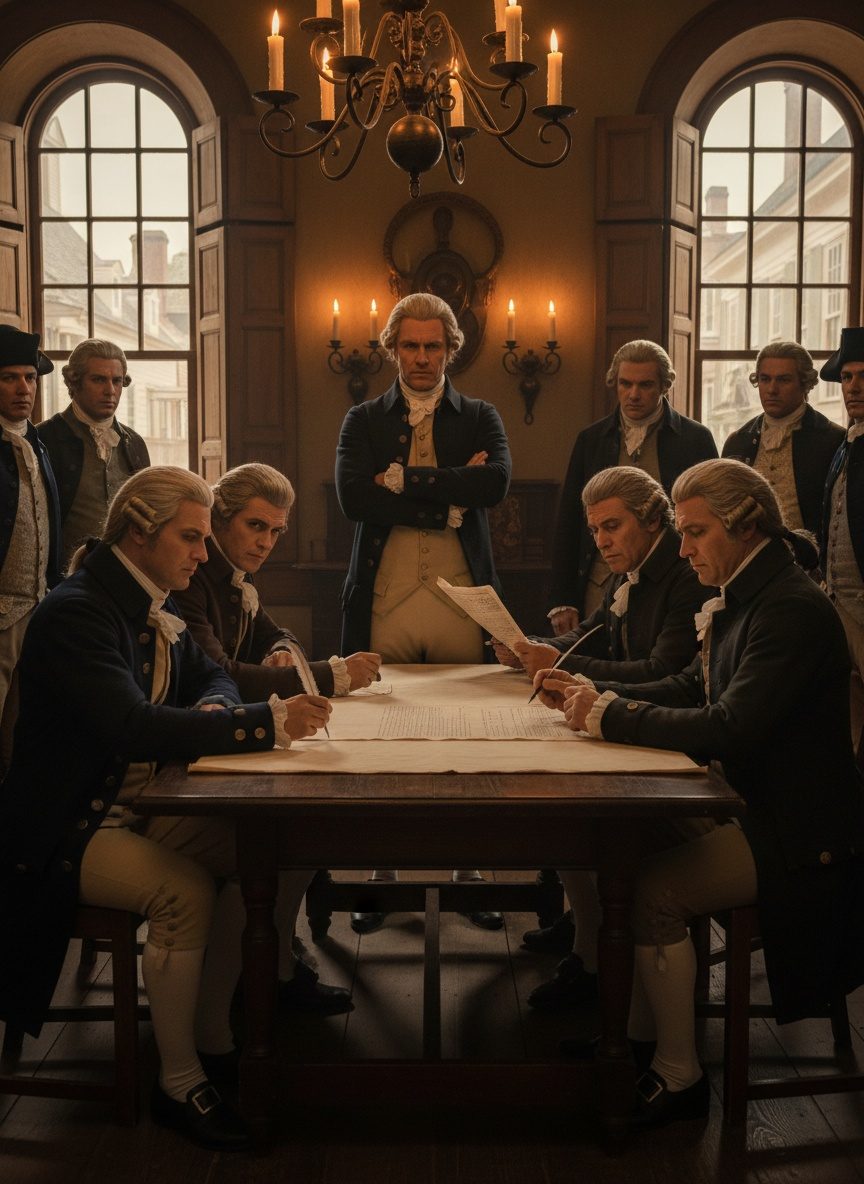
On that day of declaration, these men, shrouded under the gentle swish of powdered wigs and the solemnity of silk stockings, stood at a nascent nation's cradle, ready to face the unknown. The air was thick with the scent of ink and conviction, with documents that spoke louder than cannons and bore witness to their hopes. All eyes were on the parchment laid before them—a carefully crafted rebuke to tyranny borne of careful debate and Herculean resolve.
Read next: The Day a London Clerk Walked Into Court for a Dying Slave
As much as the document severed ties, it also stitched together new seams, forming a patchwork quilt of states bound by shared aspirations. It was a symbolic step of unity, with each signature a collective breath toward independence, each curve of the penmanship a whisper of freedom. The seeds of the world's most enduring democracy, cultivated in colonial precincts, were scattered to the winds, to grow by the light of liberty for centuries onward.
No longer subjects of a crown but architects of their destiny, the signatories laid the framework for a nation destined for greatness, drawn from the paradox of separation and unity. This bold endeavor, emerging from the remnants of English precedent, was born truly from British descent, a testament to the transformative power of ideas set free.
Much of the world has since changed—the British Empire has waxed and waned, borders have relocated, and revolutions have come and gone. Yet the American experiment remains, thriving and evolving, a testament in itself to the interplay of heritage and innovation. History, with its vast tapestry of human endeavor, finds in the pages of their Declaration both a beginning and a reminder: that the most successful creations are those which are built from the threads of the past, boldly woven into the future.