The sniper's bullet entered below his Adam's apple and exited through the back of his neck, missing his carotid artery by mere millimeters. As Eric Blair collapsed into the Spanish mud on that May morning in 1937, blood pooling beneath him, he had no way of knowing that this moment would birth one of the most important voices against totalitarianism the world has ever known. The man who would rise from that trench would no longer be Eric Blair. He would be George Orwell.
The Romantic Revolutionary Heads to War
In December 1936, a tall, gaunt Englishman with a wispy mustache stepped off a train in Barcelona, his pockets containing little more than letters of introduction and burning idealism. Eric Blair was 33 years old, a former imperial policeman in Burma who had returned to England with a deep hatred of oppression and a modest reputation as a writer. The Spanish Civil War had been raging for five months, and like thousands of other foreign volunteers, Blair couldn't stand idly by while fascism threatened to consume Europe.
What he found in Barcelona was intoxicating. The anarchists and socialist militias had transformed the city into something resembling a workers' paradise. Luxury hotels had become hospitals, churches were being used as warehouses, and wealthy men's clubs housed refugees. "It was the first time that I had ever been in a town where the working class was in the saddle," he would later write. Waiters looked you in the eye as equals, revolutionary songs echoed through the streets, and the very air seemed to hum with possibility.
Blair joined the Partido Obrero de Unificación Marxista (POUM), not out of ideological conviction—he barely understood the byzantine politics of the Spanish left—but simply because they were the first group he encountered. Within days, he was issued a ancient German rifle that "would probably blow your head off when you pulled the trigger," and sent to the Aragón front, 175 miles northeast of Madrid.
Read next: The Day a Blind Pauper Boy Sang Before a Queen
Reality Bites in the Trenches
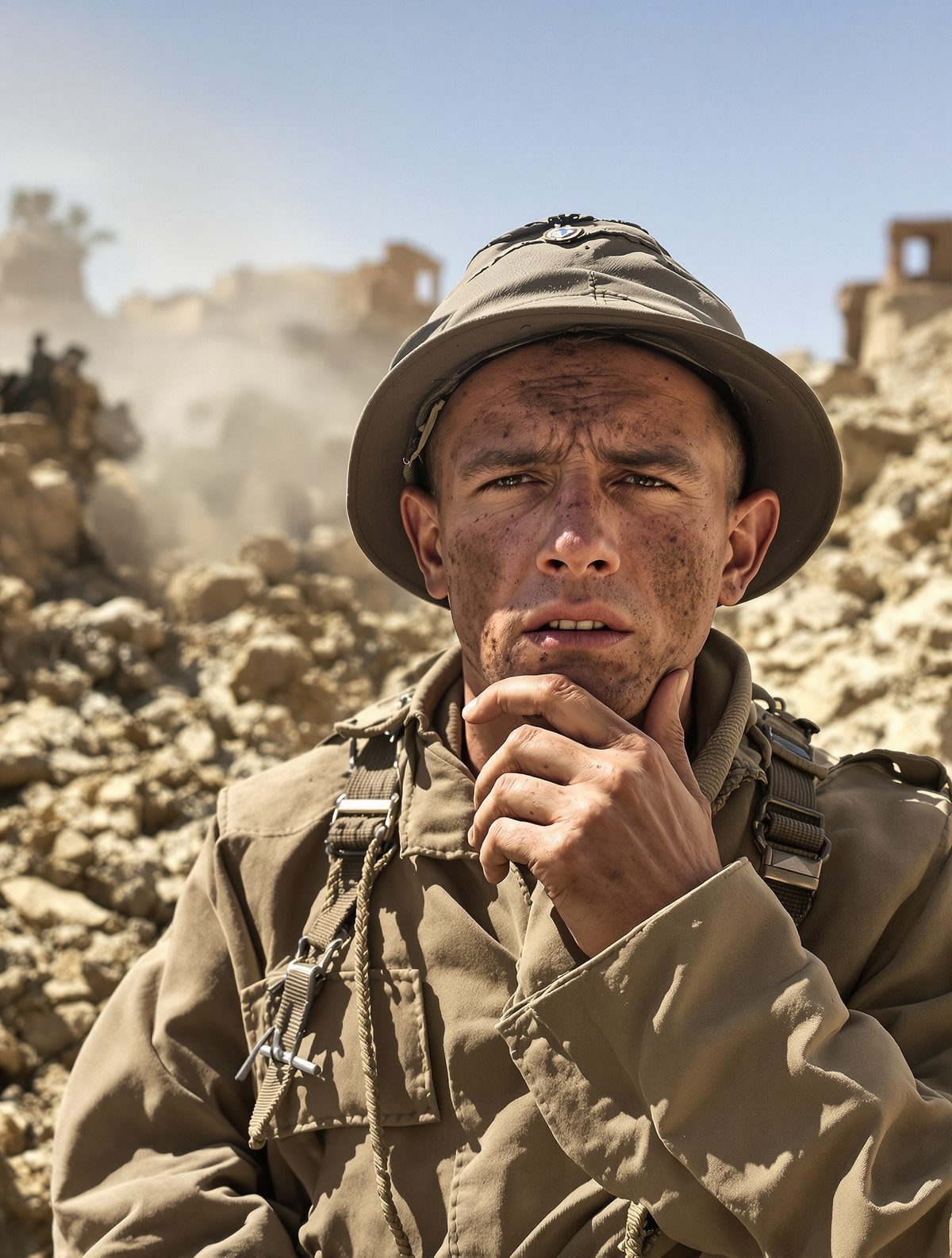
The romantic notions of glorious battle evaporated quickly in the hills outside Huesca. Blair found himself in what he called "the mingled boredom and discomfort of stationary warfare"—a stalemate that stretched across a landscape of olive groves and rocky outcrops. The POUM militia he joined was a ragtag collection of teenage boys, middle-aged workers, and foreign idealists, many of whom had never held a rifle before.
The conditions were medieval. Rats the size of cats scurried through the trenches. The men survived on a diet of beans, bread so hard it had to be broken with rifle butts, and occasional pieces of stringy mutton. In January 1937, temperatures dropped so low that sentries' rifles froze to their hands. Blair, at six-foot-three, couldn't find boots large enough for his feet and spent months with his toes poking through holes in undersized footwear.
But it was the absurdity of the war that struck him most. Both sides were so poorly equipped that they shouted propaganda at each other across no man's land rather than fight. Blair once famously held up a chocolate wrapper and called out in his public school Spanish: "Do you want some chocolate?" The fascist sentries shouted back asking for cigarettes. These weren't the storm troopers of Nazi Germany—many were just Spanish boys who happened to be on the other side of an increasingly incomprehensible conflict.
The Bullet That Changed Literature
By May 1937, Blair had been promoted to second lieutenant and was stationed near the village of Huesca. The front had barely moved in months, but the static warfare was punctuated by moments of sudden, shocking violence. On the morning of May 20th, as Blair stood chatting with another officer about the shocking price of newspapers in Barcelona, a Nationalist sniper some 175 yards away squeezed his trigger.
The Mauser bullet struck Blair just below his larynx, passed clean through his throat, and exited near his spine. The impact threw him backward, and his first thought was surprisingly calm: "Good, I've been hit." He couldn't speak or breathe properly, and blood was flowing freely, but he remained conscious as his comrades carried him to the medical station.
The wound should have killed him. The bullet had missed his carotid artery by what the Spanish doctor called "a miracle"—perhaps two millimeters. It had paralyzed his left vocal cord and damaged his throat permanently, giving him a distinctive whisper that would characterize his speech for the rest of his life. As he lay in a Spanish hospital, spitting blood and unable to speak above a croak, Blair had no idea he had just survived the experience that would transform him into one of the 20th century's most important writers.
The Revolution Devours Its Own
While Blair recovered, Barcelona was tearing itself apart. The various leftist factions had turned on each other with a viciousness that shocked even seasoned observers. Stalin's agents, operating through the Spanish Communist Party, had begun systematically eliminating Trotskyists, anarchists, and members of POUM—the very militia Blair had joined.
When Blair returned to Barcelona in late June, he found a city transformed. The revolutionary atmosphere had been replaced by fear and suspicion. POUM had been declared illegal, its leaders arrested or shot. Blair's own commander, Georges Kopp, had vanished into a Communist prison. The hotels where Blair and his wife Eileen had stayed were now under surveillance, and Communist police were hunting down POUM members.
For nearly a week, the Blairs lived like fugitives in their own camp, sleeping in different places each night, avoiding main streets, and preparing for immediate flight. The very people Blair had come to Spain to fight alongside were now trying to arrest him. It was his first direct experience of how revolutionary idealism could transform overnight into totalitarian nightmare—a lesson that would echo through every page of Animal Farm and 1984.
From Eric Blair to George Orwell
Blair and Eileen escaped Spain on June 23, 1937, crossing into France with little more than the clothes on their backs. The man who had arrived in Barcelona as an optimistic socialist departed as something else entirely—not a cynic, but someone who had seen how noble causes could be corrupted, how truth could be rewritten, and how yesterday's comrades could become today's enemies with the stroke of a bureaucrat's pen.
The Spanish experience changed everything about Blair's writing. Before Spain, he had been Eric Blair, author of decent but unremarkable books about poverty and imperialism. After Spain, he became George Orwell, a voice of moral clarity in an age of ideological confusion. The surveillance state he witnessed in Barcelona became the omnipresent telescreens of 1984. The Communist rewriting of POUM's history became the Ministry of Truth's constant manipulation of the past.
That fascist bullet had done more than damage Blair's throat—it had opened his eyes to what he called "the smelly little orthodoxies which are now contending for our souls." The Spanish Civil War taught him that the enemy of freedom wasn't just fascism, but any system that subordinated individual truth to collective ideology.
The Warning That Echoes Today
George Orwell died in 1950, his voice still weakened by that Spanish bullet, but his warnings about totalitarianism have never felt more relevant. The Spain he witnessed—where truth was malleable, where allies became enemies overnight, where revolutionary slogans masked oppressive reality—seems remarkably contemporary in an age of "alternative facts" and information warfare.
The bullet that nearly killed Eric Blair in a Spanish trench gave the world George Orwell. Without that experience of betrayal and disillusionment, without witnessing how quickly noble causes could turn sinister, we might never have had the clear-eyed moral vision that produced Animal Farm and 1984. Sometimes history's greatest gifts come wrapped in its most painful lessons.
In our current age of polarization and propaganda, Orwell's Spanish experience reminds us that the greatest threats to freedom often come not from obvious enemies, but from those who claim to be fighting for justice while quietly crushing dissent. The man who took a fascist bullet in Spain spent the rest of his life ensuring we would recognize tyranny in all its forms—even when it comes wearing the mask of liberation.