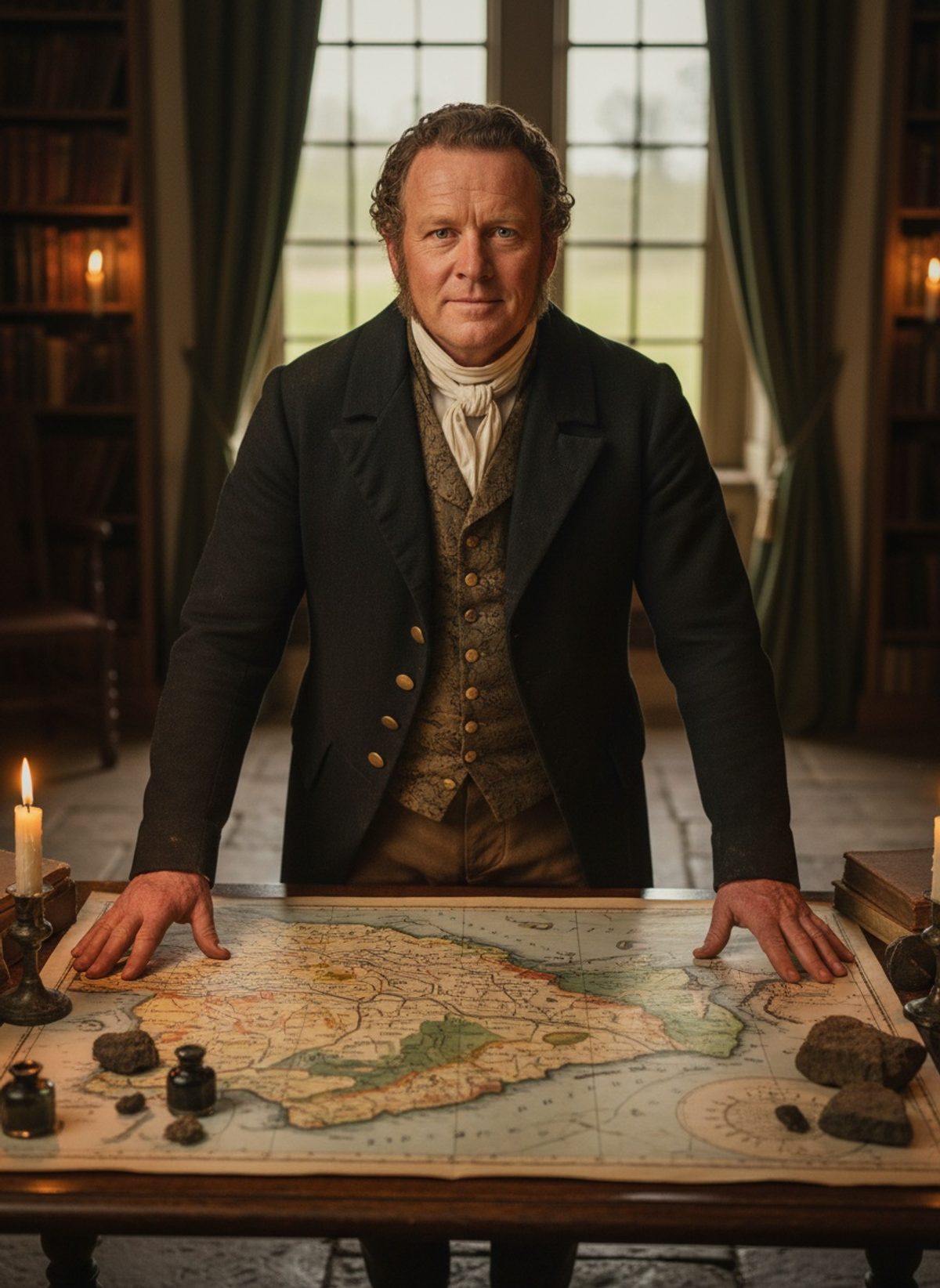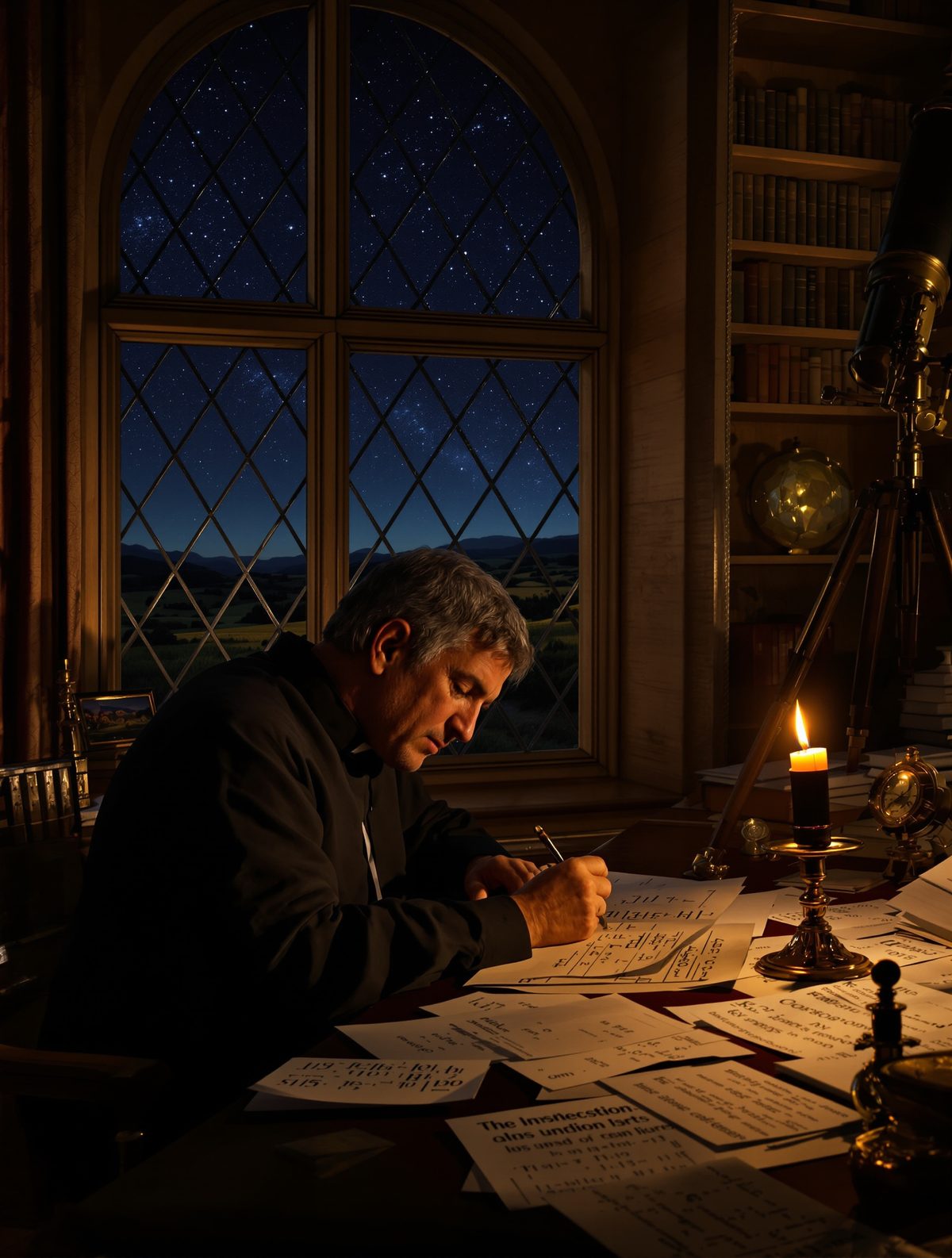
The quill pen scratched across parchment in the flickering candlelight, each stroke bringing humanity one step closer to understanding the universe's darkest secrets. Outside the windows of Thornhill vicarage, the Yorkshire countryside slumbered under a star-filled sky that would never look quite the same again. The year was 1783, and Reverend John Michell was about to predict something so extraordinary that it wouldn't be proven for another two centuries: the existence of black holes.
While his parishioners worried about earthly matters—the American colonies had just won their independence, and King George III was struggling with bouts of madness—Michell's mind wandered to celestial puzzles that would make Einstein himself pause in admiration. Armed with nothing more than Newton's laws, a sharp mind, and an audacious question, this Yorkshire vicar was about to peer into the cosmic abyss.
The Vicar Who Saw Beyond the Stars
John Michell was no ordinary country parson. Born in 1724, he had earned his stripes at Cambridge University, where he rubbed shoulders with some of the brightest minds of the Enlightenment. Before taking up his living in the village of Thornhill, he had been a professor of geology at Cambridge, revolutionizing our understanding of earthquakes and magnetism. But it was his fascination with light itself that would cement his place in scientific history.
In his stone-walled study, surrounded by leather-bound volumes and scientific instruments, Michell pondered a question that seems almost childish in its simplicity: What if light has weight? It was 1783, and the scientific community was buzzing about recent discoveries. Henry Cavendish was preparing his famous experiment to weigh the Earth, and William Herschel had just discovered Uranus, doubling the known size of our solar system overnight.
Read next: The Day a Miner's Son Gave the World Safe Light
Michell's stroke of genius was to treat light like any other projectile. If you fire a cannonball upward, gravity slows it down. Fire it fast enough—what we now call escape velocity—and it breaks free entirely. But what, Michell wondered, would happen to light trying to escape from a star so massive that even light couldn't reach the necessary speed?
Calculations by Candlelight
The mathematics were elegant in their simplicity, yet profound in their implications. Using Newton's law of gravitation, Michell calculated that a star with the same density as our Sun but 500 times larger would have such powerful gravity that light could never escape its surface. He called these hypothetical objects "dark stars"—celestial bodies that could never be seen because no light could ever leave them.
His calculations were remarkably prescient. A star 500 times the Sun's radius would indeed have an escape velocity greater than the speed of light—though Michell had no way of knowing that light's speed was the universal constant that Einstein would later prove it to be. Working entirely within Newton's framework, he had stumbled upon one of the universe's most exotic phenomena.
But Michell went further. In a letter to Henry Cavendish, he speculated that these dark stars might still be detectable through their gravitational effects on nearby visible stars. This was gravitational astronomy—finding invisible objects by watching how they influence visible ones—a technique that wouldn't become standard practice until the 20th century.
The Paper That Time Forgot
In November 1783, Michell presented his findings to the Royal Society of London in a paper titled "On the Means of Discovering the Distance, Magnitude, &c. of the Fixed Stars." The timing couldn't have been worse. The scientific world was captivated by more tangible discoveries—new planets, new gases, new continents. The idea of invisible stars seemed like philosophical speculation rather than serious science.
The paper was published in the Philosophical Transactions of the Royal Society, where it gathered dust for over a century. Even among Michell's contemporaries, few grasped the revolutionary implications of his work. Pierre-Simon Laplace briefly mentioned similar ideas in his Exposition du système du monde in 1796, but then removed all references in later editions, apparently deciding the concept was too speculative.
What makes Michell's oversight even more remarkable is that he got the basic physics right using entirely classical mechanics. While his dark stars weren't quite the same as Einstein's black holes—which require general relativity to fully understand—they were conceptually identical: regions of space where gravity is so strong that nothing, not even light, can escape.
A Yorkshire Einstein
Michell's genius extended far beyond his dark star theory. He was arguably Britain's first seismologist, correctly deducing that earthquakes spread as waves through the Earth's crust. He invented the torsion balance that Cavendish would use to weigh the Earth. He even speculated about double stars orbiting each other—another theory that wouldn't be confirmed until William Herschel's observations decades later.
Yet for all his brilliance, Michell remained a humble country vicar, tending to his flock in Thornhill while contemplating the cosmos. His neighbors knew him as a kindly pastor who baptized their children and buried their dead. They had no idea that their vicar was peering further into the universe's future than anyone had ever dared.
The irony is exquisite: while the great minds of Europe debated the nature of light in their academies and salons, the real breakthrough was happening in a Yorkshire vicarage, where a part-time scientist was rewriting the rules of the cosmos between Sunday sermons.
Vindication Across the Centuries
It wasn't until 1916 that Einstein's general theory of relativity provided the mathematical framework to properly understand Michell's dark stars. Karl Schwarzschild, working in the trenches of World War I just months before his death, solved Einstein's field equations to describe what we now call a black hole. The "Schwarzschild radius"—the point of no return around a black hole—is essentially Michell's escape velocity calculation expressed in the language of curved spacetime.
The term "black hole" itself wasn't coined until 1967, when American physicist John Wheeler used it in a lecture. But the concept that Wheeler christened had been lurking in Michell's calculations for nearly 200 years, waiting for the rest of physics to catch up.
When astronomers finally detected black holes in the 1970s—first Cygnus X-1, then many others—they were confirming not just Einstein's equations, but also the intuition of a Georgian vicar who had glimpsed the impossible using nothing but Newton's laws and his own remarkable imagination.
The Light That Never Was
Today, as the Event Horizon Telescope captures images of black holes millions of light-years away, and gravitational wave detectors listen to the cosmic ripples of colliding black holes, it's worth remembering where it all began. In a quiet Yorkshire village, a man of God looked up at the stars and saw something that wouldn't be photographed until 2019: regions of absolute darkness that define themselves by the light they devour.
Michell's legacy reminds us that revolutionary ideas can emerge from the most unexpected places. While the Royal Society fellows debated in their London halls, the real breakthrough was happening in the margins—in a country vicarage where a part-time scientist dared to ask what seemed like an impossible question.
Perhaps most remarkably, Michell's dark stars teach us that the universe's greatest secrets often hide in plain sight, waiting for someone curious enough to ask the right question and bold enough to follow the mathematics wherever it leads—even into the darkness beyond the stars.