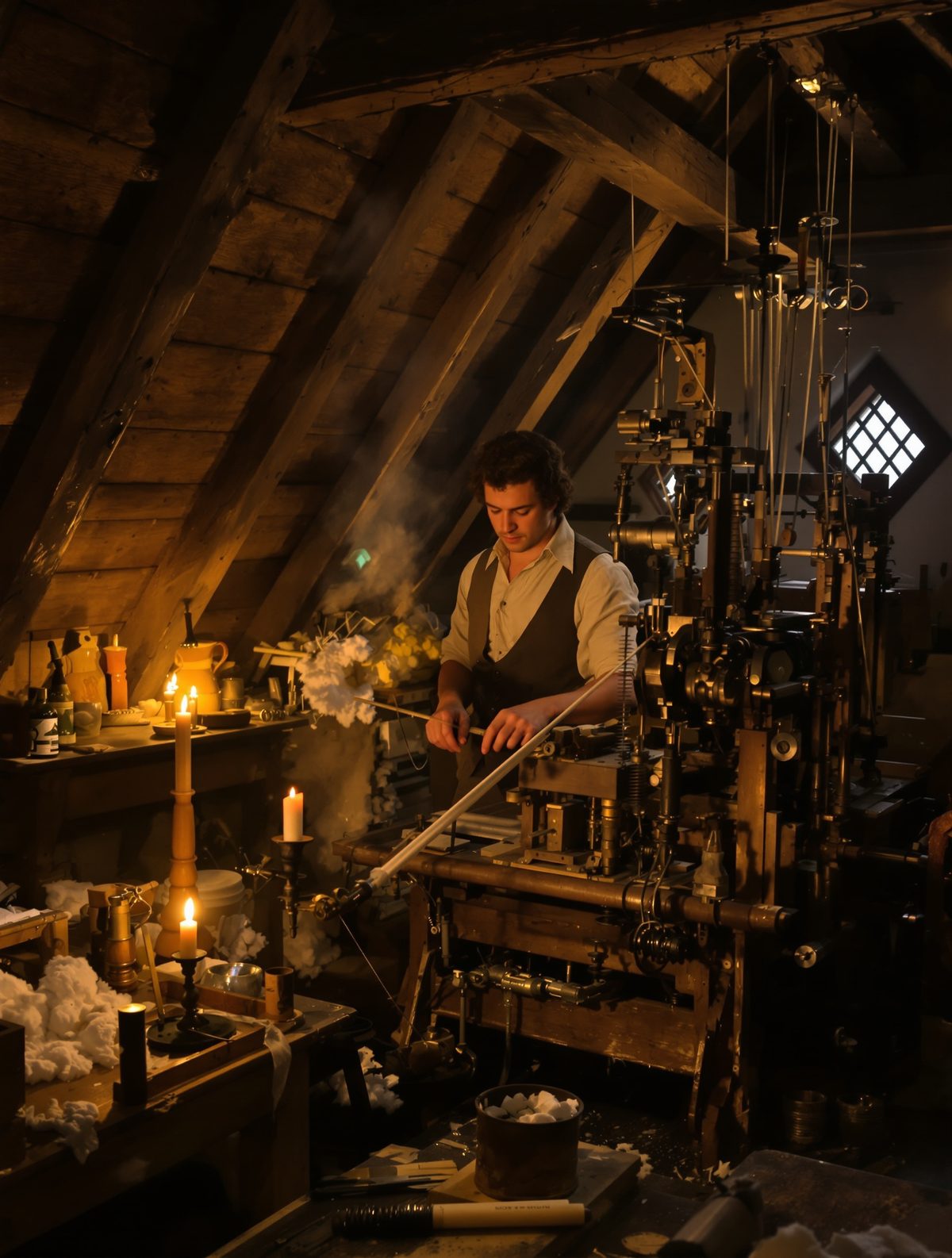
The sound of snapping thread echoed through the cramped Bolton attic for the thousandth time that week. Samuel Crompton cursed under his breath, his calloused fingers working to repair yet another break in the delicate cotton fiber. It was 1774, and the 21-year-old weaver was trapped in an impossible bind—existing spinning machines could either produce strong thread or fine thread, but never both. What Britain's booming textile industry desperately needed was a machine that could spin cotton as fine as silk yet strong enough not to snap under tension. Little did anyone know that the frustrated young man hunched over his makeshift contraption in that dim, cluttered attic was about to solve the puzzle that would make Britain the textile master of the world.
The Cotton Conundrum That Stumped a Generation
By the 1770s, British textile manufacturers found themselves caught between promise and frustration. The recently invented spinning jenny could produce multiple threads simultaneously, but they were weak and suitable only for the horizontal weft threads in weaving. Meanwhile, the water frame created strong thread perfect for the vertical warp threads, but it was coarse and thick. This fundamental limitation meant that British cotton goods remained inferior to fine Indian muslins and couldn't compete with imported silk.
For young Samuel Crompton, this wasn't just an industrial problem—it was personal survival. Working as a hand-loom weaver in Bolton, Lancashire, he watched his livelihood threatened by the limitations of existing technology. The jenny threads he used constantly broke under tension, forcing him to stop work repeatedly to make repairs. Each broken thread meant lost time, lost income, and mounting frustration.
What makes Crompton's story extraordinary is that he possessed no formal engineering training, no wealthy patrons, and no workshop full of skilled craftsmen. He was simply a working-class weaver with an intimate understanding of thread and an obsessive determination to solve what had stumped far more qualified minds.
Read next: The Day a Black Sailor Walked Into Court and Freed Himself
Five Years of Secret Obsession
In 1774, Crompton retreated to the attic of Hall i' th' Wood, a rambling Tudor mansion where his family rented rooms. There, surrounded by the detritus of failed experiments, he began work on what would become the spinning mule—though he had no idea what to call it yet. The secrecy was essential; industrial espionage was rampant, and a breakthrough invention could be stolen and copied before its creator saw a penny of profit.
Night after night, Crompton worked by candlelight, his neighbors hearing only mysterious mechanical sounds filtering through the floorboards. He cannibalized parts from jennies and water frames, creating hybrid mechanisms that combined the best features of both machines. The breakthrough came when he realized he could use a moving carriage system that would draw out the cotton fibers while simultaneously twisting them into thread of unprecedented fineness and strength.
The technical innovation was breathtaking in its elegance. Crompton's machine featured a carriage that moved away from the spindles while drawing out the cotton, allowing for much finer control over the spinning process. The thread could be drawn out to nearly four feet before being wound onto the spindles, creating cotton thread so fine it could pass for silk to the untrained eye.
By 1779, after five years of relentless experimentation, Crompton had perfected his machine. When he finally emerged from his attic laboratory, he possessed something that would transform not just British manufacturing, but the entire global economy.
The Thread That Fooled London's Finest
The first public demonstration of Crompton's machine produced gasps of disbelief. The thread emerging from his spinning mule was so impossibly fine and strong that experienced textile merchants initially refused to believe it was cotton. Some insisted it must be silk imported from China and processed through secret techniques. Others suspected some form of elaborate fraud.
The numbers tell the remarkable story: while the spinning jenny could produce thread suitable for counts up to 20 (the higher the count, the finer the thread), Crompton's mule could achieve counts of 60 to 80, with some exceptional runs reaching 100. This meant thread fine enough to weave muslins that could rival the legendary Indian fabrics that had dominated luxury markets for centuries.
Word spread through Lancashire's tight-knit textile community like wildfire. Manufacturers who had struggled for years to produce decent cotton goods suddenly saw the possibility of creating fabrics that could compete with the finest imports. But there was one problem: Crompton owned the only machine, and he was keeping its secrets closely guarded.
What happened next reveals both the desperation of British manufacturers and the curious character of the machine's inventor. Rather than negotiate licensing deals or sell his patents, Crompton found himself under siege. Manufacturers sent spies to peer through his windows, attempted to bribe his servants, and even tried to break into his workshop to steal the design.
The Greatest Giveaway in Industrial History
Faced with mounting pressure and lacking the business acumen or legal resources to properly commercialize his invention, Samuel Crompton made a decision that would haunt him for the rest of his life. In 1780, he agreed to reveal the complete design of his spinning mule to a group of Manchester manufacturers in exchange for what he hoped would be substantial compensation.
The manufacturers promised him a generous reward commensurate with the value of his invention. What they delivered was £67—roughly equivalent to £8,000 today. For a machine that would generate millions of pounds in profits and transform Britain into the workshop of the world, Crompton received less than many skilled workers earned in a year.
The bitter irony was immediate and painful. Within months of receiving the design, manufacturers across Lancashire were building improved versions of Crompton's mule. By 1790, there were nearly 5 million mule spindles operating across Britain, each one based on the principles he had developed in his Bolton attic. Meanwhile, Crompton himself struggled to make ends meet, watching others grow rich from his innovation.
This wasn't simply poor business judgment—it reflected the brutal realities of innovation in the pre-patent era. Without wealthy backers or legal protection, brilliant inventors like Crompton were often exploited by the very manufacturers who profited most from their work.
The Empire Built on Thread
The impact of Crompton's spinning mule on British industrial supremacy cannot be overstated. By 1812, there were over 4.6 million mule spindles operating across the country, producing thread of a quality that had previously been impossible. This technological leap gave British manufacturers several crucial advantages that would dominate global trade for the next century.
First, Britain could now produce cotton goods that competed directly with expensive silk fabrics. Muslin dresses that once cost months of wages became affordable luxuries for the growing middle class. Second, the superior thread quality meant British cotton goods could undersell traditional woolen products while offering better comfort and appearance.
Read next: The Day a London Clerk Walked Into Court for a Dying Slave
Perhaps most significantly, the spinning mule enabled Britain to challenge India's centuries-old dominance in fine cotton textiles. Indian muslins had long been considered the finest in the world, but by the 1790s, British manufacturers using Crompton's technology could produce comparable fabrics at lower costs. This shift would have profound implications for global trade and colonial economics.
The numbers from this transformation are staggering. Cotton exports from Britain grew from £355,060 in 1780 to £5.4 million by 1800—a fifteen-fold increase in just two decades. The textile industry became Britain's largest employer, supporting entire cities like Manchester, Bolton, and Preston. By 1830, cotton goods accounted for over 50% of British exports.
The Belated Recognition of a Forgotten Genius
Samuel Crompton's story might have ended in poverty and obscurity were it not for a remarkable campaign by his supporters in later life. By 1810, as the enormous wealth generated by his invention became impossible to ignore, a movement began to secure some recognition for the aging inventor.
Parliament eventually awarded Crompton a grant of £5,000 in 1812—a substantial sum, but still a fraction of what his invention had generated. The gesture came too late to change his circumstances significantly, but it did provide some measure of financial security in his final years.
When Crompton died in 1827, the funeral procession through Bolton stretched for over a mile, with workers from dozens of textile mills paying their respects to the man whose genius had created their livelihoods. Yet most of the mill owners who had profited enormously from his invention were notably absent.
Today, as we grapple with questions about intellectual property, innovation rewards, and the distribution of technological benefits, Samuel Crompton's story offers sobering lessons. His spinning mule didn't just transform British manufacturing—it created the template for industrial capitalism, where breakthrough innovations could generate enormous wealth while leaving their creators behind.
The next time you put on a cotton shirt or sleep on cotton sheets, remember the young weaver who spent five years in a Bolton attic, perfecting the machine that made it all possible. His genius gave Britain an empire, but history barely remembered to give him credit.