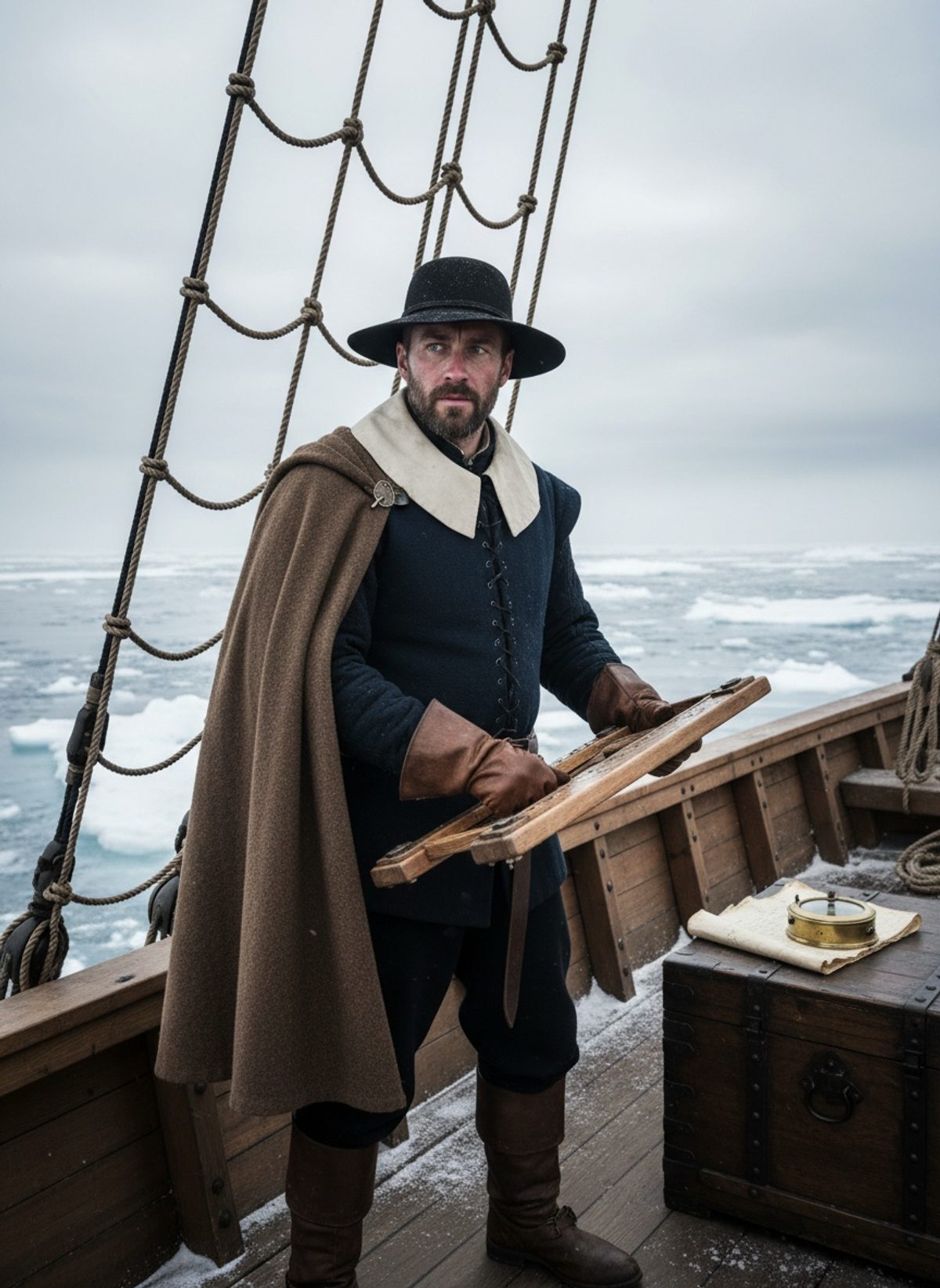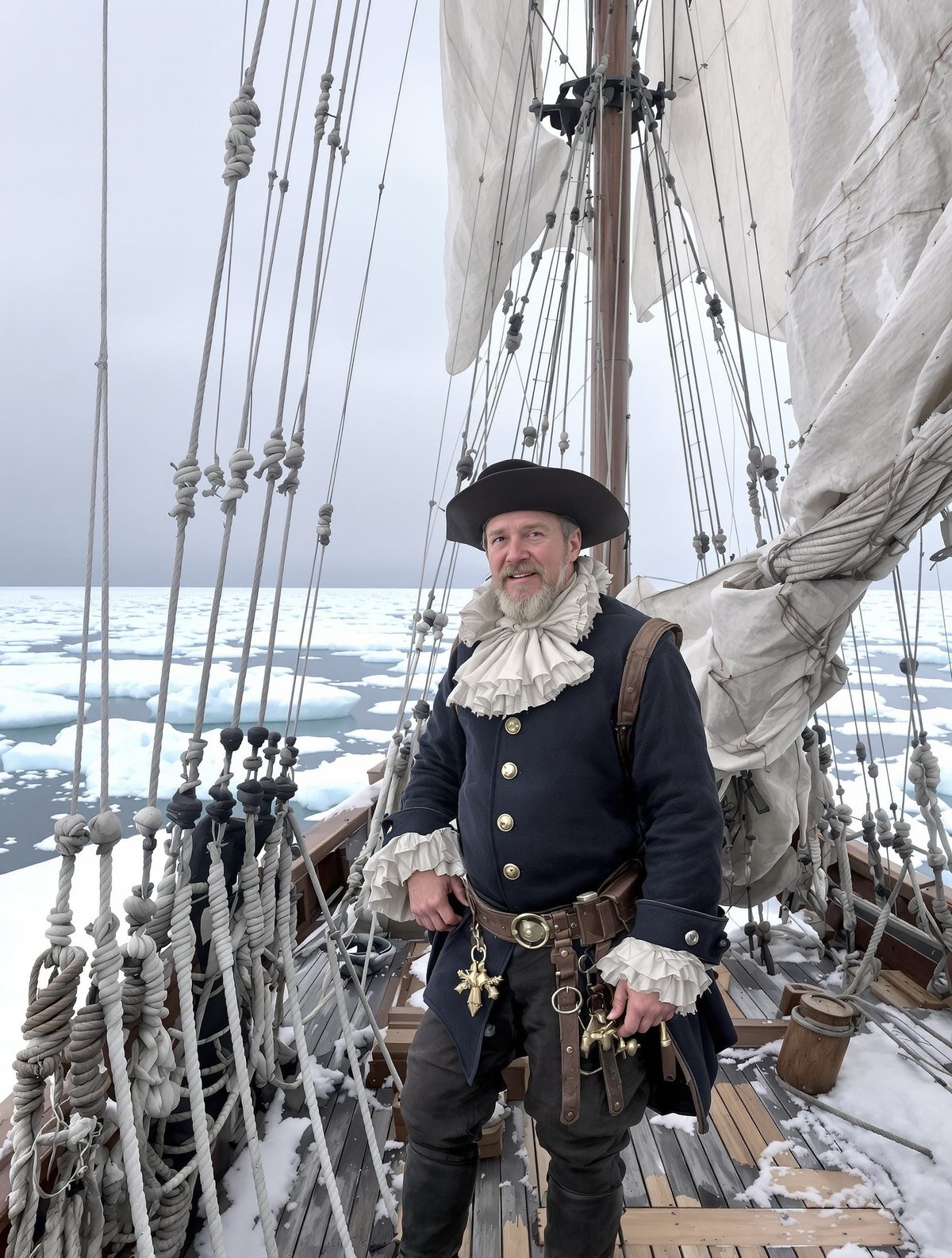
The ice sang as it closed around the Discovery, a grinding, otherworldly symphony that had haunted Henry Hudson's dreams for months. It was June 1611, and somewhere in the vast frozen maze of what would become Hudson Bay, ten desperate men huddled around their captain in a boat barely larger than a modern dining table. Behind them, the ship that had been their world grew smaller against the endless white horizon. Ahead lay nothing but ice, starvation, and the howling wilderness of the Canadian Arctic. Hudson pulled his son John closer as the mutineers' voices faded into the wind. They were already dead men—they just didn't know it yet.
The Captain Who Couldn't Stop
Henry Hudson was a man possessed by an impossible dream. In an age when England's merchants salivated over the riches of the Orient, Hudson believed he could find what had eluded explorers for decades: the Northwest Passage, a mythical sea route through the Arctic that would cut thousands of miles off the journey to Asia's spice markets and silk roads.
By 1610, Hudson had already made three attempts to crack the Arctic's secrets. He'd sailed for the Muscovy Company, then the Dutch East India Company, pushing his ships into ice-choked waters that had swallowed lesser men whole. The Dutch voyage in 1609 had taken an unexpected turn when Hudson, blocked by ice near Norway, made an unauthorized detour to explore the river that would bear his name—giving the Netherlands their claim to what became New York.
But Hudson wasn't interested in founding colonies. His obsession lay northward, in the white void where maps ended and legends began. When the Virginia Company and the British East India Company offered him command of the 55-ton Discovery for one final attempt, the 40-something captain couldn't resist. He would find the passage, or die trying.
Read next: The Day a Devon Captain Mapped the World's Last Shore
Into the Labyrinth of Ice
The Discovery departed London on April 17, 1610, carrying 23 souls into the unknown. Hudson's crew was a volatile mix: his teenage son John, loyal officers like Robert Juet and Robert Bylot, and a collection of hardened sailors who'd signed on for adventure and profit, not martyrdom.
The trouble began almost immediately. Hudson's route took them through the treacherous waters between Greenland and Baffin Island, where icebergs the size of cathedrals drifted like sleeping giants. By June, they'd discovered the strait that now bears Hudson's name—a narrow, ice-clogged channel that seemed to promise passage to the Pacific beyond.
What Hudson didn't realize was that he was sailing into one of the world's largest bays, not through to open ocean. Hudson Bay stretches nearly 500,000 square miles—larger than the entire North Sea. As summer faded and the Discovery pushed deeper into the bay's southern reaches, the crew began to understand a terrible truth: they were trapped.
The bay that had seemed like salvation in summer became a frozen prison as temperatures plummeted. By November 1610, ice thick enough to walk on locked the Discovery in place near the mouth of a river in what's now northern Quebec. The ship wouldn't move again for eight months.
Winter of Desperation
Arctic winter in the early 17th century was a special kind of hell. Temperatures dropped to -40°F, and the sun disappeared entirely for weeks at a time. The Discovery's hull groaned under the pressure of shifting ice that could crush a ship like an eggshell without warning.
Worse than the cold was the hunger. Hudson had provisioned for a summer voyage, not an Arctic siege. By Christmas 1610, the crew was on starvation rations. They scraped moss from rocks, boiled leather, and chewed on bones they'd already gnawed clean. Scurvy ravaged their bodies as their teeth loosened and old wounds reopened.
Hudson tried to maintain discipline, but his authority crumbled with each passing week. The crew blamed him for their predicament, whispering that his obsession had doomed them all. Some suspected he was hoarding food—a dangerous accusation in a ship where men were slowly starving to death.
The psychological toll was as devastating as the physical one. Imagine the claustrophobia: nearly two dozen men trapped in a wooden shell barely 70 feet long, surrounded by an alien landscape where a wrong step meant death. The Arctic silence, broken only by the ship's creaking and the ice's constant groaning, drove some men to the edge of madness.
Mutiny in the Ice
When spring finally arrived in June 1611, it brought hope—and treachery. As the ice began to break up, Hudson prepared to continue his search for the passage. But his crew had endured enough. Led by Henry Greene, a gentleman's son with a grudge against Hudson, and Robert Juet, Hudson's former right-hand man, the mutineers struck on June 23, 1611.
The details of that morning remain murky, pieced together from the self-serving testimony of survivors who had every reason to lie. What's certain is that Hudson awoke to find himself a prisoner on his own ship. The mutineers bound his hands and forced him into the ship's boat—a shallow vessel designed for short trips, not Arctic survival.
With Hudson went his teenage son John, who refused to abandon his father. Seven other men joined them: some were Hudson loyalists, others were simply the weakest members of the crew, deemed useless mouths to feed. Among them was John King, a young man Hudson had recently promoted over more senior crew members—a decision that may have sealed both their fates.
The mutineers set the boat adrift in the icy waters of Hudson Bay with no provisions beyond what Hudson's loyal carpenter managed to throw down: some meal, an iron pot, and a few tools. As the Discovery sailed away, Hudson and his companions vanished into the Arctic vastness. They were never seen again.
The Reckoning
Justice, however, was already stalking the mutineers. Their journey home became its own nightmare. Henry Greene, the mutiny's leader, was killed in a fight with Inuit hunters. Robert Juet died of starvation before reaching England. By the time Robert Bylot managed to navigate the Discovery back to London in the autumn of 1611, only eight of the original 23 crew members remained alive.
The survivors faced trial for mutiny—a capital offense. But their testimonies were the only record of Hudson's final voyage, and they painted their actions as desperate self-preservation rather than calculated murder. More importantly, they brought back proof that Hudson had indeed found a passage to a vast western sea. The authorities, hungry for any advantage in the race for trade routes, chose pragmatism over justice. The survivors were pardoned.
Hudson's fate remained a mystery that has tantalized historians for four centuries. Did he and his companions die quickly in the frigid waters, or did they somehow reach shore to face a slower death from starvation and exposure? Inuit oral traditions speak of strange white men who appeared and disappeared like ghosts, but no physical evidence has ever been found.
The Legend That Wouldn't Die
Henry Hudson's story endures because it captures something essentially human: the price of obsession and the thin line between discovery and destruction. His name graces one of North America's most important waterways, a bay larger than Germany, and a strait that remains a crucial shipping route even today.
But perhaps more importantly, Hudson's tale reminds us that every line on our maps was drawn in someone's blood. The world we take for granted—where satellite navigation guides us safely home and weather forecasts warn us of storms—was mapped by men who sailed into the unknown with nothing but wooden ships and iron will.
In our age of instant communication and global connectivity, it's easy to forget that the Arctic once represented the ultimate frontier: a place where a single wrong decision could doom two dozen souls to death in a frozen wasteland. Hudson's mutineers thought they were choosing survival over loyalty, but they discovered that some sins follow you home across oceans and through history itself.
The ice that claimed Henry Hudson still sings in Hudson Bay, and sometimes—if you listen carefully—you might hear in its voice the echo of an obsessed captain's final words, carried on the Arctic wind toward a horizon he would never reach.