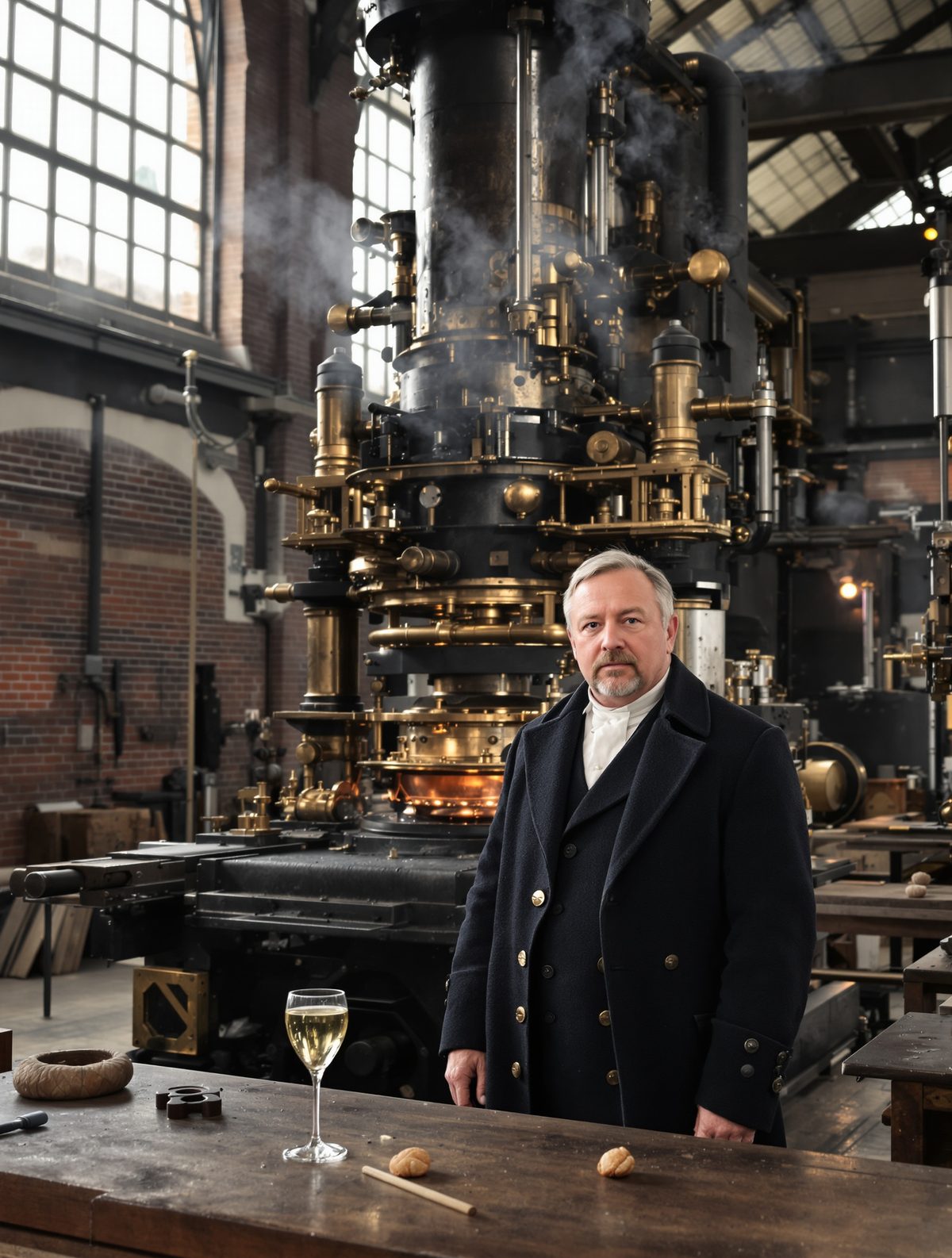
The gentlemen of Manchester's engineering society shifted uncomfortably in their chairs as James Nasmyth rolled up his sleeves that crisp October morning in 1839. Before them stood a mechanical monster—five tons of iron and steel that could deliver bone-crushing blows with the force of a thunderbolt. Yet here was this slight, intense Scotsman claiming his steam hammer could perform surgery.
On the table beside the towering machine sat two unlikely props: a delicate wine glass and a humble walnut. The skeptics smirked. They'd come to see Nasmyth's contraption forge massive iron shafts for steamships, not crack nuts. What they were about to witness would redefine the very meaning of precision engineering—and launch the Industrial Revolution into its most explosive phase.
The Impossible Problem That Started It All
The crisis began in the summer of 1839 when the Great Western Steamship Company approached Nasmyth's Bridgewater Foundry with an impossible request. They needed paddle shafts for their new vessel—iron rods so massive they dwarfed anything previously forged. These weren't ordinary components; they were the steel spines that would drive Britain's most ambitious steamship across the Atlantic.
The problem was that no forge hammer in existence could handle such enormous pieces of iron. Traditional hammers, powered by water wheels or operated by teams of sweating blacksmiths, simply lacked the power. James Nasmyth, barely thirty-one but already recognized as one of Manchester's most ingenious engineers, realized he was facing a challenge that would require reinventing the very tools of metalworking.
Read next: The Day a Weaver's Son Lit Britain's First Public Railway
But Nasmyth had been preparing for this moment his entire life. The son of celebrated Scottish painter Alexander Nasmyth, James had shown more interest in gears than brushes from childhood. At his father's Edinburgh studio, while other children played with toys, young James constructed working steam engines from brass tubing and tin. His mechanical obsession had led him south to Manchester, the beating heart of Britain's industrial transformation, where coal smoke painted the sky black and fortunes were forged in iron.
Birth of a Mechanical Monster
Working feverishly through the summer nights of 1839, Nasmyth sketched and calculated, reimagining the fundamental principles of metalworking. His breakthrough came when he realized that steam—the same force driving locomotives and factories—could be harnessed to lift and drop a hammer with unprecedented precision.
The steam hammer he designed was a marvel of controlled violence. Standing nearly twenty feet tall, its cast-iron frame resembled a mechanical giant. At its heart was a five-ton hammer head that could be raised by steam pressure and then dropped with devastating force. But here was Nasmyth's stroke of genius: the same steam system that lifted the hammer could also cushion its fall, allowing for infinite gradations of force.
Traditional hammers were crude affairs—either they struck with full force or not at all. Nasmyth's creation could deliver anything from a thunderous blow capable of shaping red-hot iron beams to a gentle tap that wouldn't disturb a sleeping cat. This wasn't just an improvement in power; it was a revolution in control.
The first prototype was completed in October 1839 in Nasmyth's Manchester workshop. Word spread quickly through the city's tight-knit engineering community. Here was a machine that promised to forge components for steamships, railways, and industrial machinery on a scale never before imaginable. But the skeptics came out in force.
The Gathering Storm of Doubt
Manchester in 1839 was a city where reputations rose and fell on the reliability of machinery. The cotton mills that dominated the skyline had made fortunes for those who backed the right innovations and bankrupted those who bet on mechanical failures. Engineers, investors, and industrialists formed a cautious brotherhood, quick to embrace proven technologies but merciless toward inventors who promised more than they could deliver.
The criticism of Nasmyth's steam hammer was swift and pointed. How could such a massive machine achieve the delicate precision that fine metalwork demanded? Traditional blacksmiths argued that their centuries of experience couldn't be replaced by steam and steel. Mill owners questioned whether the hammer's complexity would make it prone to breakdown. Most damaging of all, some suggested that Nasmyth had created an expensive solution to a problem that didn't really exist.
The young inventor found himself defending his creation in Manchester's coffeehouses and engineering societies. But words weren't enough. These were practical men who trusted their eyes above all else. Nasmyth realized he needed a demonstration so compelling that it would silence every critic and establish his steam hammer as the future of heavy industry.
The Walnut That Changed History
On that fateful October morning, Nasmyth gathered the skeptics in his workshop for what would become one of the most famous demonstrations in industrial history. The air was thick with coal smoke and the acrid smell of hot iron. Gas lamps flickered against the autumn gloom, casting dramatic shadows on the faces of the assembled engineers.
Nasmyth began with conventional displays of power. He placed a glowing iron bar beneath the hammer and released its full force. The impact sent shockwaves through the building, and the bar was instantly flattened into a perfect sheet. The demonstration continued with progressively more delicate tasks—shaping ornate metalwork, forming precise joints, creating components that would have taken skilled craftsmen hours to complete by hand.
But Nasmyth was building toward his masterstroke. With theatrical flair, he produced a fresh walnut and a crystal wine glass. He placed the nut inside the glass and positioned both directly beneath the five-ton hammer head. The room fell silent except for the steady hiss of steam and the distant clatter of Manchester's industrial machinery.
"Gentlemen," Nasmyth announced, his Scottish accent cutting through the tension, "precision is not about avoiding power—it's about controlling it absolutely."
He engaged the steam mechanism. The massive hammer began its descent with a smooth, mechanical precision that seemed almost supernatural. As it approached the walnut, Nasmyth made minute adjustments to the steam pressure. The hammer touched the shell and applied just enough force to crack it cleanly in half. The wine glass remained completely intact, without so much as a chip or crack.
The silence that followed was profound. These men had witnessed something that challenged their fundamental understanding of industrial machinery. The same mechanism that could forge massive steamship components could perform operations of watchmaker-like delicacy.
Read next: The Day a Mill Owner Walked Into Court and Freed His Rivals' Children
The Revolution Unleashed
Word of the walnut demonstration spread through Britain's industrial centers like wildfire. Within months, orders for steam hammers were pouring into Nasmyth's Bridgewater Foundry from shipbuilders, railway companies, and manufacturers across Europe. The machine that had cracked a walnut without breaking its glass container became the symbol of a new age in manufacturing.
The impact was immediate and transformative. Steam hammers allowed shipbuilders to construct vessels of unprecedented size and strength. The Great Britain, launched in 1843, became the world's first large iron steamship, made possible largely by components forged under Nasmyth's hammers. Railway companies could now produce larger, stronger locomotive parts. The entire scale of industrial manufacturing expanded as if a limit had suddenly been removed.
But perhaps more importantly, Nasmyth had demonstrated a principle that would define modern industry: the marriage of power and precision. His steam hammer proved that machines could be both enormously powerful and infinitely controllable. This concept would echo through every subsequent technological advance, from the assembly lines of the early twentieth century to today's computer-controlled manufacturing systems.
By 1850, steam hammers based on Nasmyth's design were operating in foundries from Glasgow to St. Petersburg. The young Scotsman had not just solved the problem of forging large iron components; he had fundamentally changed how humanity thought about the relationship between force and finesse in manufacturing.
The Precision Revolution We Live In
Today, as we marvel at smartphones manufactured to tolerances measured in nanometers or watch robotic surgeons perform operations of impossible delicacy, we're witnessing the spiritual descendants of Nasmyth's walnut demonstration. That moment in a Manchester workshop in 1839 established a principle that defines our modern world: true technological advancement comes not from choosing between power and precision, but from achieving both simultaneously.
The steam hammer's legacy lives on in every automated manufacturing process, every piece of precision machinery, every device that performs powerful operations with microscopic accuracy. When a modern factory robot assembles delicate electronics or when a computer-controlled machine shapes aerospace components, they're following the same principle Nasmyth proved with a walnut and a wine glass nearly two centuries ago.
In our age of artificial intelligence and automated manufacturing, it's worth remembering that the foundation of our technological civilization was laid by a young Scottish engineer who understood that the ultimate expression of mechanical power isn't destruction—it's perfect control.