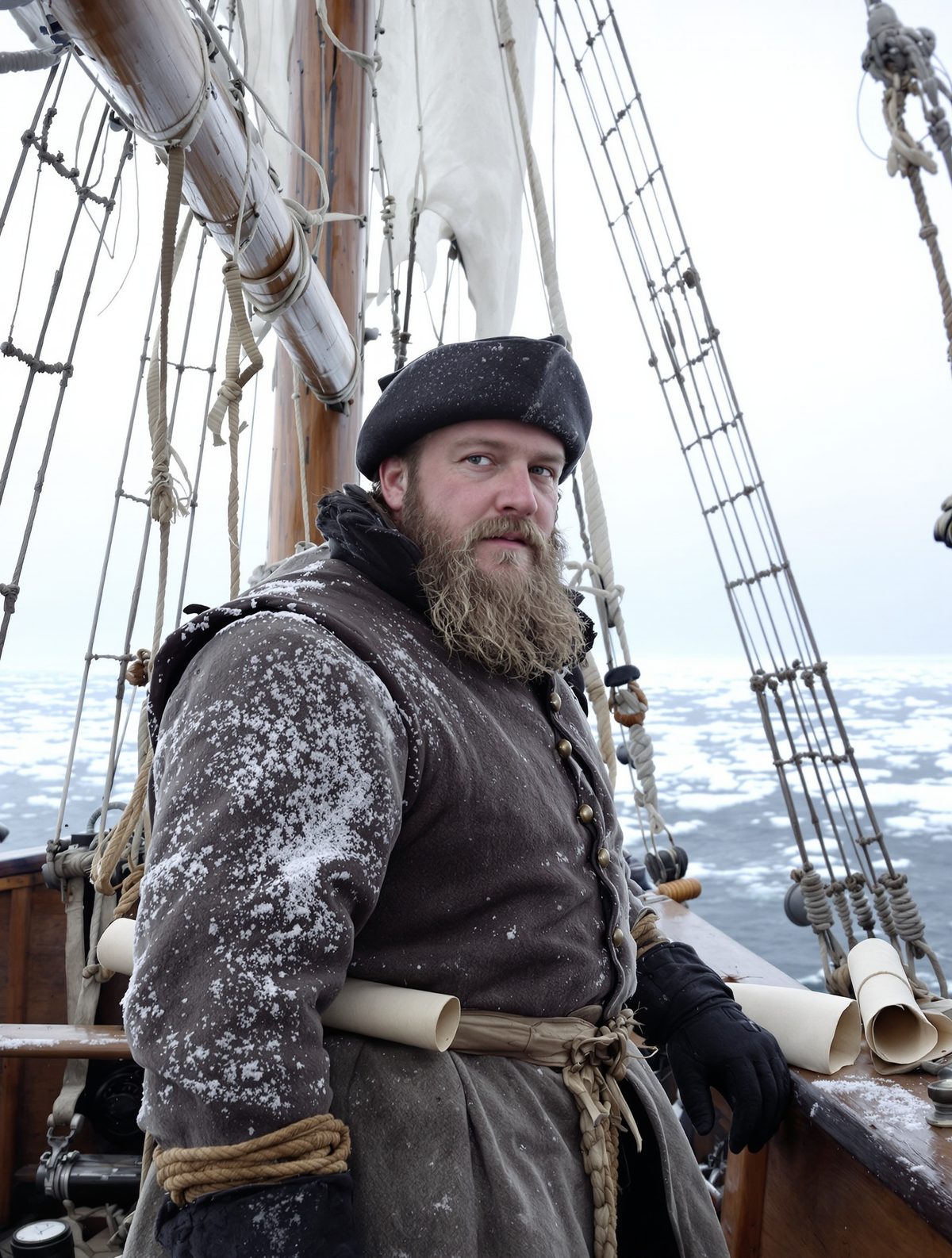
In the summer of 1585, as sunlight danced capriciously on the deck of a small ship hugging the Devon coastline, an audacious plan was brewing. Captain John Davis, a man whose name would echo through the icy chasms of history, stood at the helm, seagulls screaming around him. With eyes as steely as the waters he would soon traverse, he charted a course into the frozen labyrinths of the Arctic. The prize? A passage to China. The price? Perils unknown, dangers untold. Yet, armed with a sturdy resolve and a mariner's intuition, Davis would prove that the ends of the Earth were just starting points for a new age of exploration.
The Call of the Great White North
At a time when the name Sir Francis Drake was whispered with reverence, and Elizabethan England was gripped by the fever of discovery, John Davis of Devon was quietly contemplating the impossible. Born in 1550 in Sandridge Barton, not far from the bustling harbor of Dartmouth, Davis grew up at the very heart of maritime tradition. To him, the unexplored was a siren's song, its call irresistible to any true sailor.
While the lucrative yet perilous trade routes east to China and India had captivated the imagination of many, the nearly mythical Northwest Passage had stubbornly eluded every attempt at discovery. For decades, whispered tales of a sea route over the top of North America, through icy Arctic waters, had failed to produce results. Even the seasoned Sir Martin Frobisher had returned with nothing more than tales of treacherous waters and mysterious lands. It was into this narrative of failure that Davis boldly stepped.
The First Voyage: Into The Frozen Unknown
In late June of 1585, with the blessing of Elizabeth I and the backing of London merchants hoping for a profitable Northern trade route, Davis set sail with two modestly sized ships, the Sunshine and the Moonshine. As the vessels creaked northwards, pushing past the familiar shores of Britain into the cold embrace of Arctic waters, the crew faced trials that quickly tested their mettle.
Read next: The Day a Scots Surgeon Walked Into Timbuktu Alone
The icy veil of fog was their constant companion, teasing them with glimpses of crystalline landscapes before swallowing them whole again. Despite what many called folly, Davis continued north, his spirit unbroken by the biting icy winds that turned sails to steel and rigging to fragile lace. Reaching what Davis would name the Strait of Davis—an icy gateway into Hudson Bay—he and his crew entered realms no Englishman had yet seen.
Temperatures plummeted so low that stories say the ship's biscuits, hard as they were, could only be broken by hammers. Tales of silent auroras painting the night skies and wildlife encounters with the Inuit people were collected in precious journals. These lands, seemingly inhospitable, whispered stories of the Earth’s deep past to those who dared venture far enough to listen.
The Persistence of a Navigator
Despite the harsh conditions, Davis returned to England not with defeat, but with invaluable knowledge and a rekindled determination. In 1586 and again in 1587, he braved the icy passages with ever greater skill and tenacity. These journeys painted the Arctic in vivid, albeit cold colours, for the officers of Her Majesty's navy and the world of Elizabethan exploration. His maps, crafted with exquisite precision, were a treasure trove of nautical information that illuminated the otherwise blank pages of Arctic geography.
Davis's charts were marvels of their time; two hundred years later, they would still be leafed through by intrepid navigators and cartographers, a testament to their accuracy and detail. His reports, rich with descriptions of ice-floes and rare wildlife, kindled imaginations and opened minds to the potentials locked within frozen horizons.
The Legacy of Davis’s Explorations
Captain John Davis never saw his dream of a Northwest Passage realized in his lifetime. Yet, his voyages laid foundational stones for future explorers. Where others saw only icy menace, Davis saw pathways to adventure and opportunity. His meticulously documented encounters with the native Inuit provided a rare glimpse into the lives and cultures of the Arctic, offering a human connection to these barren lands. While his voyages did not yield the direct economic returns investors might have hoped for, they nevertheless expanded the realm of human knowledge, embodying the spirit of true exploration.
Why Davis's Bold Endeavour Matters Today
Today’s world, rapidly shrinking in the wake of technological connectivity, could take a lesson from John Davis's determination. His journey, fraught with peril and unknowns, was an exercise in resilience and perseverance—a message that echoes in our own time of challenges, both environmental and societal. Davis’s ability to turn the impossible into a map inked with possibility reminds us that across the vast tapestry of human history, the truly pivotal moments belong to those daring enough to sail beyond the edge of the known world.
As modern explorers peer into the even more mysterious frontiers of deep space and deep oceans, they do so standing on the shoulders of giants like John Davis—a humble seafarer who sailed north, into a world of white, and came back with treasures of knowledge that resonated far beyond the icy straits.