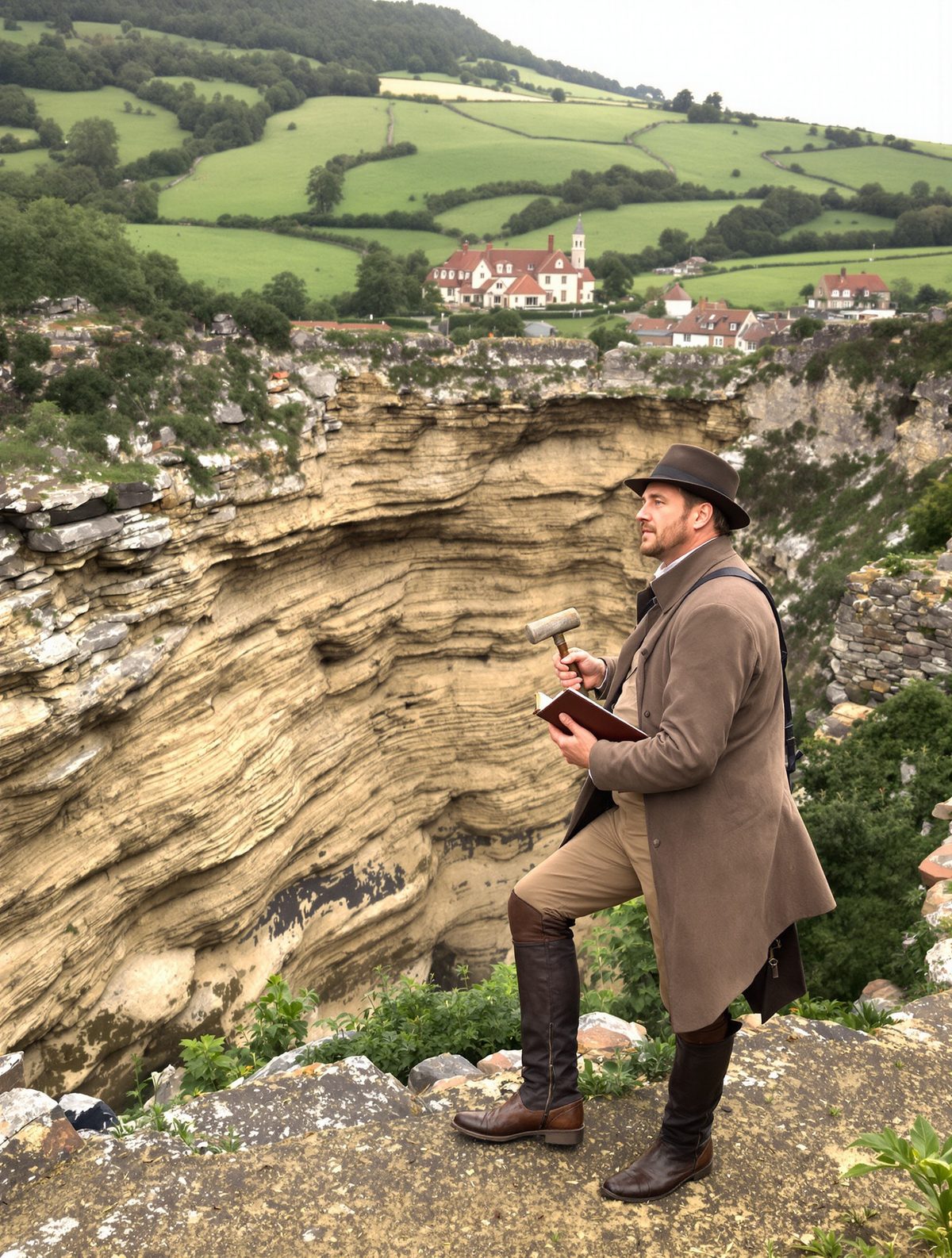
Picture this: a man in mud-caked boots stands at the edge of a freshly dug canal cutting, running his calloused fingers along a stripe of grey limestone. The year is 1794, and while Napoleon rampages across Europe, this quiet Oxfordshire surveyor is about to unlock a secret that has been hiding beneath Britain's feet for millions of years. His name is William Smith, and he's about to change forever how we see the ground beneath us.
What Smith discovered in that moment—staring at the neat layers of rock exposed by the excavation—was that the Earth keeps a diary. Every stripe of stone, every fossil embedded in clay, tells a story stretching back through unimaginable epochs. And unlike the kings and queens whose reigns historians recorded in books, this history was written in stone across the entire landscape of Britain.
The Surveyor Who Saw Time Itself
William Smith wasn't born to genteel society or university halls. The son of a village blacksmith from Churchill in Oxfordshire, he left school at eleven to work as a farm laborer. But Smith possessed something rarer than formal education: an eye that could read the landscape like a book. By his twenties, he'd taught himself surveying and found work with the canal-building mania that was transforming Georgian Britain.
It was perfect timing. The 1790s saw a frenzy of canal construction as Britain raced to connect its industrial centers. These great earthworks—cutting through hills, bridging valleys—were like surgical incisions into the body of the landscape, exposing rock layers that had been hidden since the dawn of time. Where others saw merely dirt and stone to be moved, Smith saw sequence.
Read next: The Day a Surgeon Walked Into a Prison and Freed a Madman
Working on the Somerset Coal Canal in 1794, Smith made his revolutionary observation. The rock layers—or "strata" as geologists call them—weren't randomly jumbled. They lay in a predictable order, like the pages of a book. More startling still, each layer contained its own distinctive fossils. A particular type of ancient shell would always appear in the same layer, whether you found it in Somerset or Yorkshire. Smith realized he was looking at a universal filing system written by time itself.
Walking Every Lane in England
What happened next sounds like madness by today's standards. Smith decided to walk the length and breadth of England, mapping every rock outcrop, every quarry, every cliff face he could find. For twenty-four years, he tramped across the countryside with surveying instruments, notebooks, and an obsession that cost him his marriage, his money, and nearly his sanity.
He would rise before dawn in village inns, stuff his pockets with bread and cheese, and set off across fields still wet with dew. He measured, sketched, and collected specimens from quarries in Bath, cliff faces along the Dorset coast, and canal cuttings in the industrial Midlands. Local quarrymen began to recognize the tall, weathered figure who would appear at their excavations, running his hands over the rock faces and asking endless questions about what they'd found.
Smith's method was revolutionary in its simplicity. He identified rock layers not by their mineral composition—the standard approach—but by the fossils they contained. He could hold up a small shell and declare with confidence: "This came from the layer I call the Fuller's Earth, and if you follow this layer west, you'll find coal beneath it." It was geology transformed from guesswork into prediction.
But the work nearly destroyed him. By 1804, Smith was borrowing money to fund his obsession. His wife Elizabeth suffered what we might now recognize as a nervous breakdown, unable to cope with their financial ruin and her husband's endless absences. The genteel Geological Society of London—founded by wealthy amateurs who could afford geology as a hobby—dismissed the working-class surveyor as a mere "fossil collector."
The Map That Changed Everything
On August 1st, 1815—the same month Wellington was mopping up after Waterloo—Smith's masterpiece finally appeared in London map shops. Measuring eight feet by six feet and hand-colored in fifteen different hues, "A Delineated Map of the Strata of England and Wales" was unlike anything the world had ever seen.
Where other maps showed roads, towns, and political boundaries, Smith's map revealed the hidden architecture of Britain itself. Great swaths of color swept across the landscape: the red Triassic rocks of the Midlands, the green belt of Jurassic limestone running from Dorset to Yorkshire, the grey Carboniferous rocks of northern England where coal lay waiting. For the first time, anyone could see the geological bones beneath Britain's skin.
The map cost £5 and 5 shillings—roughly £500 in today's money—and sold poorly at first. The geological establishment still viewed Smith as an upstart tradesman. But mining engineers and canal builders immediately grasped its revolutionary potential. Here was a tool that could predict where to dig for coal, where to find building stone, where clay suitable for pottery lay hidden. Smith had essentially created the world's first geological GPS.
The technical achievement was staggering. Using only foot-power, hand-drawn sketches, and an intuitive understanding of geological principles that wouldn't be formally articulated for decades, Smith had mapped the underground structure of an entire nation. Modern geologists, armed with satellite imagery and computer modeling, still use Smith's basic framework today.
Vindication and the Father of English Geology
Recognition came slowly, then suddenly. In 1831, sixteen years after his map appeared, the Geological Society of London—the same institution that had snubbed him—awarded Smith their first-ever Wollaston Medal. The president called him "the father of English geology." But the honor came too late to repair the damage to his finances and health.
By then, Smith's principles had revolutionized geology worldwide. His insight that rock layers could be identified and correlated by their fossils—now called the "principle of faunal succession"—became one of the fundamental laws of geology. Charles Darwin would later use Smith's work as crucial evidence for evolution, arguing that the progression of fossils through rock layers showed how life had changed over time.
Smith spent his final years as a respected figure, consulted by government committees and honored by scientific societies. But he never forgot the debt he owed to Britain's quarrymen, miners, and canal diggers—working people whose daily labor had exposed the geological treasures he mapped. "The leading facts in the science of geology," he wrote, "may be learned in a few days by studying good sections of strata; but similar opportunities rarely occur, except in extensive public works."
The Map That Built Modern Britain
Smith died in 1839, but his map lived on to shape the Victorian age. Railway engineers used it to plan routes through the most suitable terrain. Architects consulted it to source building stone—those honey-colored Bath terraces and grey Yorkshire mills were built from rocks Smith had mapped. Most crucially, his work guided the coal mining that powered Britain's Industrial Revolution.
The map's influence extended far beyond Britain's shores. Smith's methods spread across Europe and America, inspiring a generation of geological mappers who revealed the hidden structures of entire continents. Today, every nation on Earth has been geologically mapped using principles Smith pioneered with his muddy boots and keen eye.
Perhaps most remarkably, Smith's map gave humanity its first glimpse of deep time—the almost incomprehensible vastness of Earth's history. Those colored bands on his map represented not just different types of rock, but different ages of the world, stretching back hundreds of millions of years. In an age when most people still believed the Earth was only a few thousand years old, Smith's map quietly suggested a far grander and more ancient story.
Today, as we grapple with climate change and search for sustainable energy sources, we still depend on William Smith's legacy. The geological maps hanging in every mining company's office, the satellite surveys that guide oil exploration, the computer models that predict earthquake risks—all trace their lineage back to one man's obsessive walks across the English countryside. Smith taught us that the ground beneath our feet isn't just dirt and rock, but a library of the deep past and a guide to the future. In a world where we're finally learning to read the Earth's warnings about our changing climate, that lesson has never been more vital.