Picture this: It's 1815, and you're a merchant trying to transport wool from Yorkshire to London. Your heavily laden wagon lurches into what passes for a road, and within minutes, you're axle-deep in a churning soup of mud, horse dung, and despair. Your cargo—worth months of work—sits rotting as you wait days for enough men and oxen to drag you free. Welcome to Georgian Britain, where moving goods twenty miles could bankrupt you, and the simple act of traveling was an exercise in survival.
But one Scottish surveyor was about to change everything with an idea so simple it seemed almost stupid: forget building roads with massive stones. Use tiny broken ones instead.
When Britain's Roads Were Death Traps
To understand the revolution John Loudon McAdam unleashed, you need to grasp just how spectacularly awful British roads were in the early 1800s. These weren't roads as we know them—they were often little more than ancient tracks that had been used since Roman times, worn into deep ruts by centuries of cart wheels and horse hooves.
The typical "road" was a nightmare of contradictions. In summer, the rutted earth baked into ridges hard enough to shatter wagon wheels. In winter, the same surface became a quagmire so treacherous that travelers regularly drowned in mud holes. Contemporary accounts describe carriages disappearing entirely into these morasses, with only their roofs visible above the muck.
Read next: The Day a Baronet Stood Up in Court and Freed His Slaves
Arthur Young, the famous agricultural writer, captured the horror perfectly when he described the road from Billericay to Tilbury in Essex: "I actually measured four feet deep in mud and water in several places." He wasn't exaggerating. Coaches regularly overturned, killing passengers. Horses broke their legs and had to be shot on the spot. Goods rotted in wagons stuck for weeks in the mire.
The economic cost was staggering. It could cost more to transport coal twenty miles overland than to ship it 200 miles by sea. Fresh fish caught in coastal towns spoiled before reaching inland markets just a day's travel away. Britain was industrializing at breakneck speed, but its transport arteries were medieval.
The Broken Scotsman with a Revolutionary Vision
Enter John Loudon McAdam, though he hardly looked like a revolutionary when he took up road-making in his fifties. Born in 1756 in Ayrshire, Scotland, McAdam had made and lost fortunes in America before returning to Britain as a middle-aged man with more enthusiasm than money. What he possessed in abundance, however, was an engineer's eye for practical problems and the stubbornness of a true Scotsman.
In 1798, McAdam was appointed as a road trustee in his local area—essentially a thankless volunteer position overseeing the repair of local roads. While other trustees saw this as tedious civic duty, McAdam saw it as a laboratory. He began obsessively studying roads: how they failed, why they failed, and what made the rare good ones work.
The conventional wisdom of the day said roads needed massive foundation stones—great chunks of rock laid deep underground to support the surface. The bigger the stones, the stronger the road, or so everyone believed. McAdam watched work crews struggle to place these massive blocks, saw how water seeped between them, and observed how the whole structure shifted and cracked under load.
Then came his eureka moment, though it was less a flash of inspiration than years of methodical observation crystallizing into revolutionary insight: the road surface itself could be the foundation.
The Radical Science of Small Stones
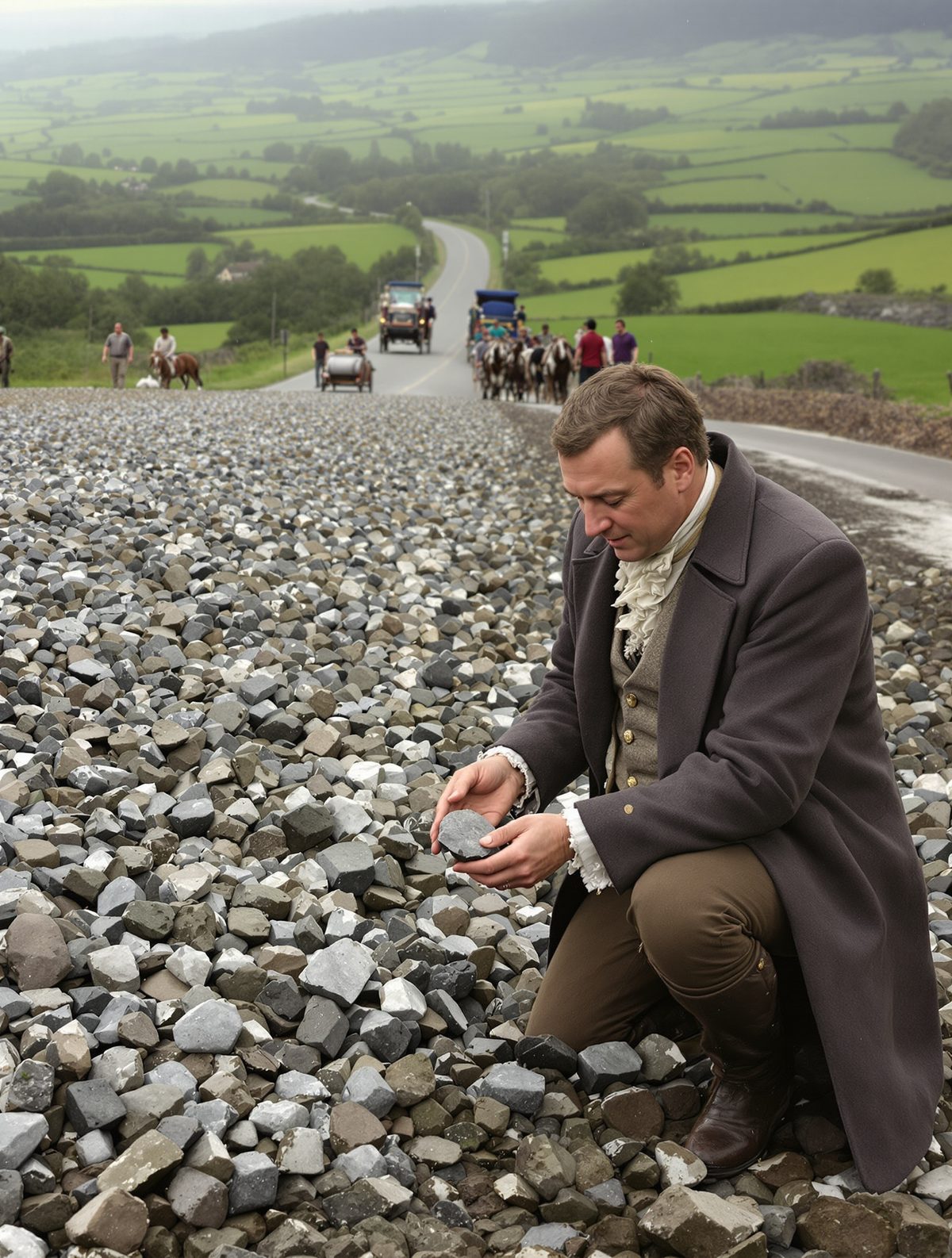
McAdam's breakthrough was counterintuitive to the point of seeming insane. Instead of massive foundation stones, he proposed using broken stones no larger than what could fit in a man's mouth—roughly three inches in diameter. These small stones, he argued, would lock together under the pressure of traffic to form a surface harder and more durable than any foundation of large blocks.
But here's where McAdam's genius really showed: he understood that water was the enemy of all roads. His small stones weren't just randomly dumped. They were carefully graded by size, with larger pieces at the bottom and progressively smaller ones toward the surface. The road was built with a distinctive camber—higher in the middle than at the edges—so rainwater would run off immediately rather than soaking in.
Most radical of all, McAdam insisted that no stone should be larger than six ounces in weight. His workers had to break rocks with small hammers until each piece met his exacting standards. Contemporary observers thought this was madness—surely such tiny fragments would be ground to powder under heavy wagon wheels?
McAdam had a different theory. Under pressure from traffic, these carefully sized stones would actually compact and bind together, forming what he called "a solid, impervious body." The key was that the stones must be completely dry when laid and that the road surface must shed water instantly. "Water is the universal enemy of roads," became his motto.
The First Macadamized Mile
In 1816, McAdam got his chance to prove his theory on a grand scale. He was appointed surveyor-general of roads in the Bristol area, giving him authority over 180 miles of some of Britain's worst highways. The roads around Bristol were particularly nightmarish—the main route to London was so bad that it added days to any journey and regularly claimed lives.
McAdam chose a particularly troublesome stretch for his first major demonstration. Working with crews who thought their new boss had lost his mind, he supervised the breaking of tons of stone into his precisely specified sizes. Locals gathered to watch what they assumed would be a spectacular failure.
The transformation was immediate and stunning. The first "macadamized" road was smooth, firm, and—most miraculous of all—remained passable even in the heaviest rain. Carriages that had taken hours to struggle through the mud could now fly along at unprecedented speeds. Word spread like wildfire.
By 1820, McAdam was overseeing road improvements across Britain. His methods were so successful that "macadamized" entered the English language as a synonym for road perfection. The government appointed him Surveyor-General of Roads for the entire country—a position created specifically for him—with an annual salary of £2,000, a fortune in those days.
A Nation Transformed by Broken Stones
The impact of McAdam's innovation was nothing short of revolutionary. Journey times that had remained essentially unchanged since medieval times suddenly plummeted. The London to Edinburgh route, which had taken two weeks in good weather, was reduced to just 45 hours by 1830. Fresh oysters from Colchester could reach London tables still alive. The cost of moving goods fell so dramatically that it sparked a commercial revolution.
But perhaps the most surprising consequence was social. Good roads democratized travel in ways no one had anticipated. Before McAdam, only the wealthy could afford the risks and delays of long-distance travel. Suddenly, ordinary people could journey to distant towns for work, to visit family, or simply to see the world beyond their villages.
The timing couldn't have been more perfect. McAdam's roads provided the circulatory system that Britain's Industrial Revolution desperately needed. Raw materials could flow efficiently to factories, finished goods could reach markets quickly, and ideas could spread at the speed of a galloping horse rather than a mired wagon.
By 1850, over 22,000 miles of British roads had been macadamized. The technique spread across Europe and the Americas, carrying McAdam's name to every continent. The broken stones of a stubborn Scottish surveyor had quite literally paved the way for the modern world.
The Legacy of a Simple Idea
John Loudon McAdam died in 1836, having lived just long enough to see his revolution in full flower. But his influence extends far beyond those first macadamized highways. When engineers began laying asphalt in the 1900s, they called it "tarmacadam"—McAdam's method with a tar binding agent. Every time you drive on smooth pavement today, you're experiencing a direct descendant of his insight about small stones binding together under pressure.
More profoundly, McAdam's story reminds us that the most transformative innovations often seem absurdly simple in hindsight. He didn't invent new materials or complex engineering techniques. He simply looked at an ancient problem with fresh eyes and asked a different question: instead of asking how to make roads stronger, he asked how to make them work with nature rather than against it.
In our age of complex technological solutions, there's something deeply satisfying about remembering that one man armed with nothing but careful observation and stubborn persistence once saved a nation's transport system with the radical idea of using smaller stones instead of bigger ones. Sometimes the most broken things just need someone willing to see them differently.