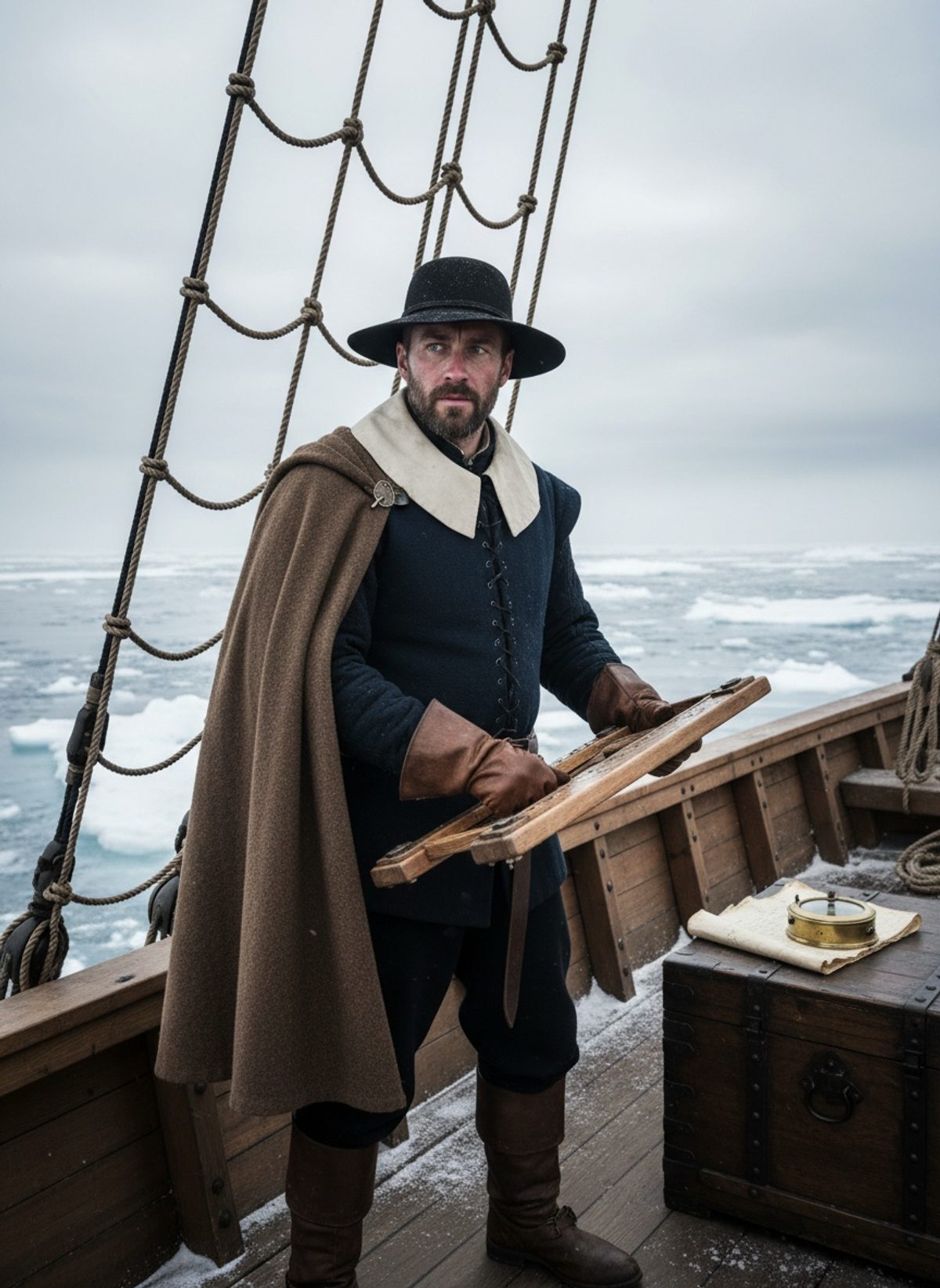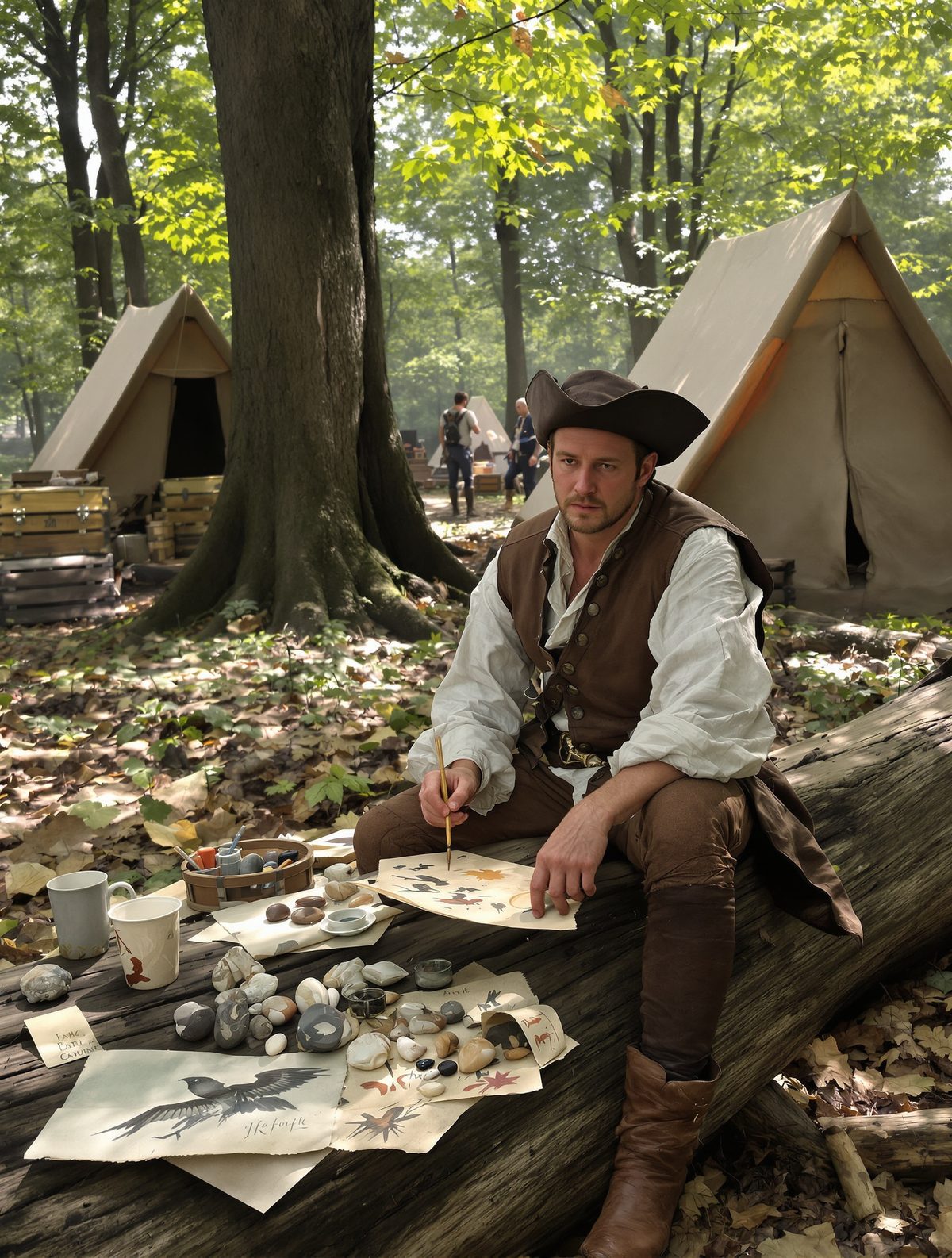
In the summer of 1585, as Sir Walter Raleigh's ships approached the mysterious coastline of Virginia, most Englishmen aboard clutched swords and muskets. But one passenger carried something far more powerful—a set of watercolour brushes and pigments that would change how an entire nation saw the New World. John White, a gentleman artist with steady hands and an insatiable curiosity, was about to create England's first visual encyclopedia of America.
While his fellow colonists scanned the horizon for threats, White saw something else entirely: a living canvas of impossible creatures and vibrant cultures that no European eye had ever recorded. His delicate brushstrokes would capture wonders that seemed almost mythical—from rainbow-scaled fish to towering Native Americans adorned in copper and pearls. These weren't mere sketches; they were England's first windows into a world that would reshape the very idea of what was possible.
The Artist Who Sailed Into History
John White remains one of history's most enigmatic figures. Unlike the fortune-seekers and glory-hunters who typically joined colonial expeditions, White was a limner—a professional watercolour artist whose usual subjects were portraits of wealthy merchants' wives and decorative maps for London parlors. What possessed this refined gentleman to abandon his comfortable studio for the dangers of the Atlantic crossing remains a tantalizing mystery.
What we do know is that by 1585, at roughly forty years old, White had established himself as one of London's most skilled watercolourists. His technique was revolutionary for its time—instead of the heavy oils favored by court painters, he worked with translucent pigments that captured light with an almost photographic precision. This skill would prove invaluable in a land where every creature seemed painted by nature itself in impossible hues.
Read next: The Day a Devon Captain Mapped the World's Last Shore
When Raleigh's expedition departed Plymouth in April 1585, White carried supplies that must have seemed absurd to his fellow passengers: dozens of sheets of precious paper, carefully sealed vials of ground minerals and plant extracts for pigments, and brushes made from the finest sable hair. While others packed extra gunpowder, White invested in lapis lazuli for the perfect blue.
Landing in Paradise
The expedition made landfall at Roanoke Island in July 1585, after a journey that had taken nearly four months. Captain Ralph Lane immediately began planning fortifications and searching for gold, but White saw riches of an entirely different kind. The Outer Banks of North Carolina teemed with life forms that seemed conjured from medieval bestiaries—except these were gloriously, impossibly real.
His first subjects were the fish, caught daily by the expedition's nets and Native American allies. White's painting of a perca (likely a type of bass) reveals an artist struggling to believe his own eyes. The creature's scales shimmer with metallic greens and golds that no English fish possessed. Each fin is rendered with scientific precision, yet the overall effect is pure wonder. These weren't just pretty pictures—they were visual proof of a New World where nature itself seemed to follow different rules.
But it was his encounter with the indigenous peoples that would produce his most groundbreaking work. The Algonquian-speaking tribes of coastal Carolina lived in sophisticated villages that challenged every European assumption about "savages" and "wilderness." White's brush captured not primitive peoples scratching out a bare existence, but a complex civilization with its own technologies, art forms, and profound relationship with the land.
Painting the "Other"
White's portraits of Native Americans are perhaps the most revolutionary images in early American art. His painting of Wingina, a Secotan chief, shows a man of obvious intelligence and dignity, adorned with copper ornaments and intricate tattoos that spiral across his chest in patterns more sophisticated than anything in contemporary European design. This wasn't the crude "savage" of popular imagination, but a leader whose bearing suggested political acumen and cultural refinement.
Even more remarkable was White's attention to Native women, virtually invisible in other contemporary accounts. His portrait of a Secotan woman and child reveals a figure of serene authority, her clothing woven with geometric patterns that demonstrate advanced textile skills. The child clutches an English doll—a detail that hints at the complex cultural exchanges already beginning between the two worlds.
What makes these portraits extraordinary isn't just their artistic skill, but their humanity. At a time when most Europeans viewed Native Americans as either noble savages or demonic obstacles to civilization, White painted individuals. Each face has its own personality, its own dignity, its own story. These watercolours became the first images to suggest that the New World was inhabited not by exotic specimens, but by fellow human beings with their own rich traditions.
A Natural History in Brushstrokes
While White's human subjects captivated viewers back in England, his natural history paintings sparked a scientific revolution. His meticulous study of a brown pelican, painted sometime in the summer of 1585, shows a bird so alien to European experience that many initially dismissed it as fantasy. The creature's enormous beak and prehistoric appearance seemed to belong more in a dragon's tale than a naturalist's notebook.
White's technique reveals an artist thinking like a scientist. He painted specimens from multiple angles, noting details of coloration, proportion, and behavior that would prove invaluable to later naturalists. His watercolour of a loggerhead turtle includes precise measurements and notes about the creature's nesting habits—information gathered through patient observation rather than hasty sketching.
Perhaps most remarkably, White captured the interconnectedness of American ecosystems in ways that wouldn't become common in European art for another century. His painting of Native Americans fishing shows not just human figures, but an entire aquatic environment: the weirs used to trap fish, the specific species being caught, even the birds diving for their own meals in the background. This was ecology rendered in watercolour, decades before the concept had even been named.
The Lost Colony's Last Images
White's artistic career took a dramatic turn when he returned to Virginia in 1587, not as an observer but as governor of Raleigh's second colonial attempt. This time, he brought his pregnant daughter Eleanor and her husband Ananias Dare, making the expedition intensely personal. When Eleanor gave birth to Virginia Dare—the first English child born in America—White painted what may have been the continent's first English baby portrait, though this precious watercolour has never been found.
Forced to return to England for supplies, White left his daughter and granddaughter behind with 115 other colonists. When he finally managed to return in 1590 (delayed by the Spanish Armada crisis), he found only the famous word "CROATOAN" carved into a post and no trace of the settlers. His journal entry from that day is heartbreaking: "We found none of them, nor any sign where they had been, saving only we found the houses taken down..."
White's later paintings carry a different emotional weight. His post-1590 works seem haunted by loss, their colors more muted, their subjects more melancholic. The confident wonder of his 1585 Virginia paintings gives way to something more complex—art created by a man who had seen paradise and then watched it vanish.
Windows Into Forever
Today, fewer than eighty of John White's American watercolours survive, housed primarily in the British Museum. Yet these small paintings—most no larger than a modern tablet—continue to reshape our understanding of early American history. They remain our only visual record of the Outer Banks before European colonization permanently altered the landscape.
More importantly, White's work reminds us that first contact between Europeans and Native Americans involved more than conquest and disease. It was also an unprecedented meeting of artistic traditions, scientific worldviews, and human curiosity. In an age of increasing cultural polarization, White's paintings offer a different model: the possibility of seeing the "other" not as threat or resource, but as fellow travelers worthy of careful attention and honest portrayal.
When John White dipped his brush into those imported pigments on a Carolina beach 440 years ago, he couldn't have known he was creating America's visual birth certificate. His delicate watercolours preserve not just the plants and animals of a vanished world, but something even more precious: a moment when wonder still trumped fear, when art could still bridge the space between strangers, and when a gentle English painter could teach an entire civilization how to see.