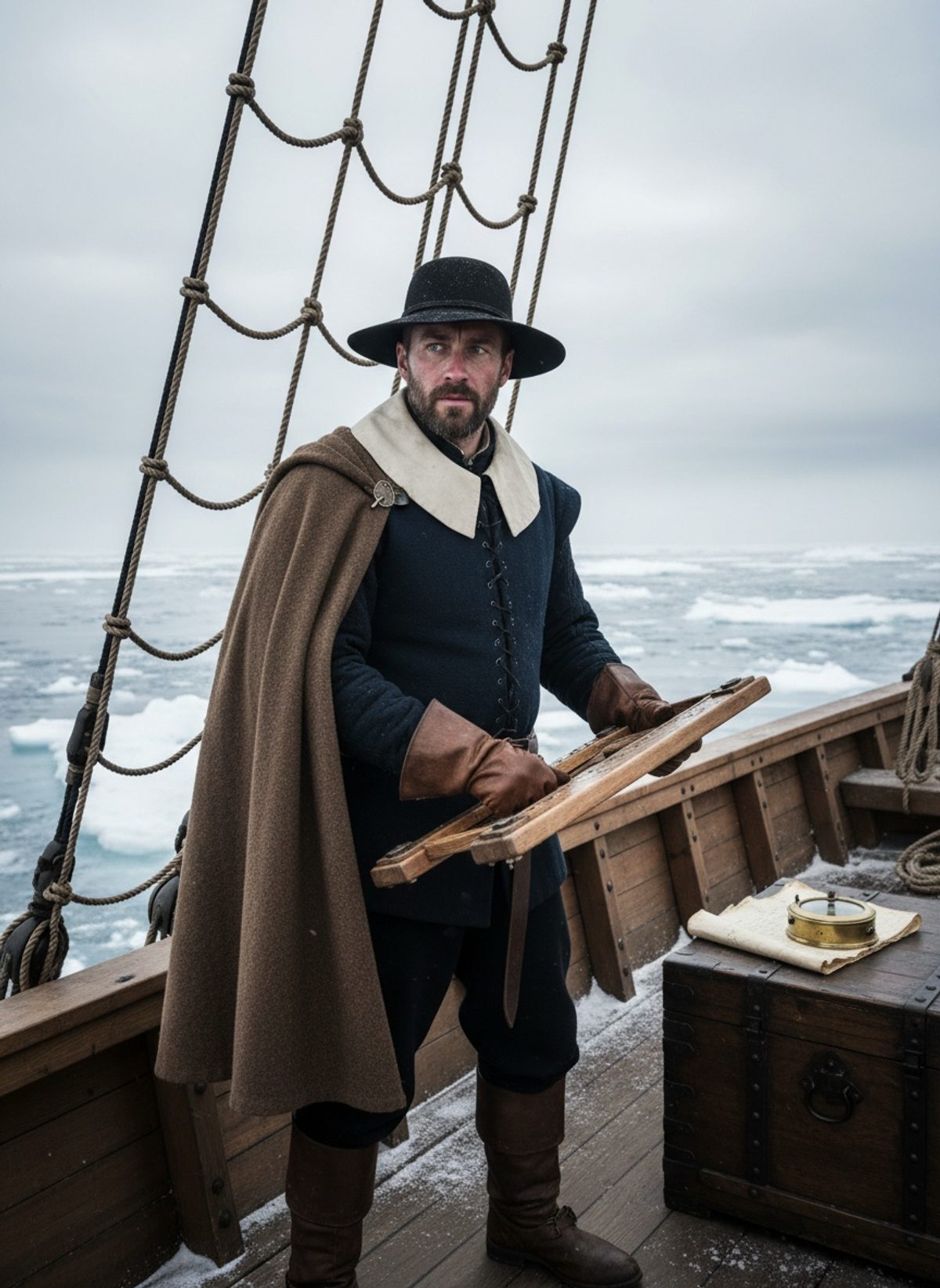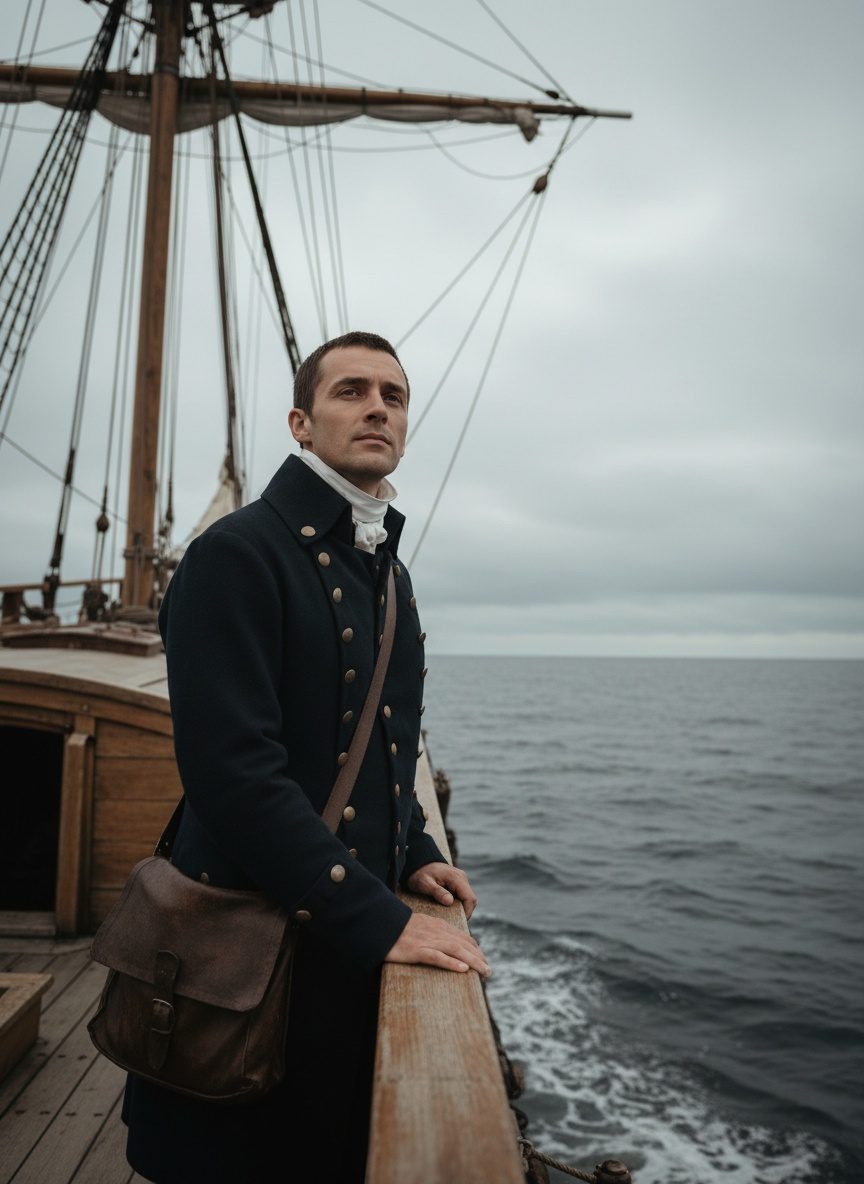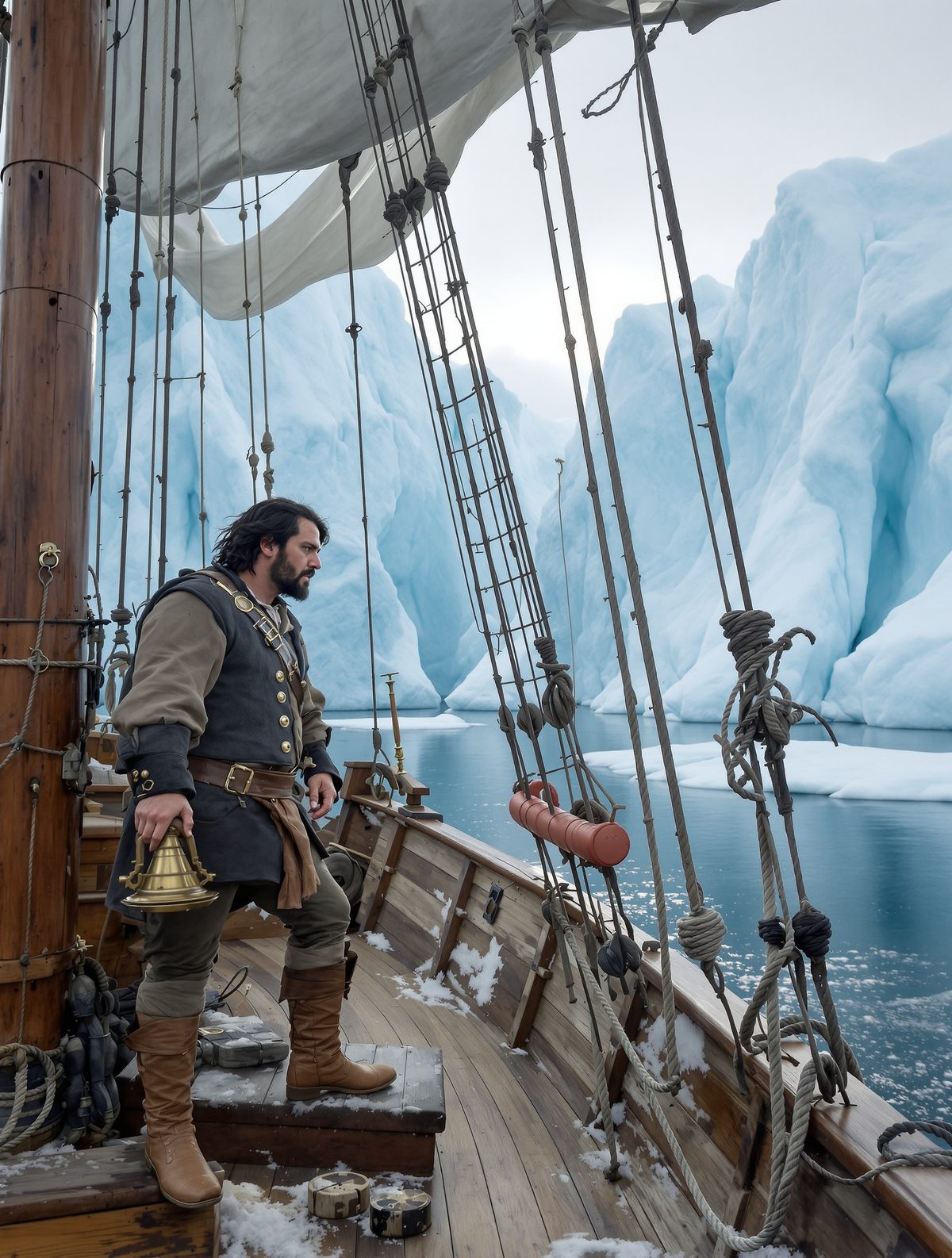
The grinding of ice against timber echoed across the Arctic silence like the breaking of bones. In the summer of 1616, somewhere north of 77 degrees latitude, the wooden ship Discovery pushed through a frozen maze that had never felt the touch of European oak. At the helm stood William Baffin, a Yorkshire pilot whose steady hand and keen eye were about to etch his name into the ice itself—and into history books that wouldn't be written for centuries.
What Baffin couldn't know, as he squinted through the endless Arctic twilight, was that no human being would sail this far north again until 1852. For 236 years, his record would stand as untouchable as the ice that nearly crushed his ship.
The Pilot Who Came From Nowhere
William Baffin remains one of history's most enigmatic navigators. Born around 1584, possibly in Yorkshire, he emerged into historical records like a ghost materializing from fog. No birth certificate survives, no childhood tales, no family connections to the sea. Yet by 1612, this mysterious figure had become one of England's most skilled pilots, capable of reading wind and wave like scripture.
What we do know is extraordinary: Baffin was a mathematical genius who could calculate longitude with unprecedented accuracy using lunar observations—a technique so advanced that most navigators wouldn't master it for another century. While his contemporaries still relied on dead reckoning and prayer, Baffin was essentially practicing space-age navigation with Renaissance tools.
Read next: The Day a Devon Captain Mapped the World's Last Shore
His reputation caught the attention of the Muscovy Company, England's premier Arctic trading enterprise. They had a problem that required his peculiar genius: finding the Northwest Passage. For decades, English expeditions had battered themselves against the Arctic ice, searching for a sea route to the riches of Asia. Ships had been crushed, crews had starved, fortunes had vanished into the white void. They needed someone who could navigate the impossible.
Into the Crushing Embrace of the Ice
On March 26, 1616, the Discovery slipped from her moorings at Gravesend and began her journey into legend. The ship herself was already famous—or perhaps infamous. She had carried Henry Hudson on his final, fatal voyage six years earlier, when mutineers cast the explorer adrift in the bay that would bear his name. Now she would carry Baffin into waters where no European had ever sailed.
The Discovery was perfectly suited for Arctic exploration: just 55 feet long and heavily reinforced against ice. Her crew of 17 men included Robert Bylot as captain—himself a survivor of Hudson's doomed expedition—and a mix of hardened mariners who understood that Arctic voyages were as much about survival as discovery.
By early July, they had reached the entrance to what we now call Baffin Bay. Here, the real test began. Pack ice stretched to the horizon like a white desert punctuated by towering bergs. The temperature barely climbed above freezing even in high summer. Scurvy lurked in the ship's hold, waiting to claim its victims. Yet Baffin pressed on, threading the Discovery through leads of open water that could snap shut without warning.
What followed was a masterclass in Arctic navigation. Baffin didn't just sail north—he mapped every inlet, charted every headland, and recorded detailed observations of ice conditions, wildlife, and magnetic variation. His charts were so accurate that they wouldn't be significantly improved until the 19th century.
The Moment That Defined Two Centuries
On July 4th, 1616—exactly 160 years before American independence—William Baffin achieved his greatest triumph. Using his revolutionary lunar observation techniques, he calculated their position as 77°45' North latitude. No confirmed expedition had ever reached so far into the Arctic's embrace.
The scene that greeted them defied description. Towering ice cliffs rose like frozen cathedrals from black water. The midnight sun painted everything in shades of gold and blue that no human eye had witnessed before. Walruses bellowed from ice floes while narwhals—those unicorns of the sea—surfaced nearby, their tusks gleaming in the otherworldly light.
But Baffin's greatest discovery wasn't the record latitude. As he mapped the bay's western shores, he identified three massive channels: Smith Sound, Jones Sound, and Lancaster Sound. He noted them carefully in his logbook but dismissed them as mere inlets. What he had actually found were the true gateways to the Northwest Passage—the very prize England had been seeking for generations.
The irony is almost painful. Lancaster Sound, which Baffin barely investigated, would later prove to be the key to Arctic navigation. In 1819, William Parry would sail through it and finally crack the geographic puzzle that had claimed so many lives. But in 1616, with winter approaching and ice beginning to form, Baffin had to turn back just short of his ultimate goal.
The Great Forgetting
Perhaps the most remarkable aspect of Baffin's achievement is how completely it was forgotten. When the Discovery returned to London in September 1616, Baffin's reports were met with skepticism bordering on disbelief. A bay larger than the North Sea? Massive channels leading west? Latitude readings that seemed impossibly high? Many concluded that Baffin had been deceived by Arctic mirages or had simply invented his discoveries to enhance his reputation.
The doubts weren't entirely unreasonable. Arctic navigation in 1616 was notoriously unreliable, and many explorers had returned with wildly inaccurate reports. Magnetic compasses behaved erratically near the North Pole. Ice and snow created optical illusions that could make mountains appear where none existed. Temperature extremes caused instruments to malfunction. That Baffin had achieved such accuracy using primitive tools seemed almost supernatural.
Gradually, Baffin Bay disappeared from maps entirely. Cartographers, lacking corroborating evidence, simply erased it. By the 18th century, many geographic authorities declared that no such place existed. Baffin's discoveries became literally legendary—stories told in waterfront taverns rather than facts recorded in atlases.
It wasn't until 1818, when John Ross rediscovered Baffin Bay during the renewed search for the Northwest Passage, that the world realized its mistake. Ross found Baffin's descriptions to be remarkably accurate down to the smallest details. The man dismissed as a fantasist for two centuries had been vindicated at last.
The Navigator's Last Voyage
William Baffin's story doesn't end in the Arctic ice. After his northern triumph, he joined the East India Company and sailed to warmer but no less dangerous waters. In 1622, while serving as pilot aboard the London during an assault on the Portuguese fortress of Qeshm Island in the Persian Gulf, Baffin was struck down by a musket ball. The man who had survived the crushing ice of the Arctic died under the blazing sun of Arabia, his greatest achievement already fading from memory.
His grave, if it exists at all, lies somewhere in the sand of a small island that few people could find on a map. Yet his true monument stretches across thousands of square miles of Arctic Ocean, bearing his name and preserving his memory in ice that has endured far longer than any stone marker.
Why Baffin's Forgotten Triumph Still Matters
Today, as climate change transforms the Arctic that Baffin knew, his achievement resonates in ways he could never have imagined. The Northwest Passage he sought but couldn't quite find has become a geopolitical flashpoint, with nations competing for control of shipping lanes through ice that may soon disappear entirely. The bay he discovered is now a highway for cruise ships carrying tourists to witness landscapes that are vanishing before our eyes.
But perhaps more importantly, Baffin's story reminds us that the most extraordinary achievements often happen in obscurity, performed by people whose names history threatens to forget. For 236 years, no one matched his northern record—not because the technology didn't exist, but because few possessed his unique combination of mathematical genius, practical seamanship, and raw courage.
In our age of satellite navigation and heated ships, it's worth remembering that once, a man from Yorkshire pushed a tiny wooden vessel through crushing ice using nothing but mathematics, instinct, and an unshakeable belief that there was always something more to discover beyond the horizon. The ice that nearly killed him has since revealed its secrets to submarines and icebreakers, but it first yielded those secrets to William Baffin and his quill pen, somewhere north of everywhere, in the endless light of an Arctic summer that lasted just long enough for one man to sail further than anyone had gone before.