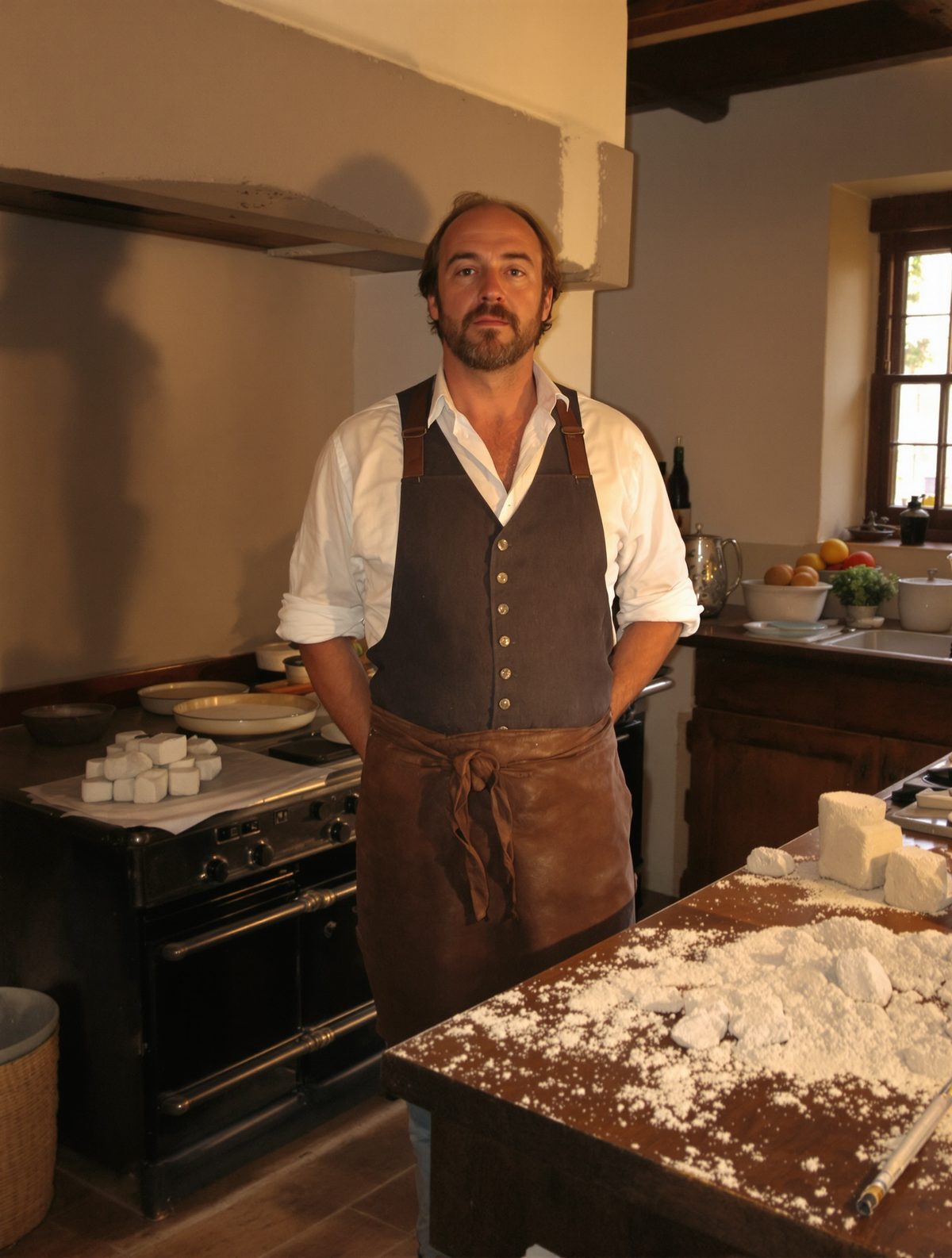
Picture this: a cold December evening in 1824 Leeds. Snow dusts the grimy industrial streets, and inside a modest terraced house on Canal Side, a stocky bricklayer named Joseph Aspdin is hunched over his kitchen stove. His wife has long since retreated upstairs, exasperated by the acrid smoke and her husband's obsession with burning rocks in her cooking pots. But Aspdin doesn't notice the smell or his wife's disapproval. He's watching intently as limestone and clay fragments crackle and transform in the fierce heat, unaware that he's about to create the substance that will build every skyscraper, bridge, and dam on Earth.
What emerged from that humble kitchen stove that night was a grey powder so revolutionary that it would reshape civilization itself. Aspdin called it Portland Cement, and it would prove to be one of the most important inventions in human history—yet most people have never heard his name.
The Accidental Alchemist of Leeds
Joseph Aspdin was not your typical inventor. Born in 1778, he was a working-class bricklayer who spent his days hauling stones and mixing mortar in the rapidly expanding industrial city of Leeds. But Aspdin possessed something that would prove more valuable than formal education: an obsessive curiosity about why things worked the way they did.
The problem that consumed him was ancient and frustrating. Traditional mortar—made from lime, sand, and water—took forever to set, especially in damp Yorkshire weather. Worse still, it would dissolve underwater, making it useless for the canals, docks, and bridges that Britain's booming Industrial Revolution desperately needed. Roman builders had somehow solved this puzzle centuries earlier with their mysterious hydraulic cement, but the secret had been lost to time.
Read next: The Day a Mill Owner Walked Into Parliament for His Children
Night after night, Aspdin conducted experiments in his kitchen, much to his family's dismay. He collected limestone from local quarries, scraped clay from the banks of the River Aire, and subjected them to increasingly violent heat. His neighbors thought he was mad—a sooty-faced bricklayer playing with fire like some medieval alchemist. They weren't entirely wrong about the alchemical comparison, though they couldn't have imagined the scale of transformation he was about to unleash.
The Kitchen Laboratory That Changed the World
On December 18, 1824, Aspdin achieved the perfect formula. He had discovered that limestone and clay, when heated to precisely 1,450 degrees Celsius and then ground to powder, created something extraordinary. When mixed with water, this grey dust hardened not just in air, but underwater—and it became stronger than natural stone.
The breakthrough wasn't just the mixture, but the temperature. Previous experimenters had heated their materials too little or too much. Aspdin's kitchen stove, stoked to white-hot intensity, hit that crucial sweet spot where calcium silicates formed—microscopic crystals that would lock together with incredible strength when hydrated.
But here's the detail that makes this story even more remarkable: Aspdin named his creation "Portland Cement" not because of any connection to Portland, Oregon (which didn't even exist yet), but because he thought his grey concrete resembled Portland stone—the prestigious limestone used to build St. Paul's Cathedral and much of Georgian London. It was a brilliant marketing move by a man who understood that perception mattered as much as performance.
From Patent to Global Phenomenon
On October 21, 1824, Aspdin filed British Patent 5022 for "An Improvement in the Mode of Producing an Artificial Stone." The patent application was remarkably brief—just 79 words that would reshape the world. He described his process as "taking a specific quantity of limestone and clay and calcining them together until the carbonic acid is entirely expelled."
Those 79 words were worth billions. But Aspdin, like many inventors, struggled to capitalize on his discovery. He set up a small works in Wakefield, producing cement in kilns barely larger than his original kitchen stove. The business ticked along modestly, supplying local builders and the occasional canal project.
The real breakthrough came through an unexpected source: his son William. In the 1840s, William Aspdin perfected his father's formula and began producing what we now recognize as true Portland cement. He discovered that by heating the mixture even hotter—until it partially melted into "clinker"—the resulting cement became far superior. This improved version could set underwater in hours rather than days, and achieved strength that surpassed the finest masonry.
The Substance That Built Modernity
The timing couldn't have been more perfect. Britain was in the grip of railway mania, and engineers desperately needed a material that could create strong, watertight structures quickly. Portland cement proved ideal for tunnel linings, bridge foundations, and railway infrastructure. The Great Western Railway became one of its first major customers, using it to build viaducts that still carry trains today, nearly two centuries later.
But it was the combination of cement with another material that truly changed everything: steel. In the 1850s, French gardener Joseph Monier discovered that embedding steel rods in concrete created "reinforced concrete"—a composite material stronger than either component alone. Suddenly, builders could construct structures of previously impossible height and span.
The numbers tell the story of cement's global conquest. In 1850, Britain produced just 10,000 tons of cement annually. By 1900, that figure had exploded to over one million tons. Today, the world produces more than 4 billion tons of cement each year—enough to coat the entire surface of England in a layer several inches thick.
The Concrete Revolution
Every great city on Earth is essentially a monument to Joseph Aspdin's kitchen experiments. The Hoover Dam contains 3.25 million cubic yards of concrete. The Empire State Building rises on foundations of concrete and steel. The Channel Tunnel, bored through chalk beds beneath the English Channel, is lined with concrete made using principles Aspdin discovered in 1824.
Perhaps most remarkably, concrete has become the most consumed substance on Earth after water. Every year, humanity uses enough concrete to build a wall 27 meters high and one meter thick around the entire equator. The material born in a Leeds kitchen now shapes landscapes from Manhattan to Mumbai, from Sydney to Shanghai.
Yet Aspdin himself lived modestly and died in relative obscurity in 1855. His gravestone in Wakefield bears no mention of his world-changing invention—a humble end for the man who gave humanity the power to literally move mountains and drain seas.
The Double-Edged Legacy
As we survey our concrete world today, Aspdin's legacy appears magnificently complex. His invention enabled the construction of hospitals, schools, and homes for billions of people. It made possible the infrastructure—roads, bridges, dams—that underpins modern civilization. Without Portland cement, there would be no skyscrapers piercing the clouds, no tunnels burrowing beneath rivers, no massive dams providing clean energy.
Yet concrete production now accounts for roughly 8% of global carbon emissions, making it one of the largest contributors to climate change. The sand required for concrete production is strip-mined from beaches and riverbeds at a rate that outpaces natural replenishment. In a bitter irony, the material that built our modern world now threatens the environment that sustains it.
Joseph Aspdin could never have imagined, as he stirred limestone and clay in his kitchen pot, that his grey powder would one day reshape continents and challenge the planet's climate systems. His story reminds us that the most profound changes often emerge from the humblest circumstances—and that every great innovation carries within it both promise and peril. The next time you walk down a city street, cross a bridge, or enter a building, remember the curious bricklayer who changed the world with fire, stone, and an unquenchable desire to understand why things work the way they do.