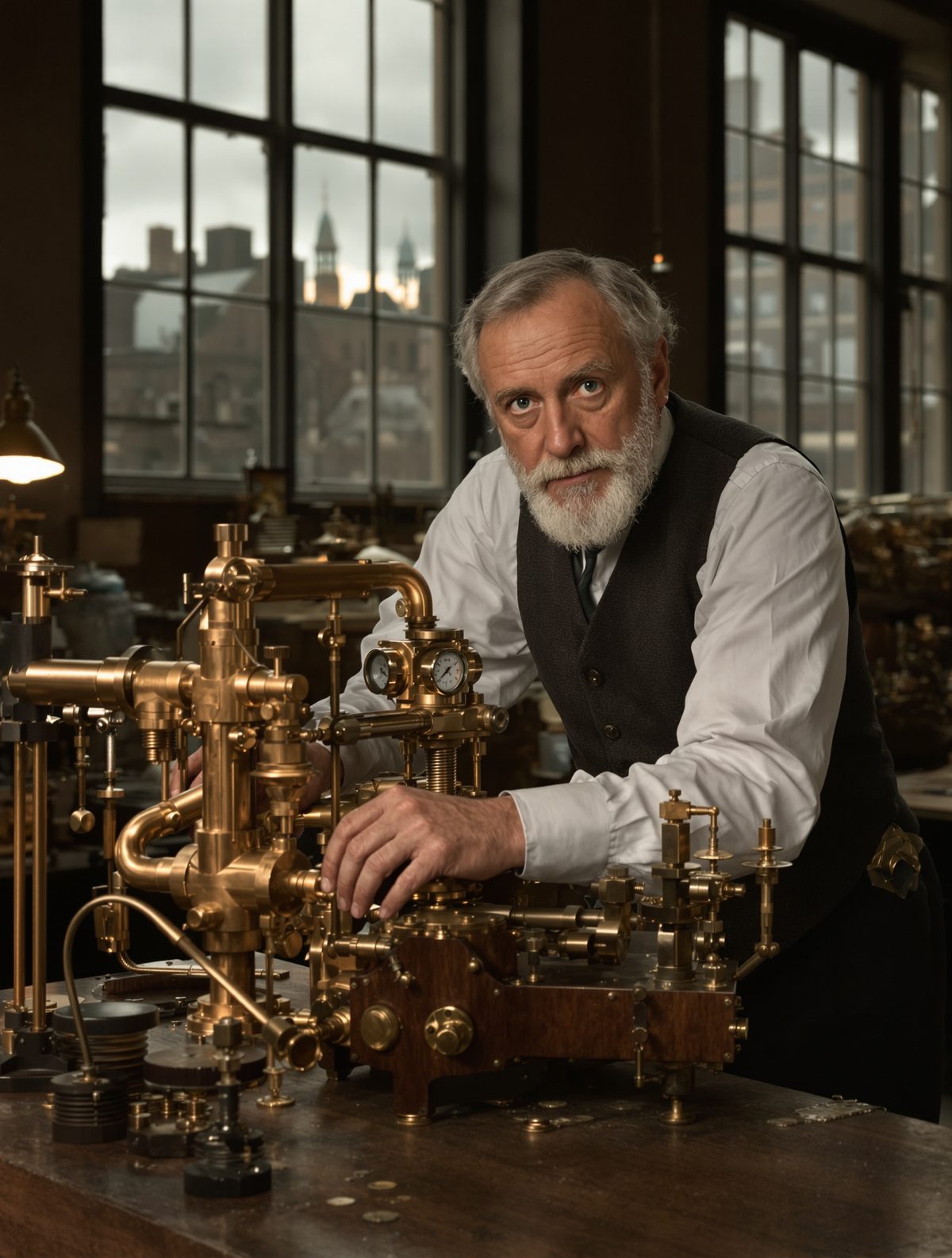
In a smoky Manchester workshop in 1856, Joseph Whitworth did something that defied belief. While his contemporaries struggled to measure anything smaller than a thousandth of an inch, this meticulous engineer casually demonstrated machinery that could detect variations of one millionth of an inch—a distance so small that 25,000 of them lined up wouldn't span the width of a human hair. To put this in perspective, if you scaled up Whitworth's precision to the size of Britain, he could have spotted a pebble displaced by less than an inch across the entire island.
What makes this achievement truly staggering isn't just the precision—it's that Whitworth accomplished it using brass, steel, and Victorian ingenuity alone, decades before electricity transformed manufacturing. His measuring machines didn't just revolutionise British engineering; they transformed guesswork into science and turned Britain into the undisputed workshop of the world.
The Perfectionist of Ancoats
Joseph Whitworth wasn't born into precision—he created it from chaos. Growing up in Stockport in the early 1800s, he entered a world where manufacturing was still essentially medieval. Craftsmen worked by eye and feel, where "close enough" was genuinely good enough, and where identical parts were virtually impossible to produce. Even the finest London gunsmiths couldn't make two rifle barrels exactly alike.
By the time Whitworth established his workshop on Chorlton Street in Manchester in 1833, he had already earned a reputation as something of an obsessive. While other engineers were content with traditional methods, Whitworth became fixated on a radical idea: what if manufacturing could be made absolutely precise? What if every part could be identical down to dimensions smaller than the human eye could see?
Read next: The Day a Surgeon's Son Chose Death Over Silence
His workshop became a temple to exactitude. Whitworth insisted that his floors be perfectly level—not just visually level, but mathematically precise. He developed his own techniques for creating true plane surfaces, scraping and measuring metal surfaces with an obsessiveness that bordered on the religious. Workers would spend weeks perfecting a single reference surface, knowing that this foundation would determine the accuracy of everything built upon it.
The Machine That Saw the Invisible
The heart of Whitworth's revolution was his measuring machine, a device so sensitive it seemed to possess supernatural powers. Picture a brass and steel contraption about the size of a large desk, its surfaces polished to mirror perfection. At its core lay a screw mechanism of extraordinary precision—Whitworth's own creation—capable of movements so minute they challenged the very limits of mechanical possibility.
The machine worked on an ingenious principle of amplification. A tiny movement at one end would be magnified through a series of levers and indicators, transforming microscopic variations into clearly visible measurements. But the real magic lay in Whitworth's screws. While ordinary screws might vary wildly in their thread spacing, Whitworth's were cut with such precision that a full revolution would advance exactly one-tenth of an inch, with individual graduations representing one-millionth of an inch.
To achieve this, Whitworth developed techniques that wouldn't look out of place in a modern laboratory. He controlled temperature meticulously, knowing that thermal expansion could throw off his measurements. He isolated his machines from vibration, understanding that a horse-drawn cart passing in the street could introduce errors larger than the tolerances he sought to measure. Most remarkably, he trained his eye to detect variations invisible to others—contemporary accounts describe him spotting surface irregularities that other skilled engineers couldn't see even when pointed out to them.
When the Royal Society Gasped
In 1856, Whitworth decided to demonstrate his achievement to the scientific establishment. Before an audience of distinguished members of the Royal Society in London, he set up his measuring machine and proceeded to measure objects with a precision that left his audience stunned. He could detect the difference between pieces of paper, measure the expansion of metals from the heat of a human hand, and demonstrate variations in supposedly identical manufactured goods that revealed the crude reality of contemporary production.
The demonstration caused a sensation. Here was a Manchester engineer achieving measurements that theoretical scientists had barely imagined possible. One witness recorded that Whitworth could measure "differences so minute that they become almost metaphysical," while another noted that his precision exceeded that of the finest astronomical instruments of the day.
But Whitworth wasn't content with mere demonstration. He understood that precision without purpose was merely a parlour trick. His real goal was to transform British manufacturing, and he set about doing so with characteristic methodical determination. He began producing standard gauges—precisely manufactured references that could ensure identical production across different workshops and even different cities.
The Gauge War That Changed Everything
Whitworth's standards didn't just improve manufacturing—they revolutionised it entirely. Before his intervention, every workshop essentially spoke its own dialect of measurement. A "quarter-inch" bolt made in Birmingham might not fit a "quarter-inch" hole drilled in Manchester. This chaos made large-scale manufacturing virtually impossible and kept Britain's industrial might fragmented across thousands of incompatible workshops.
Whitworth's solution was elegant in its simplicity: create master standards so precise that copies could be made accurately enough to ensure universal compatibility. His standard gauges, manufactured to millionth-of-an-inch precision, became the reference points that finally brought order to British manufacturing. Suddenly, a factory in Glasgow could produce parts that would fit perfectly with components manufactured in London.
The impact was immediate and dramatic. The British military, previously forced to treat each rifle as a unique item requiring custom-fitted parts, could suddenly standardise production and create truly interchangeable components. Railway companies found they could source parts from multiple suppliers with confidence. The precision that had begun as Whitworth's personal obsession became the foundation of mass production itself.
Read next: The Day a Chimney Sweep's Son Shamed a Whole Parliament
The Ripples of Precision
What Whitworth achieved in his Manchester workshop rippled out to transform the entire character of the Industrial Revolution. Before his innovations, industrialisation had largely been about power—bigger steam engines, faster machinery, more output. Whitworth added the crucial missing ingredient: precision. He proved that industrial might wasn't just about brute force, but about the ability to control and measure that force with extraordinary accuracy.
His influence extended far beyond manufacturing. The railway boom of the mid-Victorian era depended on his precision standards for rails, wheels, and connecting hardware. The great engineering projects that defined the age—from the Crystal Palace to the first transatlantic telegraph cables—relied on manufacturing techniques that traced back to principles Whitworth established.
Perhaps most remarkably, Whitworth's work established Britain's reputation for engineering excellence that persisted well into the twentieth century. The phrase "Whitworth standard" became synonymous with precision manufacturing, and his techniques were studied and copied across Europe and America. He had transformed Britain from a nation of skilled craftsmen into a precision manufacturing powerhouse.
The Legacy of the Invisible Revolution
Today, as we live surrounded by devices manufactured to tolerances Whitworth would have admired, it's worth reflecting on what this Victorian engineer truly accomplished. In an age before electricity, electronics, or computers, he achieved precision that remained unsurpassed for generations. The smartphone in your pocket, the car in your driveway, the aircraft overhead—all depend on manufacturing principles that Joseph Whitworth pioneered in his Manchester workshop over 160 years ago.
But perhaps Whitworth's most important contribution wasn't technical—it was philosophical. He proved that engineering excellence wasn't about inspired guesswork or traditional craftsmanship, but about measurement, standards, and systematic precision. He showed that the impossible was merely the imprecise, and that with sufficient care and ingenuity, humans could control matter itself down to dimensions that challenged the very limits of perception.
In our age of nanotechnology and atomic-scale manufacturing, Whitworth's millionth of an inch might seem quaint. But his real achievement was proving that precision itself was possible—that humans could aspire to measure and control the physical world with an accuracy that transformed dreams into reality. Every time we expect manufactured goods to fit together perfectly, we're benefiting from the invisible revolution that began in a Manchester workshop when one obsessive engineer decided that "close enough" simply wasn't good enough.