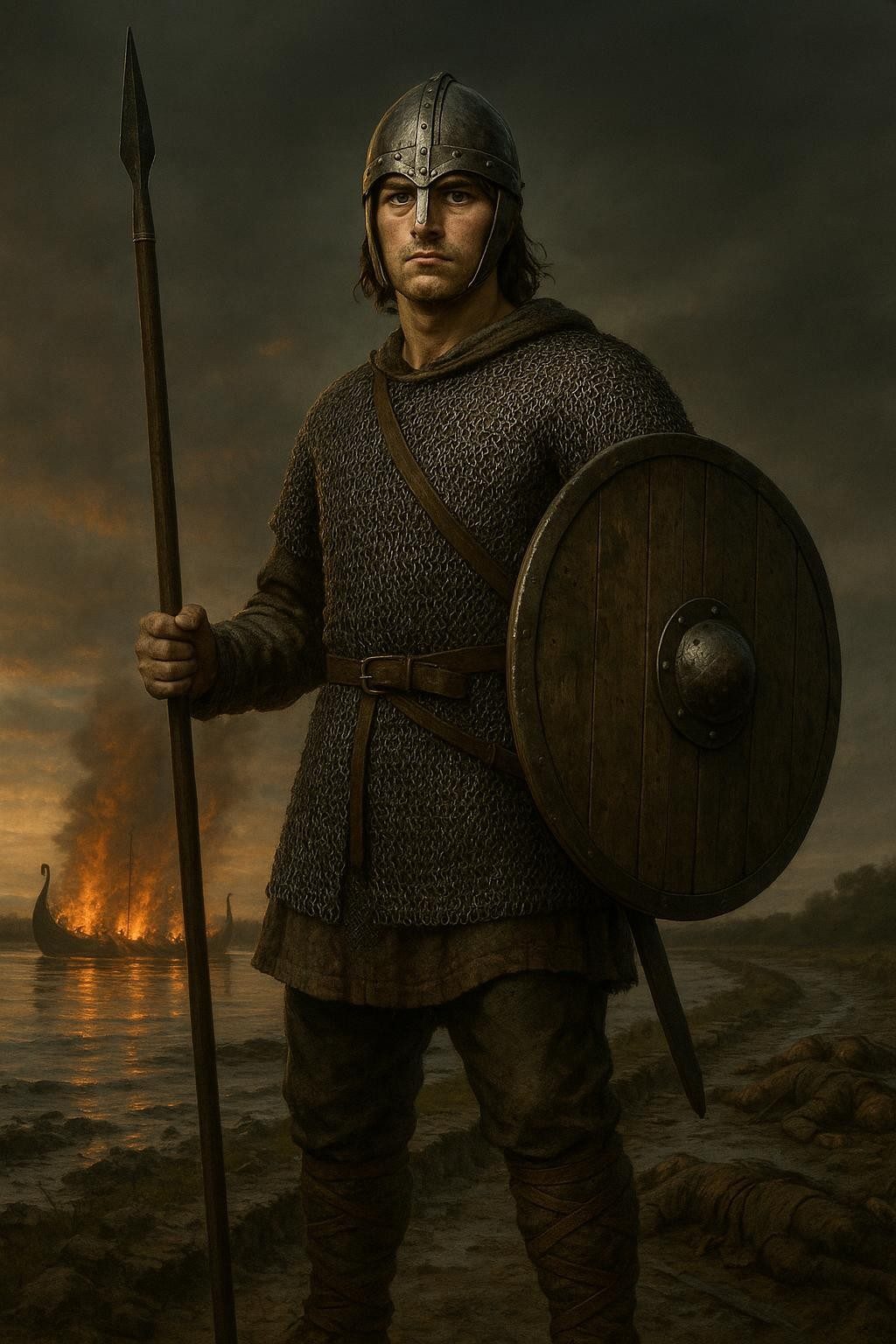
The rain hammered down on the Yorkshire moors as two armies faced each other across the swollen waters of the River Winwaed. On one side stood the forces of Christian Northumbria, their wooden crosses gleaming wet in the grey November light of 655 AD. On the other, vastly outnumbered but defiant, King Penda of Mercia gripped his sword and whispered prayers to Woden, god of war and death. He was 80 years old, and for three decades he had been the scourge of Christian England—the last great champion of the old gods in a world rapidly turning to the new faith. This day would decide everything.
What happened next in those muddy fields would not just determine the fate of kingdoms, but the very soul of England itself. When the battle was over and the river ran red with blood, Anglo-Saxon paganism would die with its greatest defender.
The Last Pagan King
Penda was a relic of a vanishing world. Born around 575 AD, he had come of age when England was still a patchwork of rival kingdoms where the old Germanic gods held sway. His name itself meant "the one who encloses"—fitting for a king who would spend his reign crushing his enemies within an iron grip. While other Anglo-Saxon rulers were converting to Christianity for political advantage, Penda remained stubbornly faithful to the religion of his ancestors.
This wasn't mere conservatism—it was calculated defiance. Penda understood that the new faith threatened everything the old warrior culture represented. Christianity preached forgiveness, turning the other cheek, and heavenly rewards for earthly suffering. The religion of Woden and Thor promised glory in battle, feasting in Valhalla for those who died sword in hand, and the right of the strong to rule over the weak. For a man who had clawed his way to power through blood and iron, there was no contest.
Read next: The Day a Saxon King Knelt and Washed a Leper's Feet
From his fortress at Tamworth, Penda built Mercia into the most feared kingdom in Britain. But he faced a problem that would define his entire reign: Christianity was spreading like wildfire, and it was bringing his enemies together. Christian kings could call upon each other as brothers in faith. Pagan rulers stood increasingly alone.
The Hammer of Christian Kings
Penda's solution was characteristically brutal—if Christianity made his enemies strong, he would simply destroy them faster than the faith could spread. What followed was thirty years of almost constant warfare that earned him a reputation as the "Hammer of Christian Kings."
His most spectacular victory came in 633 AD at the Battle of Hatfield Chase, where he allied with the Welsh king Cadwallon to crush the Christian kingdom of Northumbria. The Northumbrian king Edwin, who had been baptized just six years earlier, fell in the battle along with his son. According to the chronicles, Penda personally beheaded Edwin after the fight—a ritual execution that sent shockwaves through Christian England.
But Penda wasn't finished. The following year, he hunted down Edwin's successor, Osric, and killed him too. Then he caught Osric's replacement, Eanfrith, under a flag of truce and had him murdered. In just two years, Penda had decapitated an entire royal dynasty and left Northumbria a shattered wasteland.
The savagery was methodical. Penda understood that kings were symbols as much as rulers—by killing them publicly and brutally, he was making a statement about the weakness of the Christian god. His pagan soldiers would charge into battle crying the names of the old gods, while their Christian enemies fell before them.
The Wolf Grows Old
By the 650s, however, the world was shifting beneath Penda's feet. At 80 years old, he was ancient by medieval standards, yet he continued to lead from the front lines with the fury of a man half his age. The problem wasn't his strength—it was mathematics. Every year brought fewer pagan allies and more Christian enemies.
The kingdom that would prove his nemesis was Northumbria, now ruled by King Oswiu. Unlike his predecessors, Oswiu had learned from Penda's victories. He understood that defeating the old wolf would require more than courage—it would take cunning. Throughout the early 650s, Oswiu played a careful game of diplomacy and bribery, peeling away Penda's allies one by one.
The final provocation came when Oswiu refused to pay tribute that Penda demanded. It was an insult the old king could not ignore. In the autumn of 655, Penda gathered what would be his largest army ever—a coalition that included not just his own Mercians, but warriors from across Britain. The Venerable Bede claimed it was "thirty legions"—almost certainly an exaggeration, but it suggests a force that may have numbered 15,000 men or more.
What Penda didn't know was that his greatest allies had already been bought. The kings of Deira and Lindsey, who commanded the bulk of his coalition, had struck secret deals with Oswiu. When the moment came, they would not fight.
The Winwaed's Bloody Waters
The armies met near the River Winwaed in what is now West Yorkshire on November 15, 655 AD. The river was swollen with autumn rains, turning the surrounding countryside into a maze of marshes and streams. Oswiu had chosen his ground carefully—the terrain would prevent Penda from using his superior numbers effectively.
As the two forces arrayed for battle, Oswiu made a desperate promise to his Christian god. If victory was granted, he would give his infant daughter to the church and build twelve monasteries. Across the field, Penda made his own preparations, offering sacrifices to Woden and Thunor according to the ancient rites.
Then came the betrayal that would doom the pagan cause. Just as the battle began, the kings of Deira and Lindsey withdrew their forces, leaving Penda facing odds of three to one. A younger man might have retreated, sought more favorable ground, lived to fight another day. But Penda was 80 years old and had spent his entire life refusing to yield. He would not start now.
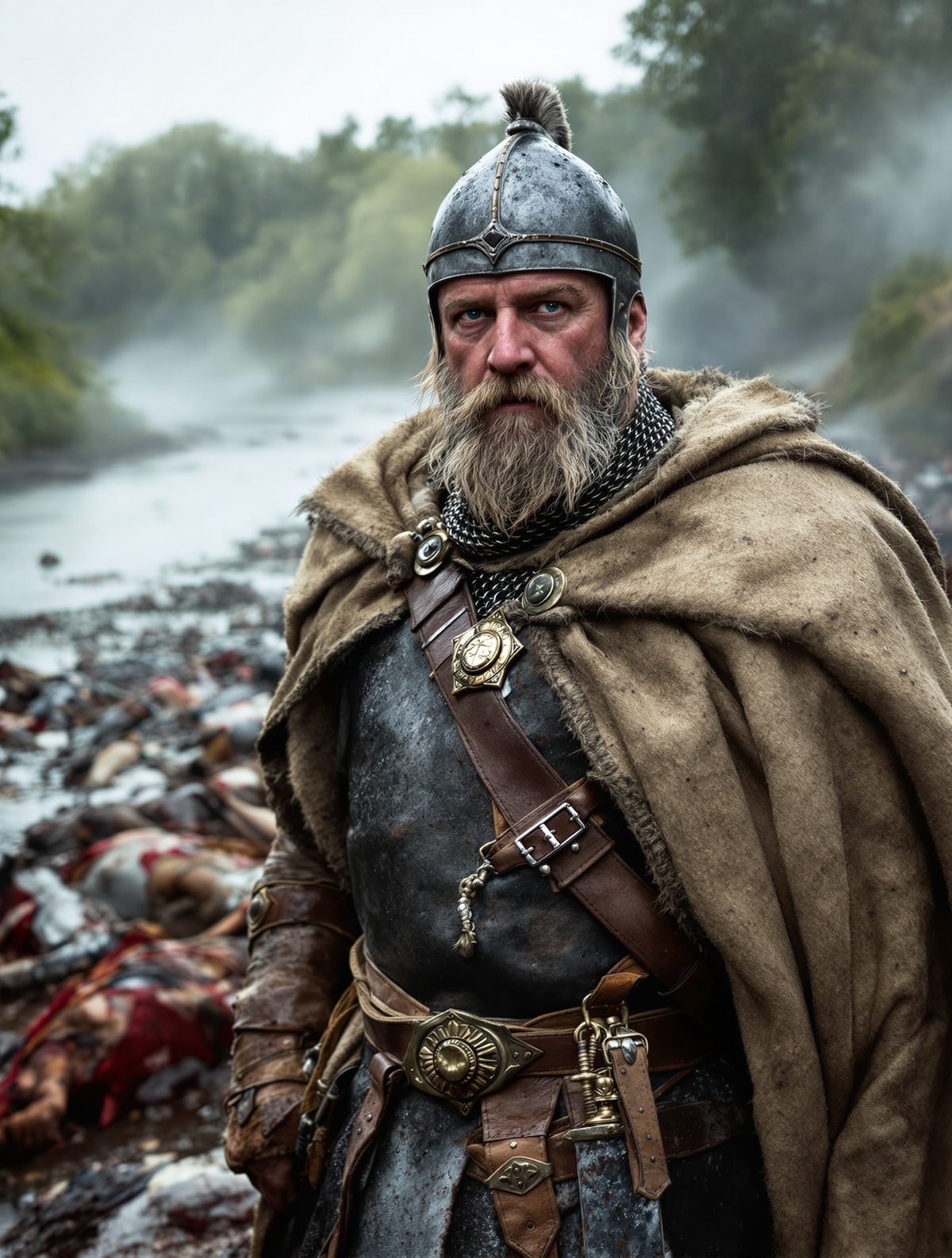
The battle was a slaughter. Penda's Mercians fought with the fury of men who knew they were doomed, but they were simply overwhelmed. The king himself charged into the thickest fighting, his grey beard flying as he cut down enemy after enemy. When he finally fell—whether to a Northumbrian spear or the swollen river itself—his army disintegrated.
The chronicles record that so many men died that day, the River Winwaed was choked with bodies. For miles downstream, the water ran red.
The Death of the Old Gods
With Penda's death, the last great resistance to Christianity in Anglo-Saxon England collapsed like a dam bursting. His son Peada had already converted to marry a Northumbrian princess, and within a generation, Mercia itself would become a Christian kingdom. The old gods weren't entirely forgotten—their names live on in our days of the week, and their stories survived in poems like Beowulf—but as political forces, they were finished.
Perhaps most tellingly, when Christian chroniclers wrote about Penda in later years, they struggled to explain him. Here was a pagan who had shown remarkable religious tolerance, allowing Christian missionaries to preach in his kingdom even as he fought Christian kings. He had been brave, honorable by the standards of his time, and utterly devoted to his beliefs. Yet their faith demanded they portray him as a monster.
The truth was more complex. Penda represented the last gasp of a warrior culture that had dominated northern Europe for centuries—a world where might made right, where gods were judged by their ability to grant victory, and where a man's worth was measured in gold and glory. His defeat marked not just the triumph of Christianity, but the beginning of a gentler, more unified England.
Standing in those Yorkshire fields today, it's hard to imagine the clash of civilizations that once played out there. But in November 655, when an 80-year-old king charged into his final battle calling on gods whose names we barely remember, the medieval world was born in blood and mud beside the waters of the Winwaed.