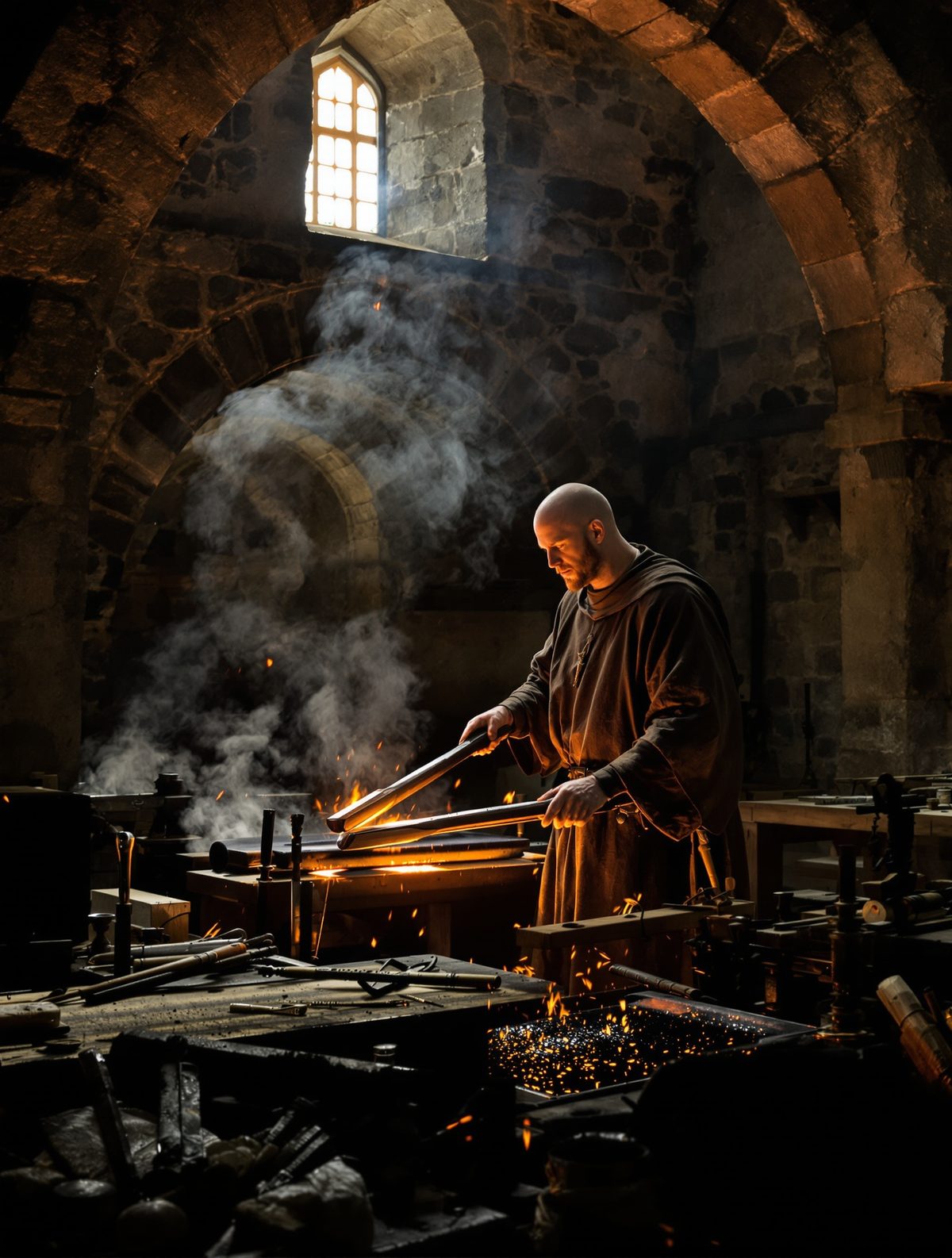
The rhythmic clang, clang, clang of hammer on anvil echoed through the stone chambers of Glastonbury Abbey on that fateful morning in 960 AD. Sparks flew like tiny falling stars as the blacksmith's muscled arms worked the glowing iron, his face illuminated by the fierce orange light of the forge. But this was no ordinary craftsman bent over the anvil—this was Dunstan, Abbot of Glastonbury and future Archbishop of Canterbury. And he was about to have the most extraordinary encounter in the history of medieval England.
The morning air was thick with the acrid smell of burning coal and heated metal when an unexpected shadow fell across the workshop doorway. What happened next would be whispered about in alehouses, proclaimed from pulpits, and carved into church stones for the next thousand years.
The Monk Who Mastered Fire and Iron
To understand the magnitude of what occurred that day, we must first appreciate the remarkable man at the center of this legend. Saint Dunstan wasn't your typical medieval monk, hunched over illuminated manuscripts in some dusty scriptorium. Born around 909 AD into a noble West Saxon family, Dunstan was a renaissance man centuries before the Renaissance—a scholar, musician, metalworker, and political powerhouse rolled into one.
At Glastonbury Abbey, where he served as abbot from 943 AD, Dunstan had established workshops that would have made any medieval craftsman weep with envy. Here, amid the sacred walls where legends claimed King Arthur himself was buried, the future saint pursued his passion for metalworking with an intensity that bordered on the mystical. His forge wasn't just a place of craft—it was a temple to creation itself, where base metals were transformed through fire and will.
Read next: The Day a Saxon Abbot Walked Into a Slave Market Alone
Contemporary accounts describe Dunstan as a man of imposing physical presence, with hands scarred from years of working hot metal and shoulders broadened by countless hours at the anvil. But perhaps most striking were his eyes—witnesses spoke of a gaze that seemed to pierce straight through to a person's soul. These were not the soft, contemplative eyes of a cloistered monk, but the sharp, assessing look of a man who had stared into fire and learned its secrets.
When Darkness Came Calling
The morning of the encounter began like any other. Dunstan had risen for Lauds at dawn, participated in the communal prayers, and then, as was his custom, retreated to his beloved workshop. He was crafting a chalice—a communion cup of such exquisite beauty that it would later be said to rival the finest works of Constantinople's master artisans.
The iron was cooperating beautifully under his skilled hands when the temperature in the forge suddenly plummeted. The flames, which had been dancing cheerfully moments before, now guttered and flickered as if struggling against some unseen force. It was then that he appeared.
Medieval chroniclers describe the Devil's manifestation with vivid, terrifying detail. He appeared not as the horned, hoofed creature of later imagination, but as a figure of terrible beauty—tall, elegant, with features that were almost angelic save for the coldness in his ancient eyes. He wore the guise of a nobleman, complete with rich robes and a knowing smile that suggested he was privy to secrets that would drive mortal men mad.
"Good morning, Brother Dunstan," the Devil reportedly said, his voice like honey poured over broken glass. "I see you work with such... passion. Perhaps we might discuss certain arrangements that could benefit us both?"
The Moment That Echoed Through Eternity
What happened next defied every expectation of medieval monastic behavior. A proper monk should have fallen to his knees in prayer, called upon Christ for protection, or fled screaming from the unholy presence. Dunstan did none of these things.
Instead, he looked up from his work with the calm assessment of a master craftsman interrupted by an unwelcome customer. His gaze flicked to the red-hot tongs lying ready beside his anvil—tongs that had been heating in the coals and now glowed with the fierce heat of divine fury.
Without warning, without prayer, without even a moment's hesitation, Dunstan's scarred hand shot out and grasped the blazing tongs. In one fluid motion—as swift and sure as any strike of his hammer—he reached forward and clamped the white-hot iron around the Devil's nose.
The scream that followed was unlike anything heard on Earth before or since. Chronicles describe it as a sound that shattered windows in the abbey church, sent every bird within miles fleeing in terror, and caused pregnant women in nearby villages to go into premature labor. The very stones of Glastonbury seemed to shake with the force of that otherworldly shriek.
The Devil, Lord of Lies, Prince of Darkness, the Tempter of Nations—reduced to a howling, writhing creature desperately trying to escape the grip of a determined monk with a set of tongs. For several eternal moments, the workshop became the stage for the most dramatic confrontation between good and evil in English history.
The Mark That Launched a Thousand Tales
When Dunstan finally released his grip, the Devil vanished in a cloud of sulfurous smoke—but not before leaving behind evidence of the encounter. The tongs, witnesses claimed, bore the permanent impression of the Adversary's nose, seared into the metal like a divine signature. More remarkably, the Devil himself was said to bear Dunstan's mark for eternity—a blacksmith's brand across his face that would serve as a permanent reminder of his humiliation.
Word of the encounter spread across England with the speed of wildfire. Suddenly, every blacksmith in the kingdom was a potential holy warrior, every forge a fortress against evil. The story resonated particularly powerfully because it celebrated not passive piety, but active, muscular Christianity. Here was a saint who didn't just pray for deliverance—he grabbed evil by the nose and squeezed until it screamed.
The tale took on additional layers of meaning as it spread. Blacksmiths began hanging horseshoes over their doors—not just for luck, but as a symbol of their connection to Saint Dunstan and his victory over darkness. The practice spread throughout medieval Europe, and even today, centuries after the religious significance has faded, people still hang horseshoes for protection.
The Saint Who Shaped a Kingdom
Dunstan's confrontation with the Devil might have been his most famous moment, but it was far from his only achievement. After his time at Glastonbury, he rose to become Archbishop of Canterbury in 960 AD, serving under three successive kings and becoming one of the most powerful figures in Anglo-Saxon England.
His influence extended far beyond the spiritual realm. Dunstan helped orchestrate the coronation of King Edgar in 973 AD—a ceremony so magnificent and symbolically rich that it became the template for English royal coronations for centuries to come. Elements of that ceremony, which Dunstan helped design, are still used in modern coronations today.
But perhaps most remarkably, the man who grabbed the Devil with tongs was also a patron of learning and the arts. Under his guidance, monasteries became centers of scholarship, manuscript illumination flourished, and England experienced what historians now call the "Benedictine Reform"—a renaissance of learning and culture that helped lay the foundation for medieval English civilization.
When Legend Becomes Truth
Modern historians might debate the literal truth of Dunstan's supernatural encounter, but they cannot argue with its cultural impact. The story of the saint with the red-hot tongs became a defining myth of medieval England—a tale that celebrated courage, craftsmanship, and the triumph of human determination over supernatural terror.
In our contemporary world, where we often feel helpless against vast, impersonal forces, there's something deeply satisfying about Dunstan's approach to confronting evil. He didn't wait for divine intervention or rely solely on prayer—he used the tools at hand and his own skill to fight back. It's a reminder that sometimes the most profound acts of faith involve not passive submission, but active engagement with the challenges that confront us.
The forge at Glastonbury is long cold, the tongs that once gripped the Devil's nose lost to history. But the echo of that supernatural scream still reverberates through English culture, a reminder that even the humblest craftsman—with courage, skill, and a good set of tools—can face down the very forces of darkness and emerge victorious. In the end, perhaps that's the real miracle: not that a saint fought the Devil, but that he did it with his own two hands and won.