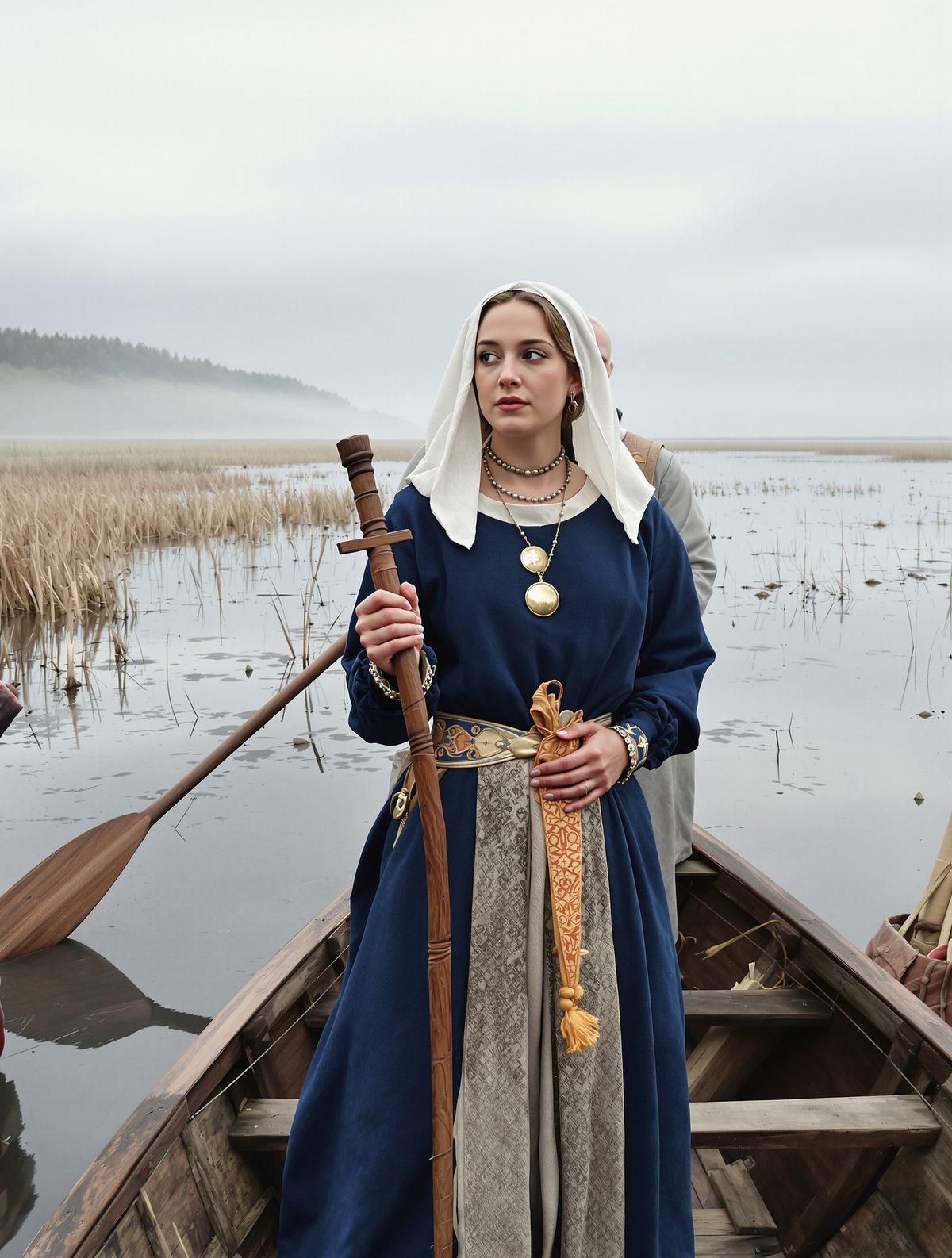
On a windswept day in the year 625 AD, Æthelburh of Kent stood at the prow of a ship as it cut through the frigid waters of the North Sea. Ahead lay Northumbria, a formidable kingdom known for its pagan traditions and mighty warriors. Æthelburh, a Christian princess from the south, arrived not with armed soldiers, but with the promise of a new faith — and a quiet determination that history has largely forgotten.
The Unlikely Missionary
Born circa 605 AD, Æthelburh was a daughter of King Æthelberht of Kent, one of the earliest Anglo-Saxon kings to embrace Christianity. Her mother, Bertha, was a Frankish princess who had brought Christian influence to Kent. With such a heritage, Æthelburh seemed an unlikely candidate to traverse the perilous path to the north. But it was a marriage proposal from Edwin, the King of Northumbria, that set her on this momentous journey.
Edwin was a pragmatic ruler, driven by ambition and political strategy. His marriage to Æthelburh was a calculated move to form an alliance with the wealthy southern kingdom of Kent. In return, he promised to allow Æthelburh the freedom to practice her faith, a concession that would turn the tides of history. Accompanying Æthelburh was Paulinus of York, a bishop sent to support her in establishing the Christian church in the heart of pagan territory.
A Kingdom of Contrasts
As Æthelburh's ship approached the rugged coastline of Northumbria, she entered a realm as varied as its landscape. Northumbria in the 7th century was a tapestry of contrasting cultures — a place where pagan traditions thrived amidst sporadic whispers of Christianity brought by missionaries like Æthelburh and Paulinus.
Read next: The Day a Saxon King Knelt and Washed a Leper's Feet
Edwin's capital was the city of Eoforwic, known today as York. Here, under the thatched roofs of wood and wattle, a bustling community unfolded. Warriors honed their skills, traders peddled their wares, and elders recounted ancient tales under star-studded skies. Though Christianity had brushed these lands before, many of its seeds were yet to find fertile ground.
The Serene Diplomat
Æthelburh's arrival in Northumbria marked the beginning of a quiet revolution. Without fanfare or conflict, she introduced Christianity into the royal court. Her chapel, built with Paulinus's guidance, became a sanctuary of worship. Every day, prayers mingled with the incense-filled air, a subtle reminder of the spiritual transformation brewing beneath the surface.
Though Æthelburh's influence was gentle, it was powerful. Her poise and fortitude captivated the court. Edwin, fascinated by this new religion, observed Christianity through the eyes of his queen. Paulinus’s persistent counsel and Æthelburh’s devoted practices left a marked impression on him. Yet, Edwin remained unconverted, torn between tradition and transformation.
The Turning Tides
In 626 AD, an assassin wielding a poisoned blade attempted to take Edwin’s life. His survival, attributed to both divine intervention and quick reflexes, became a moment of profound reflection for the king. As gratitude took root, he vowed that if victorious in an impending battle against the West Saxons, he would allow himself to be baptized as a Christian.
Victory came swiftly, with Edwin’s forces vanquishing their foes. True to his word, Edwin, on Easter Day in 627 AD, knelt beside a simple font in a wooden church in York. Paulinus performed the baptism, washing away the remnants of Edwin’s pagan past. Æthelburh, standing by Edwin’s side, watched triumphantly as the waters cascaded, symbolizing the birth of a Christian kingdom.
This moment marked a significant shift in the religious landscape of Anglo-Saxon England. Æthelburh's unwavering faith had not just converted a king, but had opened doors that would ultimately influence the entire north.
The Underestimated Legacy
While history often focuses on kings and their conquests, it is easy to overlook the unsung heroines, the women who wielded influence behind the throne. Æthelburh of Kent’s story is an illustration of subtle power and tenacious spirit. Her mission, though overshadowed by the tumult of battles and the politics of kings, was vital in solidifying Christianity as a mainstay in Anglo-Saxon England.
Her influence went beyond her husband’s baptism. Æthelburh helped establish a legacy of Christian queens who played pivotal roles in continuing the faith's expansion. The subsequent peace and cultural flourishing in Northumbria can be traced back to her serene efforts and steadfast devotion.
Lessons for Today
The story of Æthelburh of Kent is one of determination, diplomacy, and quiet resilience. In a time when turmoil and tribalism were rife, her story reminds us of the immense power found in unwavering belief and gentle persuasion. Æthelburh transformed a kingdom through patience and faith, proving that often the most powerful revolutions are birthed not through force, but through the strength of individual conviction.
As we reflect on our own times, Æthelburh’s story serves as a powerful testament to the enduring influence of those often hidden in the margins of history. Her legacy, far from forgotten, continues to inspire movements born not from might, but from the heart.