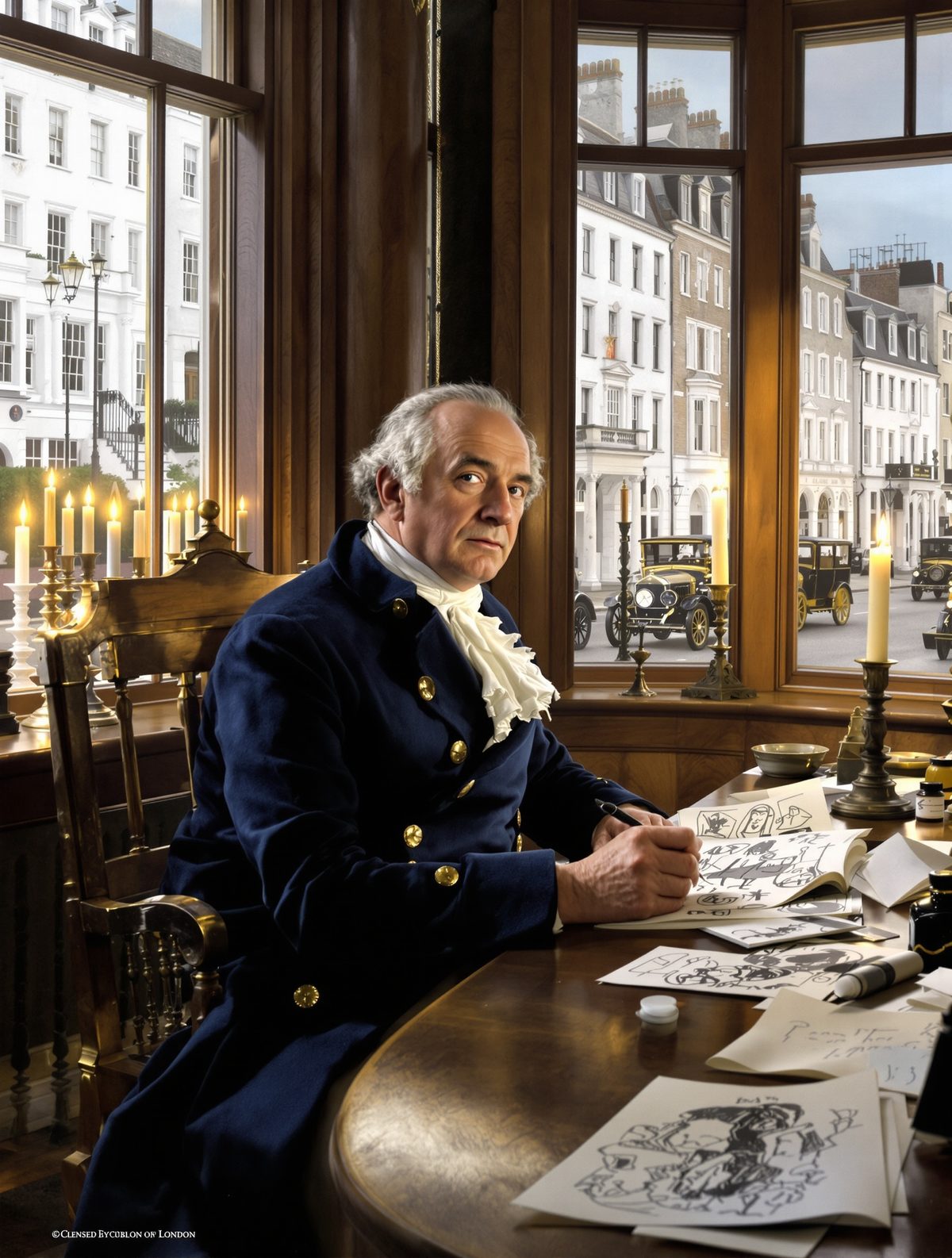
In the shadowed corners of Georgian England, where society's great and good sought refuge from the mundane in the extravagant airs of opulent ballrooms and the solemnity of parliamentary halls, one man dared to turn a mirror upon them—a mirror that both caricatured and illuminated. Enter Thomas Rowlandson, an artist whose pen sketched the absurdity of Britain's follies and, in so doing, saved the art of satire. His art was raw, acerbic, and delightfully unflinching, bringing laughter and introspection in equal measure to a nation on the cusp of modernity.
The Pen as a Sword: Rowlandson's Formidable Start
The year was 1756 when Thomas Rowlandson was born into a financially struggling family in London, but his destiny was not destined to follow the path of poverty. A prodigious talent, he soon found himself among the elite at the Royal Academy of Arts, sharpening his skills alongside the greats. However, it was not long before Rowlandson recognised the power of the pen beyond mere illustration. The Georgian era was ripe for satire—a turbulent period hosting an amalgam of societal transformations and excesses waiting to be unveiled.
In 1784, Rowlandson caught the public's eye with his work The Drunken Midshipman, which captured the imagination and ire of the nation's officers. His weapon was now drawn; with ink as his ammunition, he embarked on a crusade against social hypocrisy and political pomposity. Rowlandson’s works, replete with biting humour and keen observation, laid bare the contradictions of Britain’s elite, earning him both infamy and adoration.
High Society's Unlikely Jester
Rowlandson thrived on the excesses of the Georgian elite. His sharp eye missed nothing as he navigated the opulent masquerades and indulgent soirees, sketching characters with exaggerated noses, bulbous bellies, and dwindling dignity. Who could forget High Life Below Stairs, a scandalous portrayal of servants mimicking their masters’ debauchery, or his depiction of King George III as caricatured, not regal?
Read next: The Day a Surgeon Walked Into a Prison and Freed a Madman
London became the backdrop for Rowlandson’s artistry; the bustling streets and decadent clubs fueled his creative genius. At the notorious Brooks's Club, he christened the Prince Regent with the sobriquet “Prinny,” an image both scandalous and revealing that portrayed the gregarious monarch in less-than-flattering light. Such unabashed clarity of vision in his work transcended art—his satire conveyed a truth that resonated across social classes, despite their discomfort.
A Rogue's Gallery: Politicians and Clergy on Display
Nothing escaped Rowlandson's acerbic wit, including politics and religion. His caricature of the infamous politician Charles James Fox, known for his debaucheries and gambling, painted him as a bloated figure, helpless in the face of coin and vice. This artistic rebellion was not without risk, yet his trusted publishers, such as Rudolph Ackermann, protected his identity and works fiercely.
Perhaps one of Rowlandson’s most provocative depictions was his ruthless portrayal of the clergy in pieces like The Corsican Priests of St. Nicholas, exposing their greed and scandalous indiscretions. A mere glance at his work revealed a world of sin cloaked in the garb of virtue, a revelation both shocking and enlightening to the English populace. By pulling back the curtain on the pious and powerful, Rowlandson risked censure, yet he never wavered in his commitment to truth through satire.
The Art of Social Revolution
Rowlandson was not just an artist; he was a social commentator with a single aim: to inspire reflection. His depictions of the urban sprawl, columns of workers, and the stark reality facing the nation's indigents in pieces such as The Miseries of London, illustrated poignant contrasts within the Georgian narrative. This was art for the people—empathy inked into every stroke, resonating with the working class grappling with economic change and the encroachment of industrialism.
Through Rowlandson’s lens, satire became a tool of revolution—a silent cry for societal introspection and change. While his subjects slumbered amidst their excesses, his art prodded the conscience of a silent majority, encouraging them to question the veneers of what was deemed an acceptable society.
A Legacy for the Ages
The quills of satire graze harshly, drawing thick lines of truth across murky divides. As Rowlandson dwindled toward the end of his days, leaving the world in 1827, his artistic legacy sowed seeds that would echo into the halls of history. His vigour emboldened future generations like George Cruikshank and others, who took up the mantle of satire in prose and pen.
Thomas Rowlandson’s impact on the fabric of British satire cannot be underestimated. He demonstrated that the follies of humanity, when held up to both ridicule and reflection, can demand introspection and foster change. Today, in an era replete with digital media and instantaneous discourse, Rowlandson’s legacy serves as a reminder of satire’s pivotal role as a catalyst for awareness and reform.
Rowlandson wielded his pen with astounding brilliance and courage. As we peruse his scathing yet artful depictions, we are reminded of his unwavering belief: that the greatest societal progress often begins with a spotlight shone on its absurdities. In this spirit, Britain Untold salutes the legacy of Thomas Rowlandson, forever enshrined in the annals of British history as the caricatured crusader whose art didn’t just depict the world, but challenged it to be better.