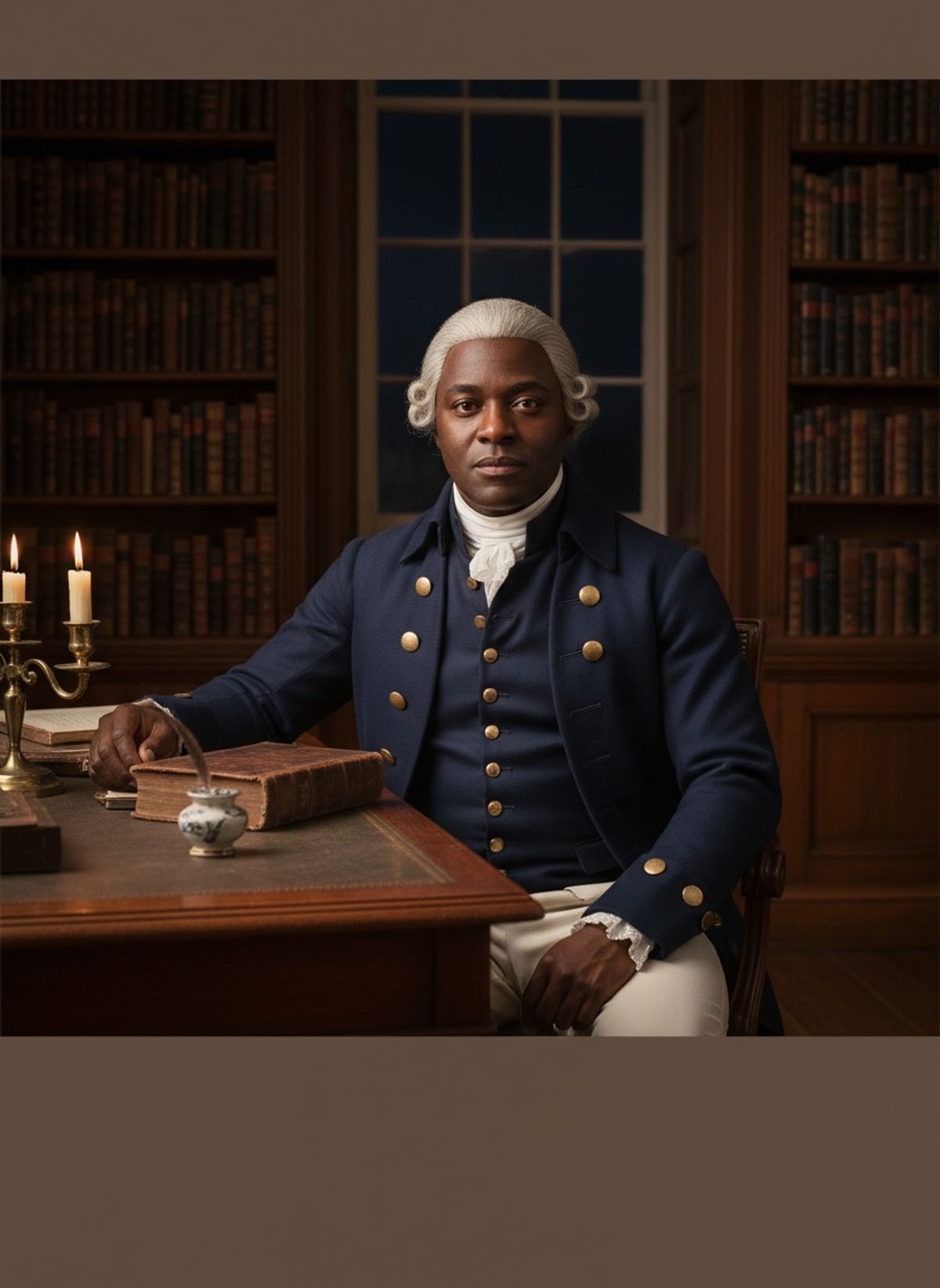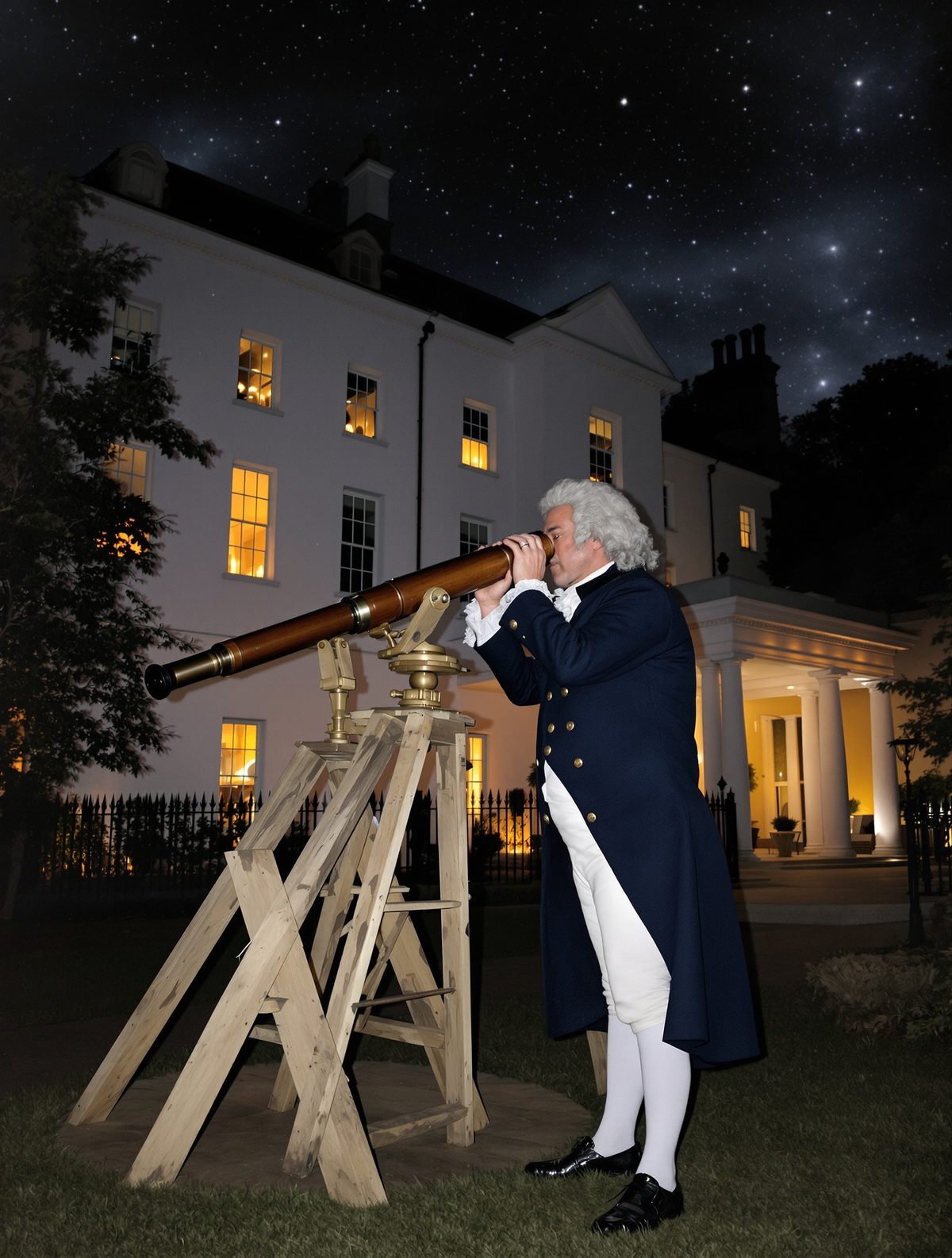
Picture this: a German immigrant stands shivering in his back garden in Bath, England, squinting through a telescope he hammered together with his own hands. The date is March 13th, 1781. The man is William Herschel, a musician who spends his days composing symphonies and his nights grinding mirrors by candlelight. In a few moments, he'll peer through his homemade contraption and spot something that will rewrite every astronomy textbook on Earth. He thinks he's found a comet. He's actually discovered a planet—and in doing so, he's just doubled the size of the known universe.
This is the story of the night amateur astronomy changed everything, and how a oboe-playing telescope-maker accidentally became one of history's greatest astronomers.
The Musician Who Couldn't Stop Looking Up
William Herschel was supposed to be famous for his music, not his telescopes. Born Friedrich Wilhelm Herschel in Hanover in 1738, he'd fled to England in 1757 to escape being press-ganged into the Hanoverian army. By 1781, he'd reinvented himself as a respectable English musician, conducting orchestras and giving music lessons to the well-heeled residents of fashionable Bath.
But Herschel harbored a secret obsession that consumed his evenings and drained his savings: astronomy. While his neighbors slept, he ground telescope mirrors in his basement, often working 16-hour stretches until his hands bled. His sister Caroline—herself destined to become the first woman to discover a comet—would place food in his mouth while he worked, afraid to let him stop polishing lest he ruin hours of progress.
Read next: The Day a Surgeon Walked Into a Prison and Freed a Madman
By 1781, Herschel had built telescopes that put the best professional instruments of the day to shame. His latest creation boasted a 6.2-inch mirror—massive for the era—that gathered four times more light than the telescopes used by the Astronomer Royal. What's remarkable is that he'd achieved this not through formal training, but through obsessive trial and error, casting over 200 mirrors before achieving perfection.
The Night Everything Changed
On that crisp March evening, Herschel was conducting his systematic survey of the heavens—a methodical examination of every patch of sky visible from his garden observatory at 19 New King Street. He was using a magnification of 227 times, scanning the constellation Gemini, when something caught his eye near the star Eta Geminorum.
There, swimming in his telescope's field of view, hung a curious green disc. It wasn't a star—stars appeared as perfect points of light even under high magnification. This object showed a visible disk, fuzzy around the edges, with a distinctly greenish hue. Herschel's pulse quickened. In the 18th century, any fuzzy celestial object meant one thing: comet.
Comet discoveries were the lottery tickets of astronomy. They brought fame, fortune, and royal patronage. Herschel carefully recorded the object's position and watched it night after night. But something wasn't right. The object moved far too slowly for a typical comet, and where was its tail? Most puzzling of all, it seemed to be moving in a perfect circle around the Sun.
The Comet That Wasn't
Word of Herschel's "comet" spread quickly through astronomical circles. The Royal Society took notice, and professional astronomers across Europe trained their telescopes on Herschel's discovery. But the more they observed, the more mysterious it became.
French astronomer Pierre-Simon Laplace was among the first to voice suspicions. The object's orbital motion was too regular, too circular for a comet. By August 1781, the evidence was overwhelming: Herschel hadn't discovered a comet at all. He'd found a planet—the first new planet discovered in recorded human history.
The implications were staggering. Since ancient times, humanity had known of five planets beyond Earth: Mercury, Venus, Mars, Jupiter, and Saturn. These had defined the boundaries of the solar system for over two millennia. Suddenly, Herschel had pushed those boundaries twice as far into space. The planet he'd discovered orbited the Sun at a distance of 1.8 billion miles—nearly twice Saturn's distance.
But here's where the story gets deliciously political. Herschel, ever the ambitious immigrant seeking to curry favor with his adopted country, proposed naming his discovery "Georgium Sidus"—George's Star—after King George III. The international astronomical community was not amused. French astronomers acidly suggested that if Herschel could name planets after his king, they should name the next discovery "Herschel" in his honor. Eventually, the planet received its current name—Uranus, after the Greek god of the sky—but not until 1850.
The Rewards of Accidental Genius
Herschel's discovery transformed him overnight from provincial music teacher to celebrity scientist. King George III, delighted to have a planet named after him, granted Herschel an annual pension of £200 (roughly £30,000 today)—enough to abandon music entirely and pursue astronomy full-time. The king also gave Herschel the informal title of "King's Astronomer" and moved him to a house near Windsor Castle, where he could show visiting dignitaries the wonders of the heavens.
But perhaps the most remarkable aspect of Herschel's story isn't what he discovered, but how he discovered it. This was citizen science at its purest—a self-taught amateur with homemade equipment outperforming the professional establishment. Herschel's telescope cost him perhaps £100 to build; the Royal Observatory at Greenwich had spent thousands on inferior instruments.
Herschel went on to revolutionize astronomy, discovering two moons of Uranus, several moons of Saturn, and pioneering the study of double stars. He mapped the Milky Way, discovered infrared radiation, and proposed that nebulae were distant galaxies—an idea so radical it wouldn't be accepted for another century. All of this stemmed from that one night in March when he glimpsed a green disc through his handmade telescope.
The Universe Gets Bigger
The discovery of Uranus did more than add a new planet to astronomy textbooks—it fundamentally changed humanity's perception of its place in the cosmos. For thousands of years, the solar system had seemed a cozy, comprehensible place. Saturn, visible to the naked eye, marked the edge of the known universe.
Suddenly, there was twice as much universe as anyone had imagined. If there was one undiscovered planet, might there be others? The search was on, leading to the discovery of Neptune in 1846 and dozens of asteroids in between. Herschel had opened the floodgates of discovery.
Even more profound was what Uranus taught astronomers about observation and expectation. The planet had actually been spotted and catalogued as a star at least 17 times before Herschel's discovery, including by the great John Flamsteed in 1690. But those astronomers saw what they expected to see—a star—rather than what was actually there. Herschel's fresh eyes and superior optics revealed the truth.
Today, as we discover thousands of exoplanets around distant stars and probe the outer reaches of our own solar system, we owe a debt to that shivering musician in Bath who refused to accept that what he saw through his telescope was impossible. Herschel's story reminds us that the greatest discoveries often come not from expensive institutions or advanced degrees, but from curiosity, persistence, and the willingness to see the universe as it really is—not as we expect it to be. In an age when citizen scientists are once again making major discoveries, from identifying new species to finding planets, William Herschel's legacy feels more relevant than ever. Sometimes all it takes to double the universe is a homemade telescope and the courage to look up.