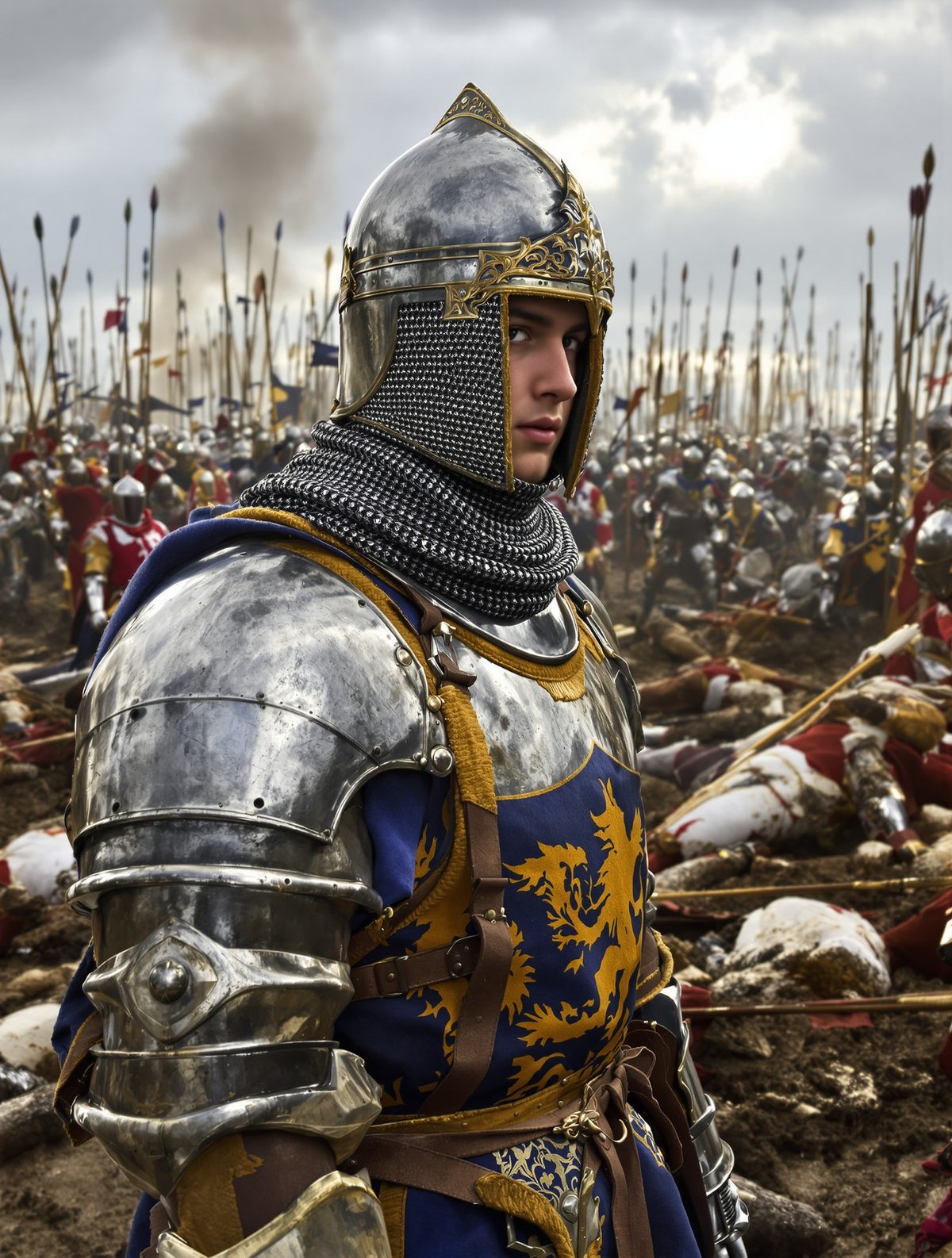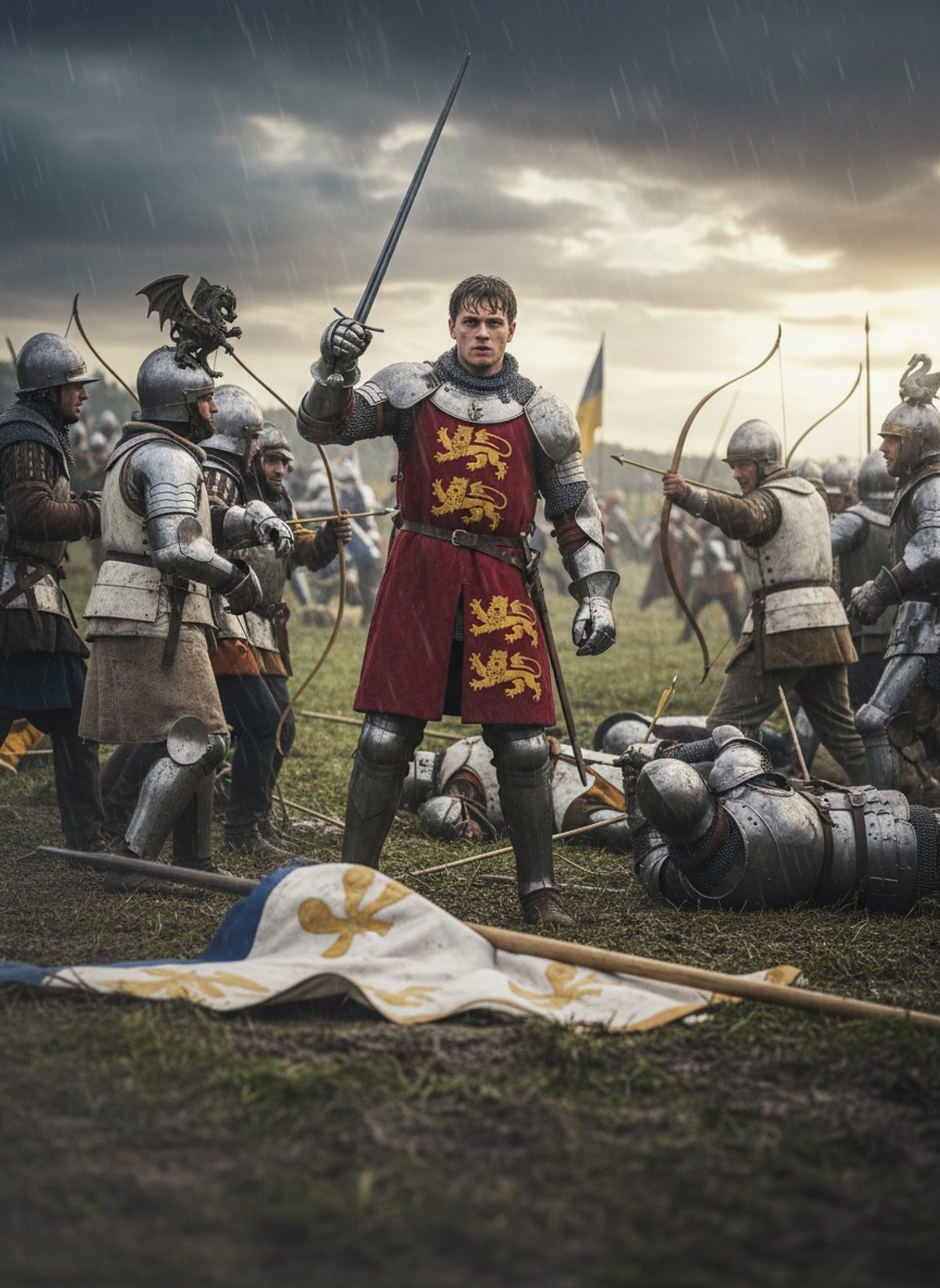
The air was thick with the smell of churned earth and sweat as the clamor of steel clashing pierced the humid August afternoon. Amidst the chaos at Crécy, a young warrior steeled his resolve, each heartbeat echoing the thunder of hooves on wet ground. This was not just any clash; it was the makings of a legend. Sixteen-year-old Edward, heir to the English throne, stood amidst the fray, his standard floundering but his spirit unyielding.
The Boy with the Lion’s Heart
It was an age when legends were forged in the heat of battle, and princes were expected to ride as knights in the prime of youth. Edward, the Prince of Wales, had been molded by the ideals of chivalry, his heart as fierce as the three lions emblazoned on his surcoat. Raised on tales of heroism and honor, he found himself on the blood-soaked fields of northern France, amidst what would become the infamous Battle of Crécy.
Against the odds, Edward was thrust into the heart of the conflict, tasked with leading a division of hardened soldiers. Here, prowess in arms met the harsh realities of medieval warfare. The air buzzed with the deafening hum of arrows loosed by the famed English longbowmen, each volley a rippling challenge to the advancing French knights. Before the onset of dusk, this young prince was set to gamble not just with the lives of his men but with his very legacy.
King on the Hill
A mere stone's throw from the heart of the melee, King Edward III positioned himself strategically on a hill, gazing down upon the unfolding tempest. His silhouette against the autumn twilight was a study in leadership and restraint. As the French cavalry reared and fell against his son’s lines like a tempest against a cliff, King Edward's calm endurance spoke volumes. Throughout the tide of the battle, men implored the king for reinforcements to protect the future sovereign.
Read next: The Day a Mayor Knelt Between a King and Six Hostages
The King’s calculated decision to refrain spoke to more than confidence; it was a test, a crucible where boyhood gave way to the mantle of kingship. Observers would later speak of his stoic declaration: if his noble son should falter, then he would perish like a common soldier. It was a brutal, yet telling, trust — faith that would either destroy a boy or etch a king into history.
A Crowned Warrior at Crécy
As the afternoon faded into a blood-red dusk, the conflict intensified. The French forces, bedecked in armor and sworn to seize victory, thundered forward, their lances glinting in the dimming light. The Prince of Wales stood resolute as knight after knight charged, determined to break the English line. Shadows danced across his mud-streaked face, eyes alive with defiance.
The standard fell, the emblem of a thousand battles crumpled in the mud. Yet, the young prince rose from where he had been battered to the earth. In these critical moments, his resolve shone brightest. Surrounded, outnumbered, and tested beyond the limits of youth, he held firm, rallying his contingent with bravery that belied his years. Amongst the chaos of clashing swords and cries of the wounded, he became a living embodiment of the chivalric ideal, proof that courage is not the absence of fear, but the will to confront it.
Night Falls on French Valor
As the evening deepened, a shocking stillness descended over the battlefield, mingling with the moans of the dying. Scores of France’s finest knights lay undone by the relentless storm of arrows and English resolve. Crécy had claimed the flower of French chivalry, leaving a landscape of broken armor and extinguished ambition.
The cost had been steep, yet victory was undeniable. The teenage prince, once driven to his knees in the mud, had stood indomitable amidst the ruin. His valor not only held the line but shifted the tides of the Hundred Years’ War. As the battle smoke lifted, whispers of his courage began to seed themselves into legend. Edward, Prince of Wales, now stood as a bastion of youthful heroism woven into the very fabric of medieval mythos.
The Making of a Legend
The story of Crécy would ripple across the annals of history, a testament to indomitable courage and strategic patience in the face of overwhelming odds. For many, this was the forging of the Black Prince, a moniker that would come to symbolize his ferocity and acumen as a military commander. In the murk and uncertainty of medieval warfare, the victory at Crécy was as much about the spirit of one young man as the army that stood beside him.
As students of history reflect on that fateful August day, they find more than a mere battle victory; they find the passage of youth into maturity, a tenacious spirit refusing to crumble, and the emergence of a leader whose legend would inspire generations. It is a reminder that in the mud and blood of conflict, amidst the clamour and chaos of war, the seeds of greatness are often sown.