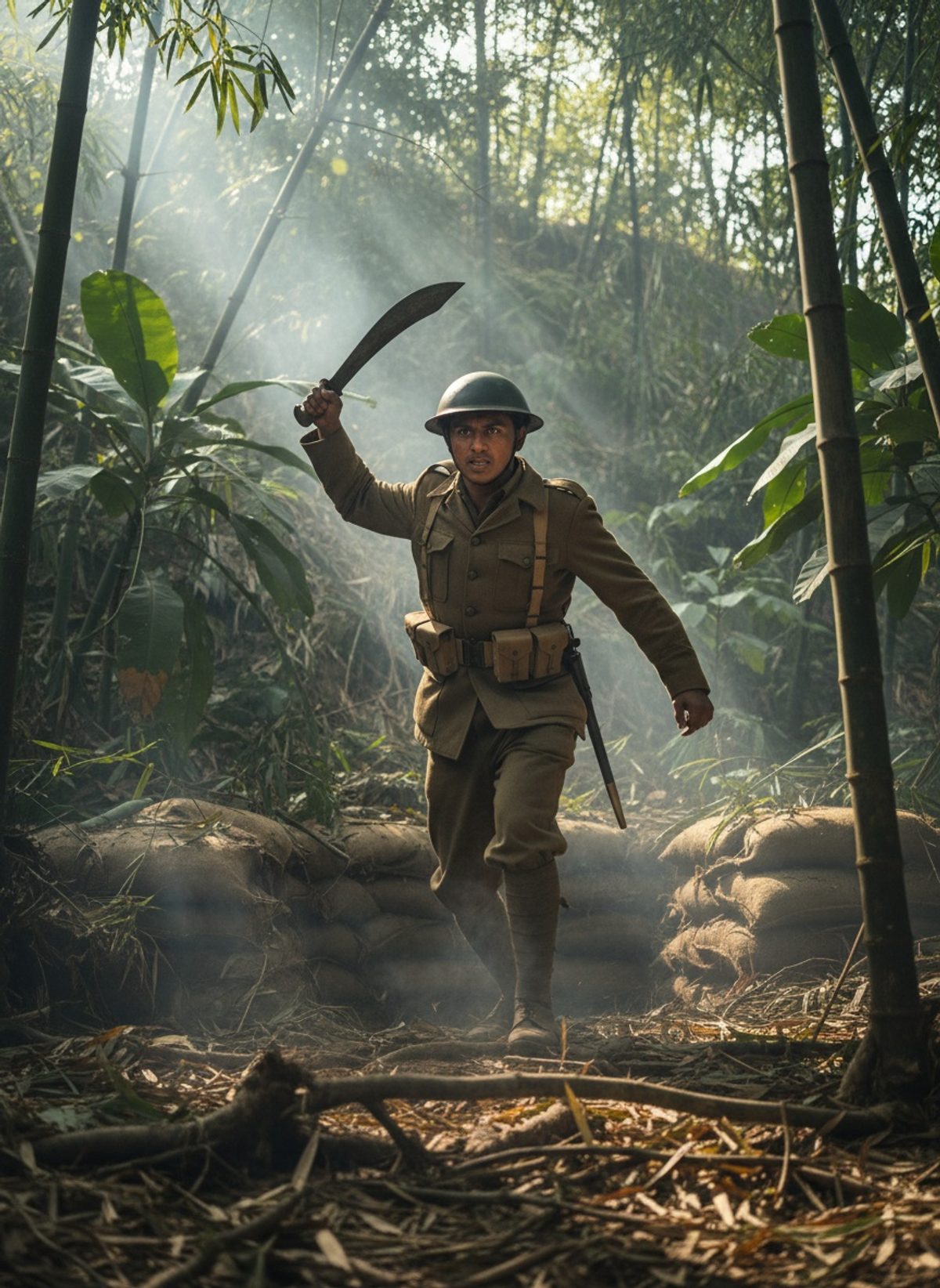
The jungle of Burma in March 1945 was stifling, a dense canopy preserving humid heat and muffling even the sharpest sounds. Under this verdant and oppressive roof, sunlight filtered heavily, casting dappled shadows over the tangled undergrowth. The lazy drone of insects was punctuated by the sporadic crack of gunfire, a reminder that just beyond the hills lay a battle for control over Southeast Asia. Amidst this tangled jungle stood Snowdon East, a hill named innocuously after a Welsh peak yet transformed into a tableau of wartime desperation and valor. Here, the British forces of the 3rd Queen Alexandra's Own Gurkha Rifles found themselves pinned down by Japanese soldiers who had entrenched themselves into every available position, the hill a fortress of wood and madness. The grim stakes were smothering: relinquishment of the hill meant a potential unraveling of the Allied push across Burma. In the midst of this chaos, a lone figure, Rifleman Bhanbhagta Gurung, resolved to alter the course of combat with little more than his unyielding bravery and his kukri in hand.
The Strategy of Silence
The defenses atop Snowdon East were cunning in their simplicity. The Japanese soldiers, adept in guerrilla warfare, fortified every tree, each hollow becoming a firing point, collectively orchestrating a symphony of lethal fire that cut into the ranks of their Gurkha adversaries. Each crack of rifle and burp of machine guns sliced through the jungle's oppressive stillness, keeping Gurkha soldiers pinned under a danse macabre of death and survival. As the sun climbed and shadows shifted, so too did the urgency of the situation. The radio crackled tales of faltering lines elsewhere, the broader picture a quilt of peril and potential devastation. Reinforcements were delayed, awareness of their plight questionable at best.
In this crucible, Bhanbhagta Gurung watched his fellow men fall, each loss a punctuated moment of distress but also of resolve. The jungle was both ally and enemy, offering shadowy cover while concealing advancing threats. Isolation of engagements was a hallmark of this theater of war, individual deeds having outsized impacts. Yet, what stood out more than tactical maneuvers was the underlying ethos of the Gurkhas. "Kafar hunu bhanda marnu ramro," went their ancient code — better to die than live a coward. As one fortification fell, seemingly insurmountable, new demands emerged. Without orders, but fueled by the visceral urge of survival and heritage, Gurung decided to silence the hill once and for all.
Into the Teeth of the Tiger
Bhanbhagta Gurung's decision was both momentous and understated, a solitary march against a well-entrenched enemy. Discarding the now cumbersome weight of a rifle whose trigger did not assuage diminishing numbers or broken spirits, he unsheathed his kukri, the iconic curved blade of the Gurkhas. It's a weapon less of brutality than precision, a tool of intimacy on battlefields crowded with distant kill shots.
Read next: When Wolfe Died on the Heights and Won a Continent, 1759
His advance was silent, eyes narrowed, calculating distances between cover and concealment, each breath and step in rhythm with his heartbeat. For all the bark of commandeered machine guns, the flesh upon the ground thundered with an intensity all its own. Close combat turned his stealth presence into a nightmare for the Japanese, scrambling downhill against a man whose resolve was now lethal purpose.
The first position fell quickly, chaos of close quarters punctuated by shrill surprise, as the blade found its mark. The second outpost took more mettle, requiring the ascent of the hill’s gradient, amidst a rain of small arms fire and exploding grenades. Gurung ducked and fired back, an economy of motion sharply reducing threats in the span of heartbeats. Each stronghold eliminated brought not just strategic advantage but a swell of fervor to those watching in amazement.
Valor in Shadowed Light
Confronted by defenses that seemed endless, Gurung's path was neither linear nor smooth, a landscape of madness where resolve alone was signposted by victory. By the time he reached the fourth position, the Japanese were entrapped by the spirit they could neither see nor predict. Commanders, moments before wagering a feast on stalemate, began considering other avenues as previously impregnable positions became exposed earth. Such progress did not come without its toll; blood mingled with sweat, exhaustion mounting among the living and dying alike.
The final push, to the highest plateau, bore witness to the most primal of forces — the human spirit birthed from the embers of desperation. In the closing melee, Gurung hurled grenades to root out the entrenched Japanese, the detonations like thunderous crescendos in what had become a theatre of deliverance. The silence that settled over Snowdon East afterwards was not just the momentary pause of warfare but the defiance of one waiver not, even beneath all-hearing sky.
The retelling of this day remains a reminder of the power of individual courage within the collective struggle. Bhanbhagta Gurung’s leadership, though born in desperation, illuminated the darkness of warfare with beams of heroism. His actions, etched into the memory of his comrades and later honored formally, serve as potent testimony to the depths of human spirit under intense duress. This tale of selflessness and prowess was more than a testament; it was a manifestation of a creed lived rather than recited. The legends of textbooks may often omit individual saga, but among the bold hills of Burma, like Snowdon East, the echoes of Gurung’s steps still resonate, retelling how valor turned the tide when the end seemed inevitable.