September 13, 1759. The morning mist clung tightly to the rugged cliff face of the Heights of Abraham.
In those first breaths of dawn, the landscape seemed serene, giving no hint of the fierce contest about to unfold. The St. Lawrence River flowed quietly below, as unaware as the French garrison stationed at Quebec of the unexpected visitor scaling the sheer walls above. This was James Wolfe’s hour, and he had staked everything on this gambit — a move so audacious, critics considered it his last, doomed gamble. But what happened over the next few hours reshaped the future of a continent.
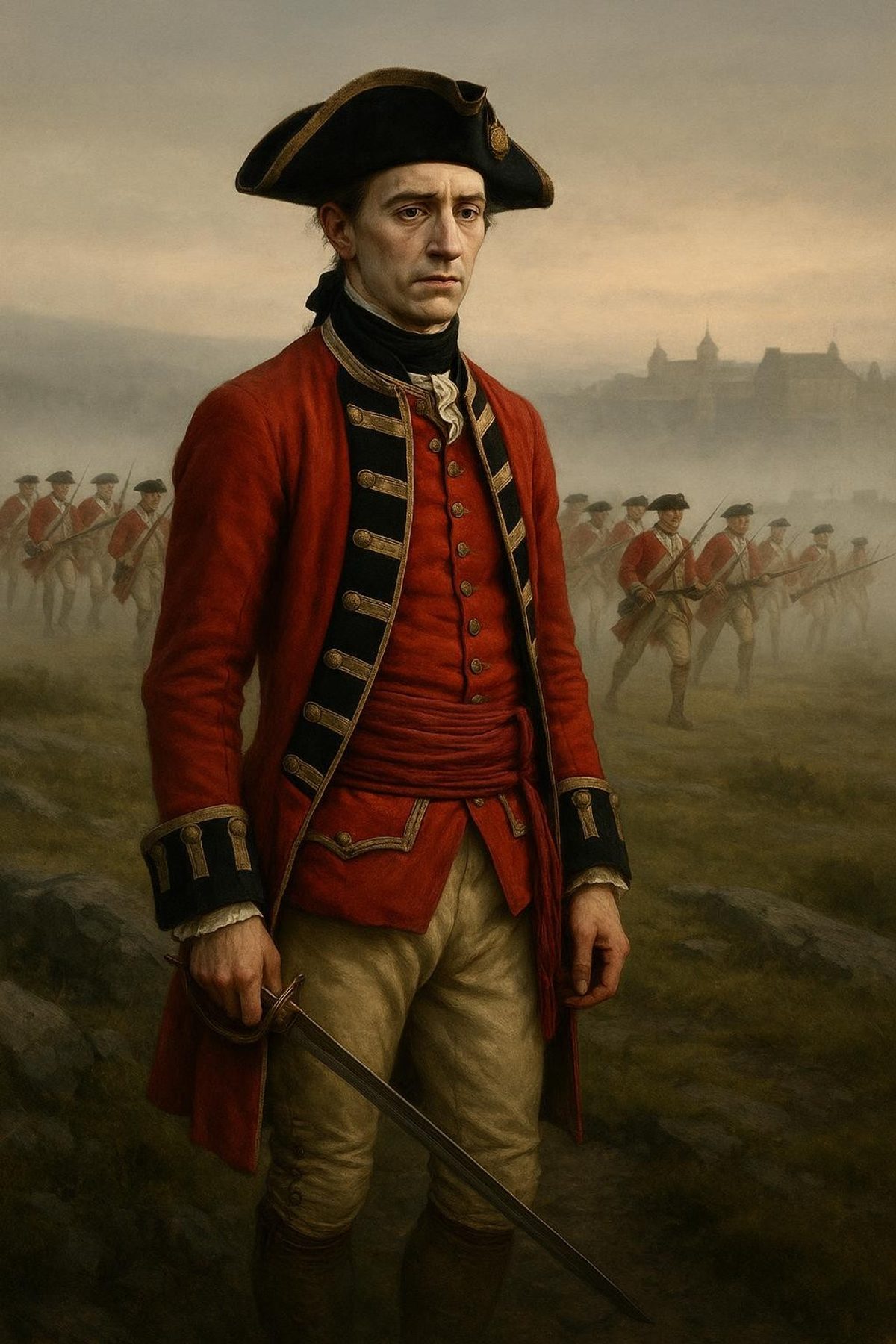
Wolfe, the son of General Edward Wolfe, was not the portrait of a dashing hero. His pale complexion, often pallid from illness, betrayed the battle within his own body. Consumed by consumption, he often vomited before confrontations, and despite the courage he displayed in combat, his own officers mocked him behind his back. Yet, beneath this sickly exterior lay an indomitable spirit. At the tender age of 18, he had risen to a brigade major, his military acumen quickly apparent in numerous theatres across Europe. By 23, he was a lieutenant-colonel. The Peace of 1748 paused his trajectory, exiling him to the monotonous garrison duty in the Scottish Highlands, but brought no respite to his ambitions or his fiery drive.
Following the outbreak of the Seven Years’ War in 1756, Wolfe found new avenues for his military genius. In 1758, success came at Louisbourg where his tactical brilliance shined, an accomplishment that caught the unwavering eye of Britain’s Secretary of State, William Pitt. Appointed to lead a force tasked with capturing Quebec, Wolfe's young life had prepared him precisely for this challenge. The French fort sat atop its formidable cliffs, a fortress thought impregnable. So secure were the French, under the command of General Montcalm, that they largely dismissed the possibility of a British assault from these heights.
Read next: When the Iron Gates of Mafeking Finally Opened, 1900
Determined to make the impossible possible, Wolfe spent weeks probing for weaknesses. Scrutinizing the tide charts of the St. Lawrence River, he discerned precise timings for the stealth landing. His finest hour demanded cooperation with his men — from the seasoned veterans to the newest recruit. It was on this silent morning, before the day had fully stretched his limbs, that Wolfe’s handpicked troops began scaling the ascent, utilizing whispers as their only means of communication, and helping each other upward in deafening silence. The French sentries, groggy and unsuspecting, were quickly overwhelmed as they gaped at the red-coated surge where none should have been.
From his position on the heights, Wolfe arrayed his men with near-mathematical precision. The lines stretched two deep, a tactic calculated to maximize firepower. As the early morning haze lifted, Montcalm finally glimpsed the British troops deployed upon the plain — a sight that propelled him into immediate action. Though the French ranked relied deeply on local militia accustomed to the way of guerilla warfare within the vast North American wilderness, Wolfe's disciplined lines held firm. With the resounding roar of unison volleys, the British forces unleashed their musketry upon Montcalm’s men.
It took thirteen heartbeats of volatility, a clash that swung the balance of power on a continent. Wolfe, struck by gunfire three times, fought on. His men witnessed his fall, hurriedly bearing him off the field. Yet, even as his lifeblood ebbed away, word reached him of victory. "Now, God be praised," he managed to murmur, "I die content." It was a solemn epitaph for such a youthful figure, a soldier who had clawed his way to triumph just as he succumbed to its iron price.
In the scheme of warfare, thirteen minutes is but a blink, yet within it, destiny played out on the Heights of Abraham. As Wolfe lay dying, Montcalm himself was struck during the retreat and succumbed the next day, leaving both leaders as hollow echoes amid the ensuing quietude. By the time the sun set on this decisive day, Quebec had irrevocably changed hands, starting a chain reaction that would eventually extend British influence across North America and write the obituary for New France.
For many, Wolfe’s story is but a footnote in a textbook, his etched portrait distant and staid. Yet, peel away the layers of history, and the thrills of Wolfe’s vision become clear, as does his indelible mark on destiny. His willingness to challenge the existing certitudes of military strategy, to see potential where others saw inevitable defeat, offers not just a lesson in leadership but a meditation on the power of audacity. The very landscape of Quebec, with its storied cliffs and river, stands as a silent testament to one morning where human resolve confronted impossible odds and triumphed.
As new nations emerged from the shadows of empire, the pen of history may ink out different narratives, but Wolfe’s ultimate gamble continues to reverberate through time—a bold move that shrank an ocean, changing the connection between peoples across continents. His life, stamped out prematurely on the soil of a new world, became the seed of a new chapter, and in understanding his story, we grasp the complexity of the past, which shapes the contours of the present. The Heights of Abraham remind us that history is often crafted by those who dare to climb into the mists of the unknown, forever redefining the landscape below.