The early morning fog hangs heavily over the Charnel House that is the Western Front. Its dreary blanket swathes the battered earth, the sharp contours of mortar craters barely discernible under the grey shroud. Footsteps squelch softly in the mud of Loos-en-Gohelle, where the trenches snake lazily through the scarred landscape. Mist and silence prevail, broken only by distant, sporadic shell blasts and the eerie whisper of toxic fumes drifting ominously. It is September 1915, and in the ghostly quiescence lies a seething anticipation — the gloom of uncertainty before the storm of war.
The Green Tide
They called it "the Green Tide". The noxious vapors surged unpredictably, a cruel, inhuman weapon loosed to corrode flesh and morale alike. For the soldiers of the King's Own Scottish Borderers, the gas attack heralded chaos, asserting its dominance as it rolled towards them. The acrid stench enveloped the trench, triggering coughs that shredded throats and eyes that streamed tears down grime-caked faces. Defensive measures felt pitiful against this invisible menace; even before the assault had truly begun, confusion and fear threatened to overrun discipline.
In the cloying murk, their masks ill-fitting and their resolve tested to the breaking point, the troops clawed at a fading hope. In such moments, the ghastly calculus of war demands quick thinking, resilience, and extraordinary acts of courage to tip the scale back in favor of the beleaguered forces. It was here, amid the choking desolation, that one man’s valor would resound across No Man’s Land, lifting spirits from the depths of despair.
The Piper’s Choice
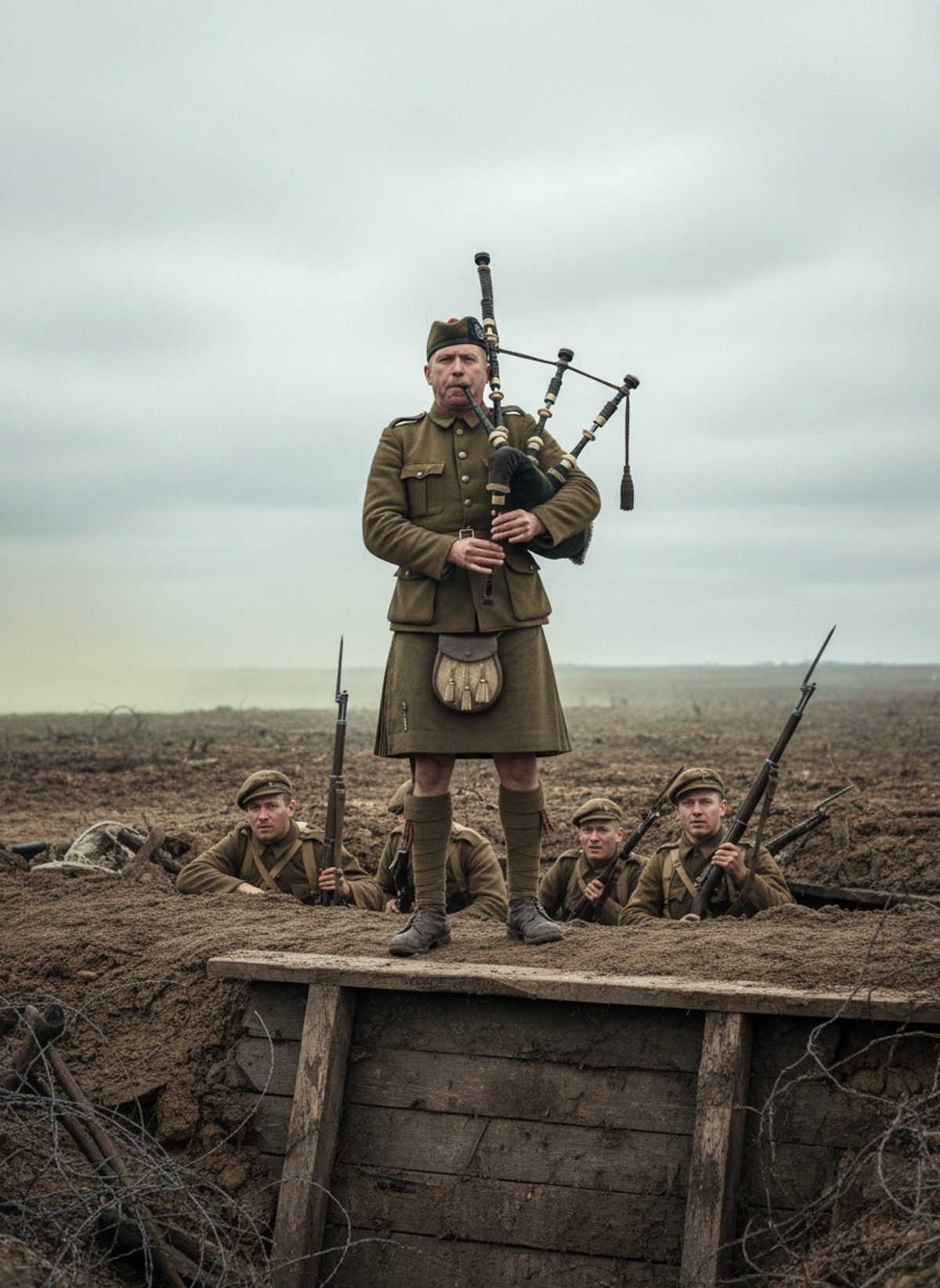
Amidst the chaos, a lone figure, Daniel Laidlaw, cast aside the safety of the trench for the open air, where peril was unfathomable. Climbing out, he brought no rifle to the fore. Instead, a set of Highland pipes cradled against his shoulder. The act was bold; it was audacious, maybe even reckless. But, above all, it was necessary — a spark to reignite the fighting spirit quenched by poison and panic.
Read next: When the Brodie Helmet Turned Death Into Injury, 1915
The skirl of the pipes cut through the lethal haze. The notes were ancient, a warlike clarion that reverberated through the souls of warriors bred from generations past. It was a sound that harked back to battles fought in the rugged terrain of the Scottish Highlands. Their forebears had marched to its rhythms, and so too would they, casting off the dawdling terror and rallying behind the haunting melody of courage.
Forward!
That familiar peat-rich timbre carried with it a galvanizing power. The strident drone of the pipes, with the tune’s peaks and falls, spoke of valor over fear and unity in the face of overwhelming odds. Laidlaw stood unwavering in his resolve, the pipes’ dirgeful call transforming doubt to determination among his comrades. With the intoxicating strains filling the air, the men found their footing anew, conscripting fear into camaraderie.
Men began to climb, following Laidlaw across the battleground where the air hung heavy with the reek of chlorine and the thud of artillery slowed to a tempo they could fight by. As they advanced, their steel was not solely one of arms but of belief — belief in the kinship of the regiment and the rallying power of their shared heritage. Until now, music seemed antithetical to the conditions of war, yet here it was: a conductor of bravery, orchestrating the impossible.
Into History’s Echoes
Laidlaw’s defiance of death that day, his gesture devoid of theatrics but dense with meaning, served as a human bridge across the No Man's Land. By the time the final strains of his play faded, he had accomplished something profound. His fellow soldiers went over, inspired by both necessity and conviction, lit anew by this solitary act. As they edged ever nearer to the enemy, the pipes' resonance waned behind them, just a memory but one that powered the flesh with resolve and hearts with fierce loyalty.
It is a curious footnote, this encounter between instrument and war instrument, exceptional not solely for the heroism displayed but the curious union of music and battle. The clash of steel and sinew, manipulated by hands honed in training fields, found its brotherhood in the manipulation of reeds and air. Laidlaw’s valor left its imprimatur not just on the men who followed him but on the annals of warfare, a testament to innovation spurred by desperation.
A Tune Beyond Time
Tales of war are punctuated by tales of men; among them, few rise beyond the din to leave a legacy that glimmers with the richness of human spirit. Daniel Laidlaw’s courageous piping amidst the swirling gas and gunfire stands as such a story, one that reverberates beyond historical litter and timeworn biographies. If war has its heroes, then Laidlaw's pipes are a reminder of the more transcendent qualities of hope and the power of shared memory.
His action at Loos serves as an evocative symbol of leadership and inspiration, illustrating the capacity of music to knit together the fibers of human courage. In recalling that misty September day, we are reminded that valor is not merely a matter of the physical but resonates in tones that lift spirits and shorthand despair. As we close the pages on Laidlaw’s chapter in the Great War, the haunting notes of his pipes whisper an eternal refrain: sometimes, in the cacophony of battle, the soul salutes not to the saber, but to the song.