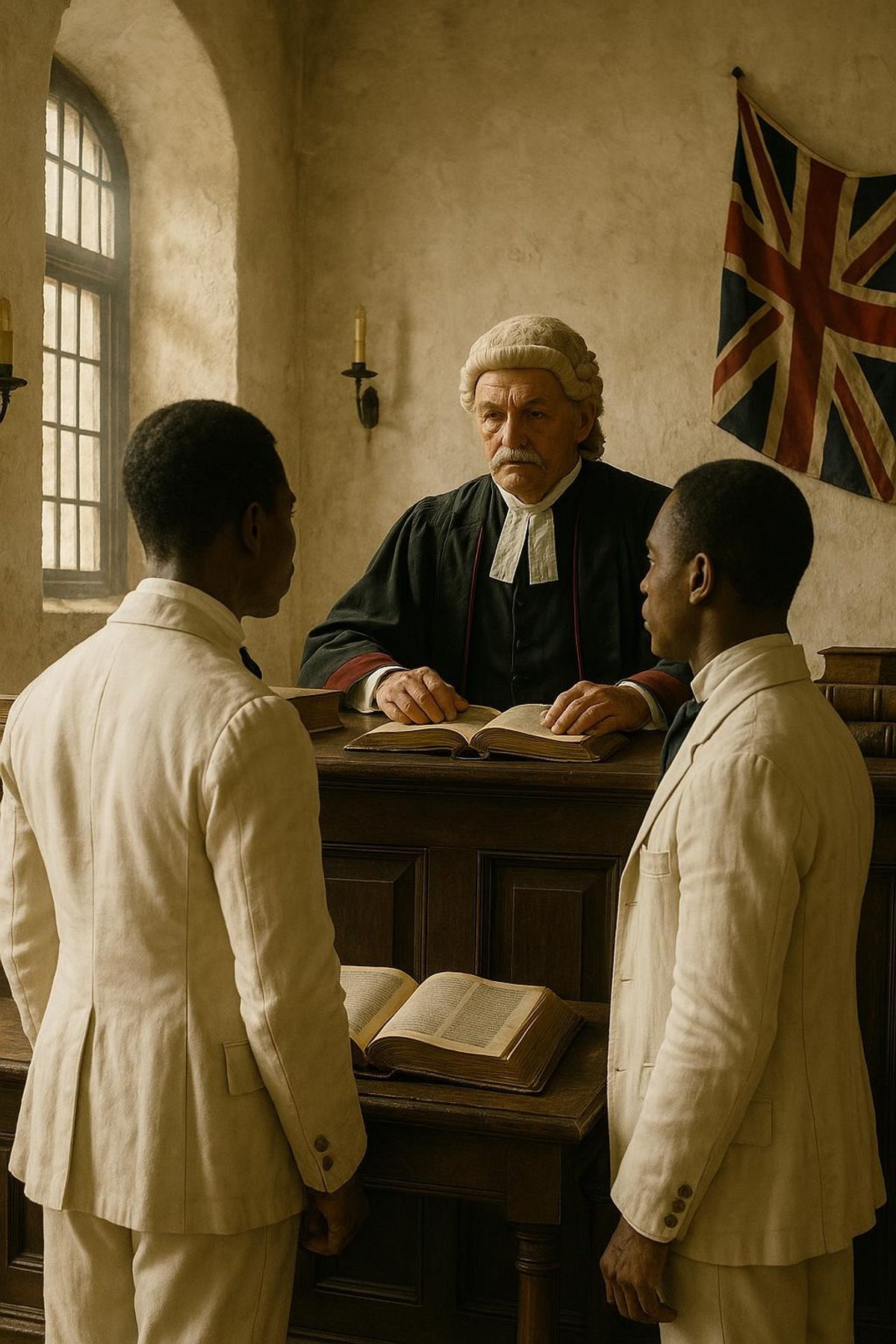
Metal clinked against stone as the heavy door creaked open, echoing through the castle’s narrow corridors. The faint smell of saltwater mixed with sweat and old varnish filled the cool air of the courtroom as the newest group of prospective local legal apprentices shuffled in, eager to catch a glimpse of the colonial justice machine at work. It was 1874, and a courtroom had been born within the walls of Cape Coast Castle, once the haunting vestibule between capture and the abyss of slavery. Now, the castle found a new purpose as the British Crown imposed its intricate web of common law upon the Gold Coast, what we know today as Ghana.
The William a Castle Called Home
Anchored on the windswept coastline of West Africa, Cape Coast Castle was no stranger to the currents of history. The fort's massive whitewashed walls once masked the horrors within, a troubled legacy of the trans-Atlantic slave trade. Yet here, in the makeshift courtroom among stone walls imbued with sorrows untold, a new kind of governance began its inexorable march. The court sessions attracted local men hungry for learning and eager to wield the strange new power of the English legal system, a force that simultaneously fascinated and mystified them with its solemnity and decorum.
Imagine the scene: burly British judges robed in crimson and ermine silver, their voices commanding the room, while newcomers from surrounding regions stood listening intently. The rhythmic cadence of legal arguments filled the air, punctuated by the occasional scratch of a quill capturing the day's proceedings. In these gatherings, language became currency, the bridge over which authority passed, revealing a subtle shift in power dynamics. The African hinterlands began to assimilate the nuances of jurisprudence that had, until then, shaped societies an ocean away.
Principles Pried From Precedents
As the Gold Coast officially joined the Empire's arduous cartography, gifted local men began to internalize the spirit of English common law. They observed keenly the rituals of justice, the weighing of evidence, the solemn pronouncements of guilt or innocence. These were principles where no man, not even the governor himself, could claim supremacy over the rule of law. It was a notion foreign and radical, yet contagious in its allure of impartiality and fairness.
Read next: When Ludwig Guttmann Argued With the Gestapo, 1938
Among quaint village squares and bustling marketplaces, this new lexicon of law began to intertwine with oral traditions long dominated by elders and customary decrees. As these young African scholars personally absorbed the art of legal argumentation, communities slowly recognized the dawning of a new era—one that promised justice not merely as a function of power, but as a service of society.
Beyond the Fort's Walls
Within a generation, the seeds planted in that courtroom grew beyond the castle’s stony embrace. African litigants, educated in the principles of common law, became adept at arguing cases before British judges. The Gold Coast legal scene became a tapestry of guiding lights—visionaries who dared roll up their sleeves and wade into the sea of legal challenges that stretched between age-old customs and imported doctrines.
Some entered the colonial service, swelling the ranks of government bureaucrats; others stood firm as stalwart defenders of native rights against capricious laws designed to favor colonial interests. It was not merely a transplant of legal systems, but an evolution crafted by local intellect and nurtured through perseverance, ambition, and conflict.
Courtroom to Nationhood
The dawn of the 20th century saw the courtroom at Cape Coast Castle flourish into the judicial bedrock of a burgeoning nation. The system instantiated there reverberated through the colonies, from urban nodes bustling with trade to remote villages cloaked in the quietude of tradition. By then, the common law had found its final bastion in schools, shaping the minds that would inevitably seek independence and empowerment.
Fast forward a few decades, and colonial constraints began to crack under the weight of a deeply rooted national consciousness. The common law had, inadvertently perhaps, taught the lessons of freedom it never intended to give. As Ghana surged towards independence in the mid-20th century, it carried within its legal DNA the unyielding principle that no one, indeed, stood above the law.
The Legacy Left Standing
Stepping into the library of Ghanaian legal history today, one cannot overlook the enduring legacy of 1874. The principles of English common law, first sown in a colonial court, have remained deeply anchored, influencing modern Ghana's judiciary long after the last British ship sailed away. It is a stark reminder that while empires may fade, the systems of governance they unearth can transcend time and geography, generative in ways unintended yet transformative beyond measure.
This singular chapter reminds us that what might begin within shadowed corridors of power can ripple through time into a nation’s foundational identity. As Ghana continues to navigate the intricate dance between tradition and modernity, it is a testament to the complex legacy of 1874—that laws can indeed outlive their creators, shaping the realities of those they were once imposed upon.