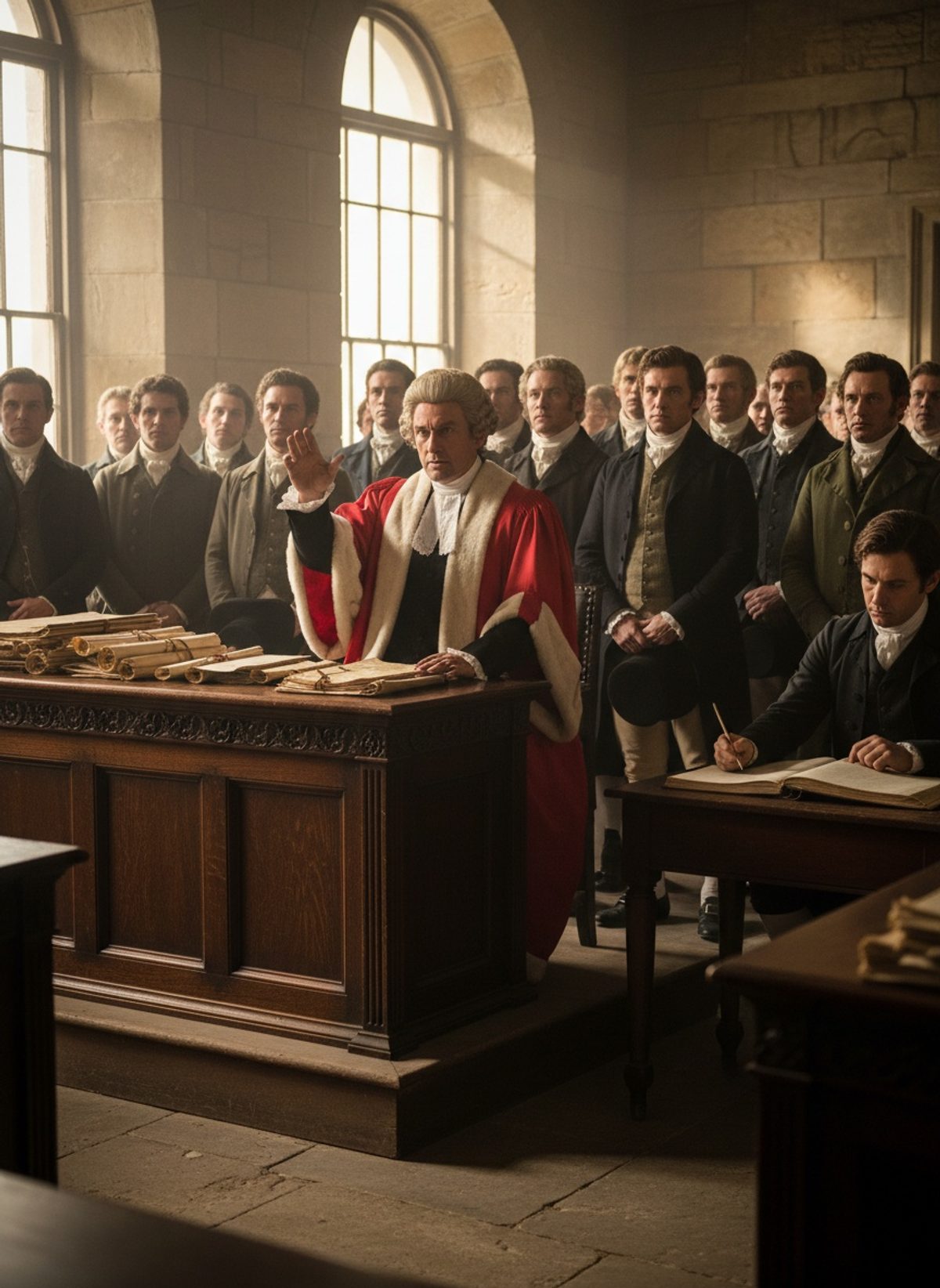
February 24, 1824. The sunlight spilled through the narrow windows of the Sydney courthouse, casting long shadows across the room's timber floorboards.
For thirty-six years, the legal system of New South Wales had been decidedly one-sided, with trials held before a single judge, lacking the cornerstone of British justice: the jury trial. However, on this particular day, Chief Justice Francis Forbes was about to change the course of colonial history.
At first glance, Forbes might have seemed an unlikely revolutionary. As the first Chief Justice of the Supreme Court of New South Wales, his initial responsibilities had seemed clear-cut: uphold the unwieldy dictates of English law and maintain order in a burgeoning penal colony. Yet, beneath his composed exterior lay a fervent belief in equitable justice—a belief that placed him on a collision course with the colonial apparatus he was sworn to serve.
The legal affairs in New South Wales had been, in many ways, dictated by expediency rather than fairness. The early settlers and the burgeoning free population of the colony had accepted a stark reality: convicts had no right to a jury of their peers. The authorities justified this system under astonishingly practical pretexts—the population of New South Wales was derived predominantly from criminal stock, and therefore, a fair and impartial jury was considered an unattainable luxury.
Read next: When Ludwig Guttmann Argued With the Gestapo, 1938
Nevertheless, as the colonial society grew, so did its insistence on the rights that were considered inviolable in the homeland. By the early 1820s, settler unrest was beginning to surface, echoed in the taverns and marketplaces of Sydney. Free settlers and emancipated convicts alike began to voice discontent, questioning why they should be denied the fundamental tenets of English justice. It was amid this growing murmur of discontent that Francis Forbes began his tenure.
Forbes brought with him a wealth of experience from the colonies of Bermuda and Newfoundland, where he had earned a reputation for steadfast integrity. Upon reviewing the judicial system of New South Wales, he was appalled by the stark absence of juries. Embarking on a campaign for reform, Forbes argued vehemently for the introduction of trial by jury as an inalienable right of the colonial subjects. It was not just legal reform he was advocating; it was a plea for human dignity.
It was a bold stand. Francis Forbes was not merely advocating for a change in the courtroom proceedings but was championing a broader shift towards democratic ideals—a radical concept in a penal outpost underpinned by autocratic rule. With an eloquence that left even his detractors grudgingly impressed, Forbes lobbied both local authorities and officials back in London, highlighting how such reforms would serve to stabilize and legitimize colonial governance.
The British Empire, though known for its rigidity, was not immune to reasoned persuasion. As Forbes laid out his argument, he posited that a jury system would not only reflect enlightened governance but also serve practical ends. Empowering colonists by extending rights akin to those in England could act as a safety valve, dissipating growing frustrations before they reached a boiling point.
The debates were far from one-sided. Critics countered Forbes' position with fervent opposition, asserting that the logistical and philosophical hurdles would outweigh any potential benefits. Questions were raised regarding the competence and impartiality of potential jurors drawn from the region's convicts and settlers. Nonetheless, Forbes remained steadfast, buoyed by the conviction that moral imperatives could catalyze political and legal transformation.
After relentless lobbying and negotiation, an unprecedented resolution emerged. Against considerable odds, and to the astonishment of Sydney’s inhabitants, the British authorities acquiesced, recognizing the potential for harmony that a jury system could offer. Thus, on February 24, 1824, New South Wales gifted its residents the opportunity to begin a new chapter in colonial jurisprudence—the first jury trial was held on Australian soil.
Observers at the time might not have realized the magnitude of the moment, yet history would come to regard it as a profound leap toward equality and justice. The courthouse, serving both as a backdrop and as an agent of change, stood as both witness and participant in this transformation. It echoed with the promise that justice, akin to the sunlight that warmed its floors, would now shine brighter for all her inhabitants.
This shift toward a more just legal system was no seamless transition. There would be fits and starts, trials and errors, yet the introduction of jury trials planted the seeds of societal restructuring. Future generations would look upon this as the dawn of a new era, one where the underlying belief in democracy, fairness, and equality found solid footing in a land replete with historical ironies.
The courthouse still stands today, a stalwart guardian of memory, and a testament to the enduring nature of justice. It serves as a tangible link to the transformational vision of Francis Forbes and the indomitable spirit of those who dared to demand their rights.
As such, the legacy imparted by this struggle is much more than a chapter in legal history; it's a continued reminder of the power of unwavering conviction in the face of daunting odds. The story of New South Wales' first jury trial underscores the importance of challenging the status quo and fighting for reform. It is a timeless narrative—a continuing affirmation of the dignity that justice pledges to uphold, resonating far beyond the confines of a courtroom, altering the trajectory of an entire nation's ethos. Francis Forbes' resolve kindled a flame that would illuminate Australian jurisprudence long after the colonial dawn gave way to the Australian identity. And that is a legend they left out of the textbooks.