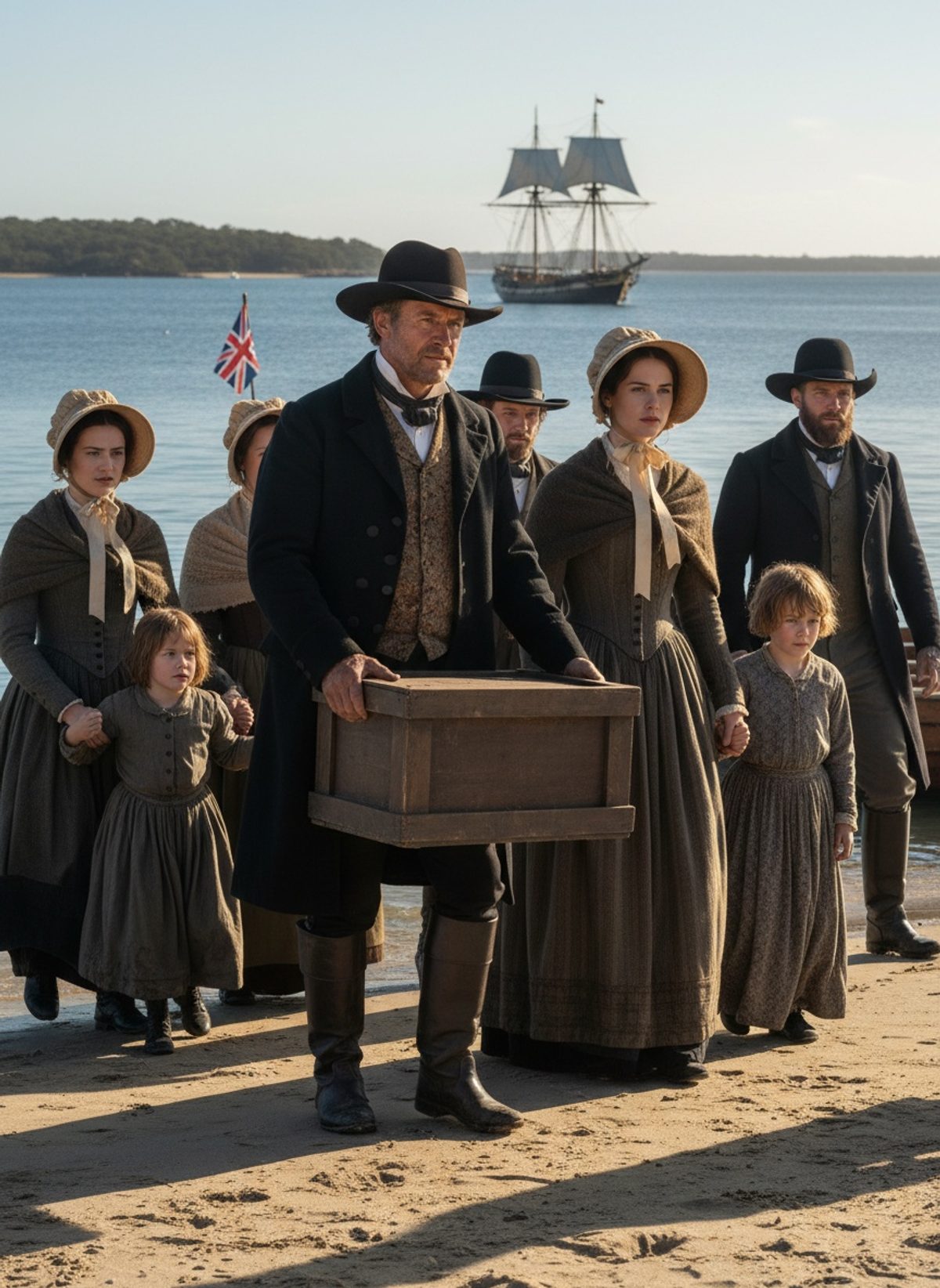
The surf lapped against their boots as they waded ashore, the salty air mingling with the scent of damp earth and fresh opportunity. Here, at Holdfast Bay in 1836, these pioneers gazed upon the rugged coastline, each soul driven by a singular vision—a colony built not on the groans of convicts but on the hopes of free men and women. The sunlight danced on the water's surface, much like the spark of change that Edward Gibbon Wakefield had kindled in their hearts. This was South Australia, a testament to there being another way to forge a colony.
Edward Gibbon Wakefield was a man who dared to dream beyond the grim shackles of penal settlements that dotted the Australian continent. His radical idea was simple yet powerful: instead of a society founded on punishment, why not construct one composed of willing settlers, each contributing to and profiting from the fruits of their labor? Wakefield's vision found fertile soil in those yearning for a fresh start, and soon a plan was conceived—a colony without chains, a settlement where freedom and self-worth were the currency of choice.
As they stepped onto the beach, the first settlers of South Australia's history were greeted not by lash-wielding overseers but by the untamed frontier itself. The dusty beaches and scrubland stretched infinitely before them, a canvas of possibilities and challenges. In contrast to the other colonies that had grown from convict blood and sweat, these settlers were not shackled by past crimes but rather bonded by a common goal: to create a society of equals, untainted by the stigma of convict origins.
The first months were a whirlwind of activity, the settlers' hands busy constructing rough shelters and working tirelessly to cultivate the recalcitrant land. Families labored together, turning soil and raising walls, and bonds stronger than steel were forged in the shared tribulations. The nucleus of what would become Adelaide took root, the city's streets whispered into being by the fervent ambition of its builders. In this sprawling and sunburnt land, polished elegance and cultivated civility seemed a distant promise, yet the spirit of enterprise was indomitable.
Read next: When John Macarthur's Wife Saved a Colony's Wool Clip, 1804
As the settlement grew, it attracted a motley drawn by the promise of land and liberty. Merchants, craftsmen, and laborers arrived in pursuit of prosperity and independence, each eager to engrave their mark on this burgeoning tapestry. Unique among the Australian colonies, South Australia stood as a beacon of progressive ideals, a shining rebuke to the traditional systems of forced servitude and subjugation.
In those first daring days, challenges loomed as large as opportunities. The absence of convict labor meant that every task, every acre cleared or fence erected, required the toil of free hands. There were failures and missteps as the settlers grappled with the harsh realities of their new environment. The climate was unforgiving, the desert stubborn in its unwillingness to yield, and yet the colonists persevered, driven by the vision Wakefield had planted in their minds.
Wakefield's principles of systematic colonization demanded careful selection and distribution of emigrants—people suited to the colony's needs and left behind those who would not adapt or contribute. The notion of selling land at a regulated price rather than giving it away ensured the funds were reinvested into improving the colony, rather than leading to chaotic sprawl and speculation. Here was no room for idle nobility, for the success of the venture relied on economic practicality and the diligence of its people.
While other colonies built upon the back of prisoners were entangled in class struggles and legal inequalities, South Australia prided itself on equality and opportunity. Education and religion played a foundational role; schools and churches sprouted up as naturally as orchards and fields. The settlers’ legacy was not just carved in infrastructure but cultivated through intellect and conscience. Even their courts of law eschewed the brutality common elsewhere, preferring a judiciary that embraced reform and rehabilitation rather than retributive justice.
The colony's early conduct showed how shared ideals could foster unity. Debates and discussions thrummed over coiled pints at public houses as settlers plotted the best path forward. Amidst these conversations, the practical challenges of life in South Australia were met with ingenuity and teamwork. The challenges faced were myriad, but what arose from the dust was a community resilient in spirit and diverse in origin yet unified by a common creed that the sins of the past should not bind the chains of the future.
South Australia's origins stand as a bold counter-narrative to the prevailing winds of punitive colonization. It exemplifies how a society might be constructed anew with the bricks of liberty and the mortar of equality. This bold experiment did not merely survive—it thrived. The early settlers' tale is one of scant resources but rich conviction, showing that empire need not be built upon the bones of the subjugated, but could instead rise from the hopes of the aspirant.
As we reflect on these audacious pioneers, their legacy echoes through the ages, resonating with anyone who dares to imagine a world molded by choice rather than chance. It is a reminder that even within mighty empires, alternative visions can spark profound transformation—alighted not with the flames of oppression, but with the warm glow of shared purpose and enduring freedom.