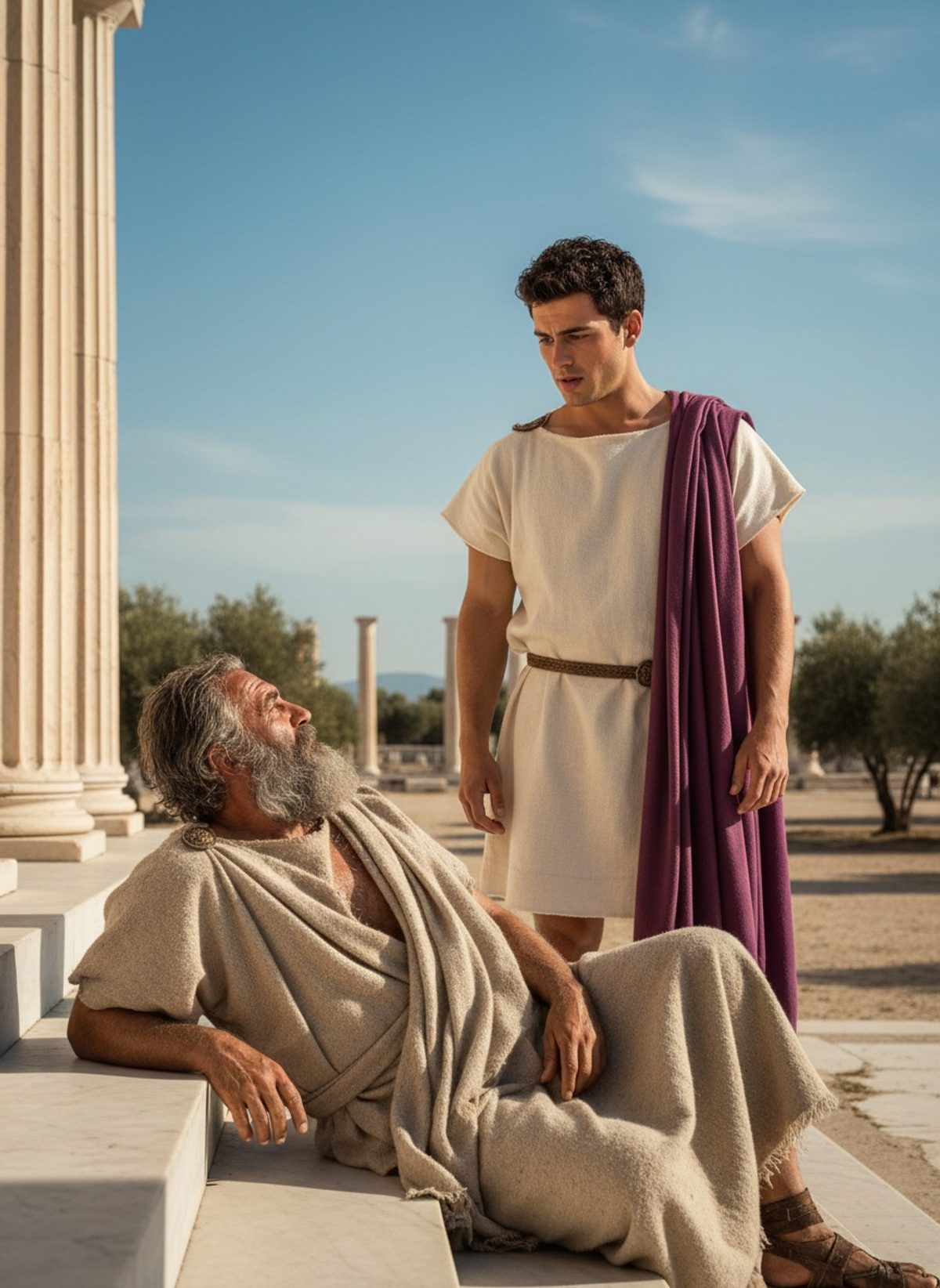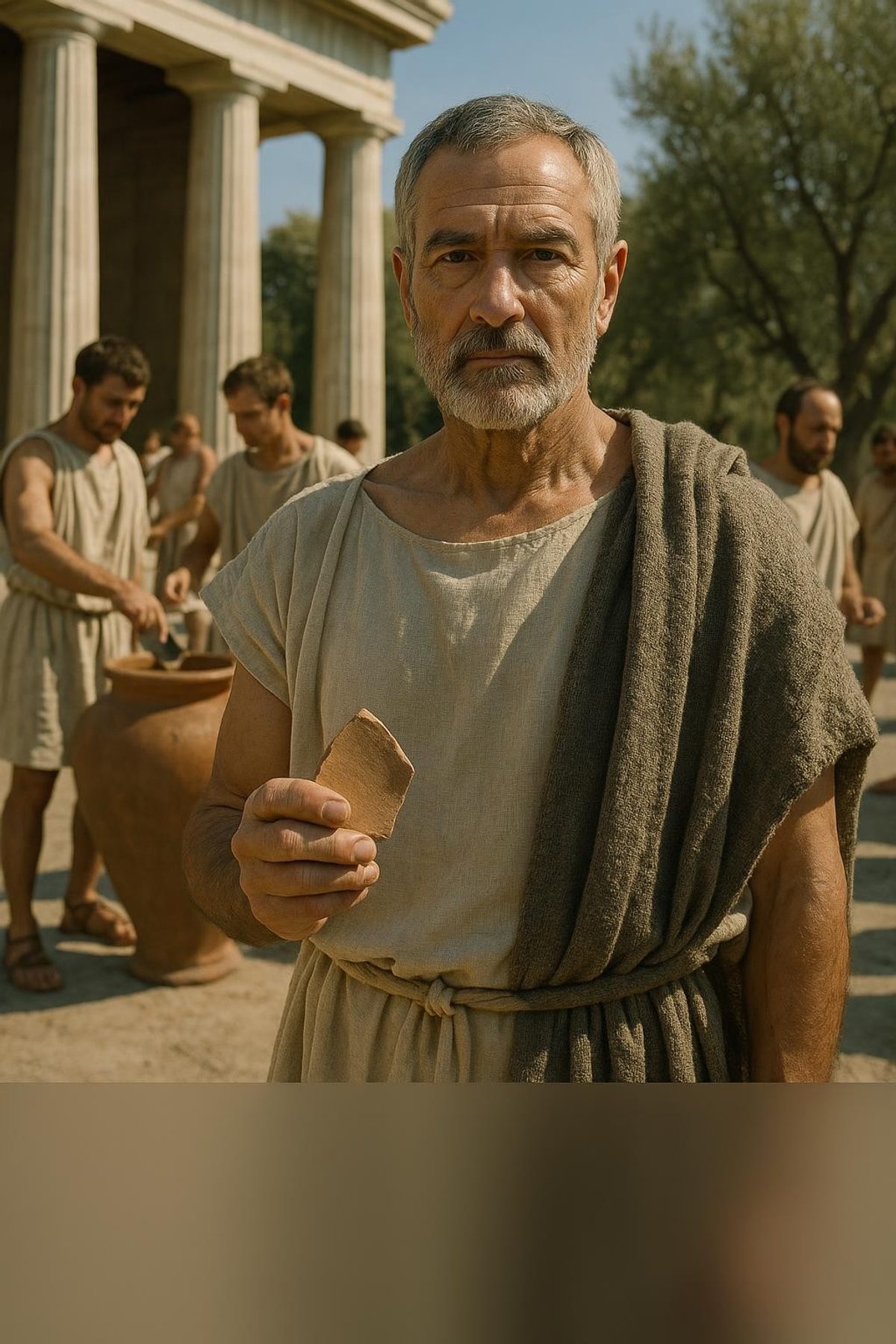
He voted for his own exile. Aristides, known as "the Just" throughout Athens, wrote his own name on a shard and walked away from the city he had served so faithfully.
The Rise of Aristides: The Man Known As "The Just"
Athens during the Classical Period was a city-state teetering on the edge of greatness. Its streets, lined with temples and budding marketplaces, were a backdrop for the emergence of a man who would become one of its most honorable citizens—Aristides. Born around 530 BC, Aristides belonged to a moderate Athenian family, yet his talents propelled him to the echelons of power in a burgeoning democratic society. He was a disciple of Cleisthenes, the architect of Athenian democracy, and it was during the Battle of Marathon in 490 BC that Aristides first carved his name into the annals of history. As a fierce strategist of the Antiochis tribe, he played a key role in repelling the mighty Persian forces and was consequently elected archon eponymos in the aftermath.
His ascent, however, was never without friction. Foremost among his rivals was Themistocles, the statesman advocating for Athens to strengthen its naval prowess. Their enmity was fueled not only by political divergences but also by youthful rivalry for the affection of a beautiful boy named Stesilaus. Yet, amid political skirmishes and personal contests, Aristides maintained an unwavering integrity that earned him his "Just" moniker. A stark and respected contrast to the oft-political machinations and manipulations of others, his very surname was a badge of honor that eventually provoked subtle resentment among his compatriots.
Despite his virtues and veneration by figures like Herodotus, tensions simmered beneath the surface. The common people grew weary of hearing him glorified for his unyielding fairness and honesty. In an ever-expanding city-state, where Athens began defining its role as a major power through innovation and assertion, was there still room for a man bound by overarching principle? Aristides, by the early fifth century BC, became the embodiment of a conflict between traditionalism and a rapidly modernizing Athens.
Read next: Damon Walked Into the Cell. Pythias Walked Free.
A Shard and an Exile: The Ostracism of Aristides
In the bustling agora, the heart of Athenian democracy, drama unfolded on a fateful day around 482 BC. A crowd convened, each citizen holding a small piece of pottery known as an ostrakon. On those shards would be inscribed the names of individuals whom the populace believed should be banished for ten years, in an effort to protect the polis from potential tyrants or destabilizing influences. Today, the name on everyone’s lips was Aristides.
As the process unfolded, a peculiar incident occurred that has since become the stuff of historical legend. An illiterate citizen approached Aristides himself, not knowing who he was, and asked him to inscribe a name on his pottery shard—the name of Aristides. With serene composure, the famed statesman requested why the stranger sought his ostracism. The simple reply was stunning in its candidness: "It irritates me to hear him everywhere called 'the Just'." Aristides, without protest, wrote his own name, reflecting an acceptance that transcended personal ambition or grievance.
For a city pressing toward progress, Aristides' steadfast traditionalism had become a discomforting mirror, reminding citizens of a world advancing faster than some voices would allow. His compliance with the vote was a declaration of faith in the democratic process, a testament to his character. Through this singular act, he ironically fortified his reputation as the "Just", accepting the verdict with the gravitas history has immortalized. Even rival Themistocles, who had played a hand in the machinations leading to his exile, hardly found vindication in this moment. For Aristides, stepping out of Athens at that time was as much about upholding the collective democratic decision as it was a personal journey toward temporary obscurity.
The Return and Redemption: A Warrior's Final Victory
Destiny, however, had not finished weaving the threads of Aristides' story. As the echoes of his footsteps faded beyond Athens’ walls, global tides began to shift. The Persian Empire, undeterred and relentless, returned to Greece’s shores with vengeance and ferocity in 480 BC. Facing existential peril, Athens decreed the recall of exiles. Aristides returned, his past grievances overshadowed by a call to defend all he cherished. He was immediately reinstated as strategos and became a vital force in the struggle to safeguard Greek autonomy.
In September of that year, Aristides, though operating under Themistocles’ command, proved pivotal at the Battle of Salamis, where he landed troops on the island of Psyttaleia, obliterating the Persian garrison. His commitment remained steadfast through the subsequent Battle of Plataea in 479 BC, acting with valor and strategic acumen. The victory fortified Aristides' status, not as a man ousted from his people, but as an indelible figure within the fabric of Athens' noble triumph.
As peace laid its cloak over Greece, Aristides held significant influence over the nascent Delian League. His equitable assessment of tributary obligations to the league exemplified his dedication to fairness, and his judgments would serve Athens well beyond his death in 468 BC. Some accounts say he died on a journey to the Black Sea, others within the confines of an Athens finally at peace, yet the true location of his passing remains elusive.
Aristides’ tale is a poignant reflection on the dichotomies of public life and personal integrity. His experience transcends time, challenging today's world to question the costs and rewards of principled living. In a global stage often defined by transient triumph and celebrity, Aristides remains an exemplar of what it means to prioritize collective good over personal ambition. His life prompts us to explore not just the politics and wars of history but the very essence of justice and what it means to live with purpose—a narrative to remember when decision and integrity intersect with the public's ever-volatile gaze.