323 BCE. The air in Babylon was thick and unmoving.
The Shadow of a Giant
As the light refracted through the palace walls where Alexander the Great lay dead, a cold realization settled over his generals — the world had changed irrevocably in an instant. The sudden absence of the man who had commanded armies and conquered empires left a vacuum so immense that it threatened to swallow his finely built legacy whole. In the midst of this seismic upheaval stood one man, Cassander, who eyed the potential spoils of Alexander's fallen empire with more than just ambition. Cassander saw in Alexander's emptiness both opportunity and an existential dread that would haunt him, a fear amplified by the ghostly echoes of the man he sought to defeat even in death.
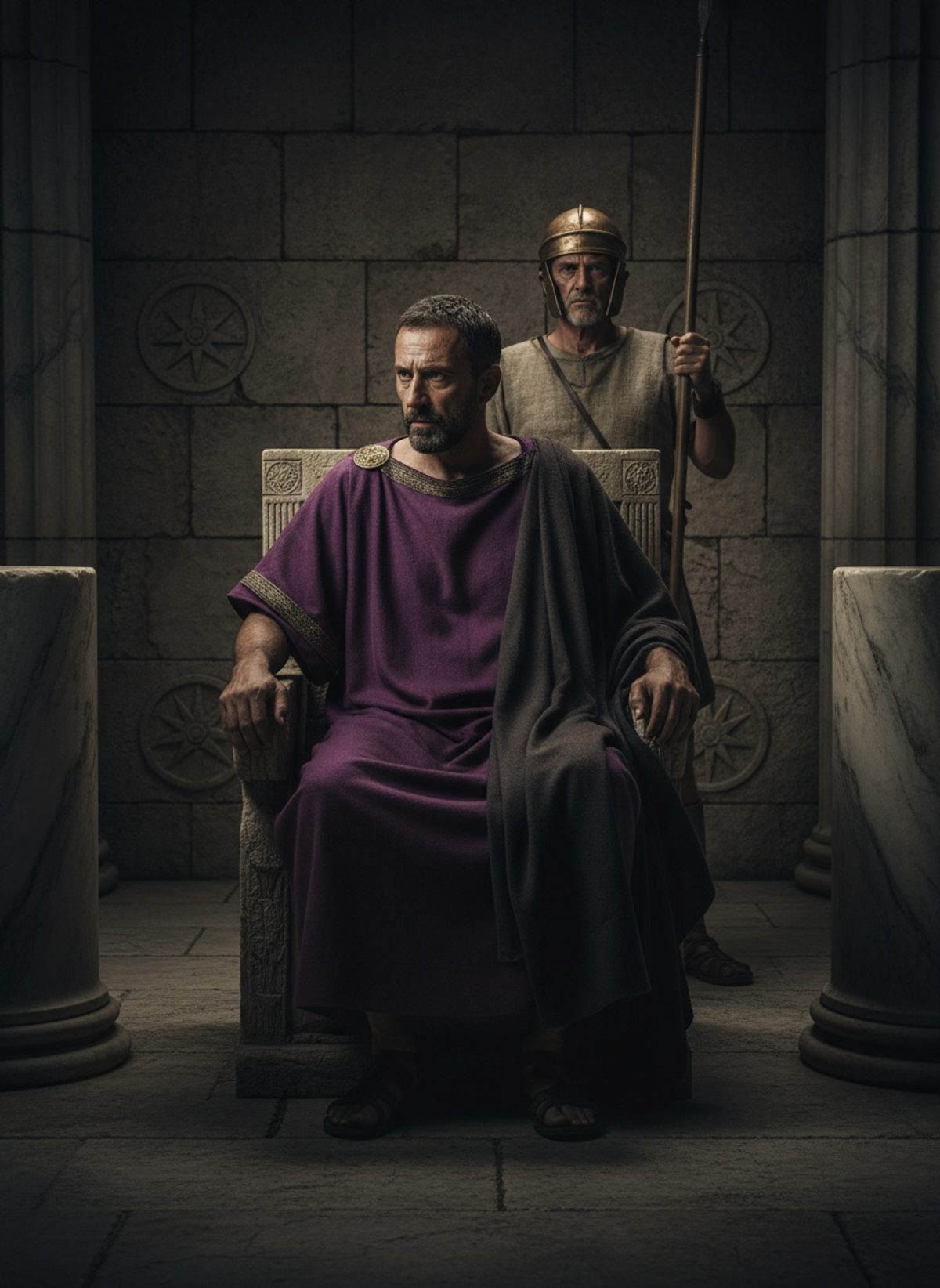
Cassander, who would become King of Macedonia, was more than a rival of Alexander — he was born under the weight of his ruler's shadow. Observing the commander from a young age, Cassander was the son of Antipater, a trusted officer in Alexander's father, King Philip II’s circle, destined for a role in the imperial hierarchy. Yet, upon encountering Alexander, Cassander witnessed a figure of almost mythical greatness whose image would leave a deep mark on his psyche. For Cassander, Alexander was not just a usurper to the seat of power he coveted, but a figure who embodied what Cassander could never be. It was a fear that turned to resentment, then to loathing, and ultimately, to a legacy etched in blood.
A Ruthless Campaign
To understand the lengths to which Cassander would go in his campaign to erase Alexander's memory, one must descend into the bloody corridors of Macedonian power struggles. Haunted by Alexander's triumphant ghost, Cassander methodically sought to erase his bloodline from existence, an operation as ruthless as it was thorough. First, he targeted Olympias, Alexander's influential and formidable mother, who had supported various factions at odds with Cassander's aspirations. Her execution was not merely a political maneuver but a cold calculation in Cassander’s effort to dismantle the keystones of Alexander's dynasty.
Read next: Phormio Had Forty Ships. They Had Two Hundred.
Undeterred and increasingly emboldened, Cassander's purge continued with the brutal assassination of Roxana, Alexander’s widow, and her young son, Alexander IV. These killings served as a chilling testament to Cassander’s desire to annihilate the future prospects of Alexander’s line, erasing any remnants of his imperial lineage from the annals of history. The callousness required to execute a child was not lost on contemporaries; it spoke volumes about Cassander’s determination to bury Alexander’s legacy in unmarked graves. Yet, despite these acts, whispers of Alexander's name refused to die down, haunting Cassander in the halls of power just as resonant as during the quivering nights when darkness swallowed the land.
A Haunting Legacy
Even with Alexander and his kin reduced to stories told by the hearth, Cassander remained haunted by the image and ideals of a man whose empire, though splintered, could never truly be divided. Stories circulated that Cassander would physically tremble at the mention of Alexander, a testimony to the grip his memory held over those he'd left behind. Cassander's own reign was marked by constant paranoia, his every move shadowed by the looming titan of history he could never escape. The people of Macedonia spoke in hushed tones about the spectral presence that seemed to guard Alexander's memory from beyond the grave.
Cassander’s actions may have erased the physical embodiments of Alexander's line, but they also ensured his own legacy would forever be intertwined with the man he had hoped to forget. Historical accounts largely remember Cassander not for any great achievements but for his systematic destruction of a legacy that seemed more potent in absence than in life. This irony of boundless ambition underscored by an unshakable fear speaks to the enduring influence of Alexander's larger-than-life persona. The relentless whisper of greatness echoed through Cassander's conscience, reminding us that power constructed on the foundation of fear is always fleeting.
Today, the saga of Cassander's obsession with undoing Alexander serves as a cautionary tale about the futility of erasing history’s indisputable giants. In the end, Cassander’s maneuvers to extinguish Alexander's legacy only fanned its flames, leaving an indelible mark on a world that never forgot the young conqueror. The narrative of Cassander, ever haunted by the ghost he could never outrun, thus remains a poignant reminder of the inescapable power of memory and legacy.