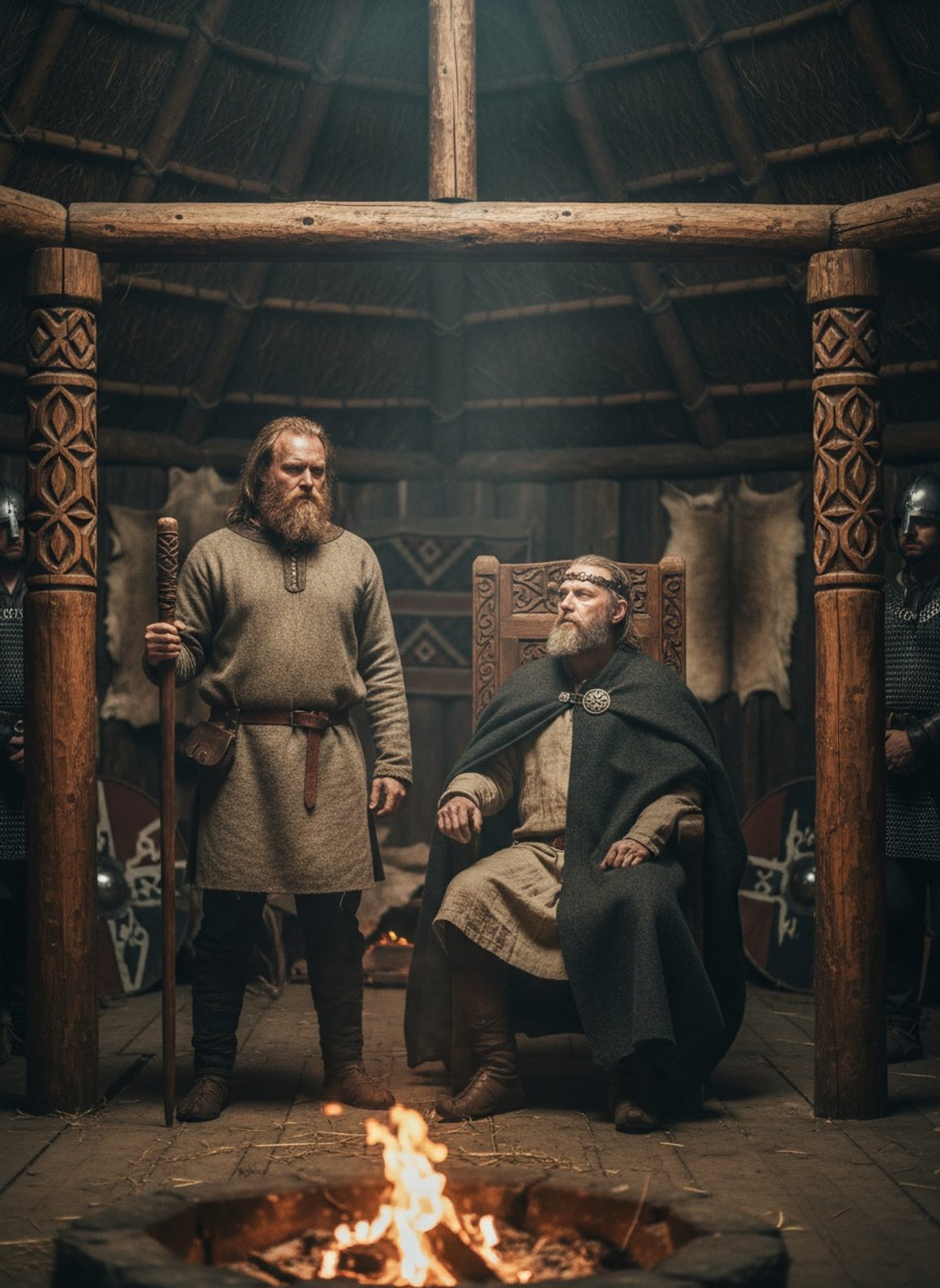
The crisp Norwegian wind swept across the fjords, carrying with it the echoes of ancient tales woven by the skalds of old. Darkened clouds rolled ominously across the sky, threatening rain but casting a dramatic backdrop over the royal court of King Óláfr Tryggvason. Inside the timbered hall, the warmth of the hearth crackled, but there was a chill in the air far colder than the northern winds. Hallfred the Troublesome Skald, renowned for both his wit and stubbornness, stood at the center of a tense confrontation that had the potential to reshape destinies.
When Pagan Songs Clashed with Christian Converts
Norway, around the year 1000, was a land in the throes of transformation. Under King Óláfr Tryggvason's determined reign, the old ways were giving way to the new faith of Christianity, not through gentle persuasion, but through the sharp edge of conversion by force. Amidst this tumultuous era of change stood Hallfred, a skald whose heart still beat with the rhythms of Norse myths and legends. Hallfred's poetry, celebrated for its evocative depictions of the old gods, was a vivid reminder of a world now under siege. Yet, neither time nor tide could make Hallfred abandon his muse, even when faced with a command from the king himself.
A Courtroom Gamble and a Poet’s Pledge
The hall echoed with anticipation as Hallfred prepared to do the unthinkable: defy the king's explicit orders. Óláfr, a fervent Christian convert, demanded Hallfred abandon these pagan odes and embrace narratives solely rooted in the Christian faith. But for Hallfred, silencing his voice was akin to losing his very identity. He strode forward, each step echoing in the silent hall, until he stood before the throne. The room was breathless as Hallfred recited every verse, each word hanging in the air like the crystalline moments before a storm. This was not just an assertion of individual will—it was an act of cultural resistance.
The Skald’s Dance with Danger
With each word, Hallfred seemed to chant a centuries-old defiance against the encroaching new order. His speech was a torrent of thunder amidst the reverent silence of the others gathered in the court. “Who could dare to laugh at the old gods?” his verses seemed to challenge. This was a brazen act, one that danced perilously close to the edge of rebellion in the eyes of King Óláfr. Yet Hallfred’s sincerity, his passion for his art, and perhaps an underlying admiration, stayed the king’s hand when others might have sought retribution with alacrity.
The King’s Laughter and the Poet’s Freedom
Then, a moment of tension broke. King Óláfr, leaning forward with the interest of a hunter watching prey, allowed a chuckle to escape his lips. The laughter, rich and rolling, filled the hall with an unexpected warmth. Against all odds, Hallfred had managed to turn his defiance into something that amused rather than angered. Perhaps it was the king's recognition of Hallfred’s authenticity or the enduring power of the skald’s art that flickered as a reminder of what had once been. Regardless, Óláfr chose to keep Hallfred by his side, an acknowledgement that the old ways, though not fully embraced, would not completely die out.
Echoes Through the Ages
In allowing Hallfred to walk out of that hall with his life and craft intact, King Óláfr made a decision that reverberated beyond those walls. The skald's verses, though rooted in a fading mythos, spoke to an undercurrent within the human experience—the struggle between change and tradition, faith and heritage. Hallfred’s story becomes not only a tale of courage and conviction but a lens through which we can view our own expressions of belief and identity. In the timeless struggle to preserve what we deem sacred, Hallfred and Óláfr’s saga serves as a reminder that the human spirit, infused with creativity, is resilient and defiant, and sometimes, the unlikely laughter in the face of authority can be the most potent victory of all.