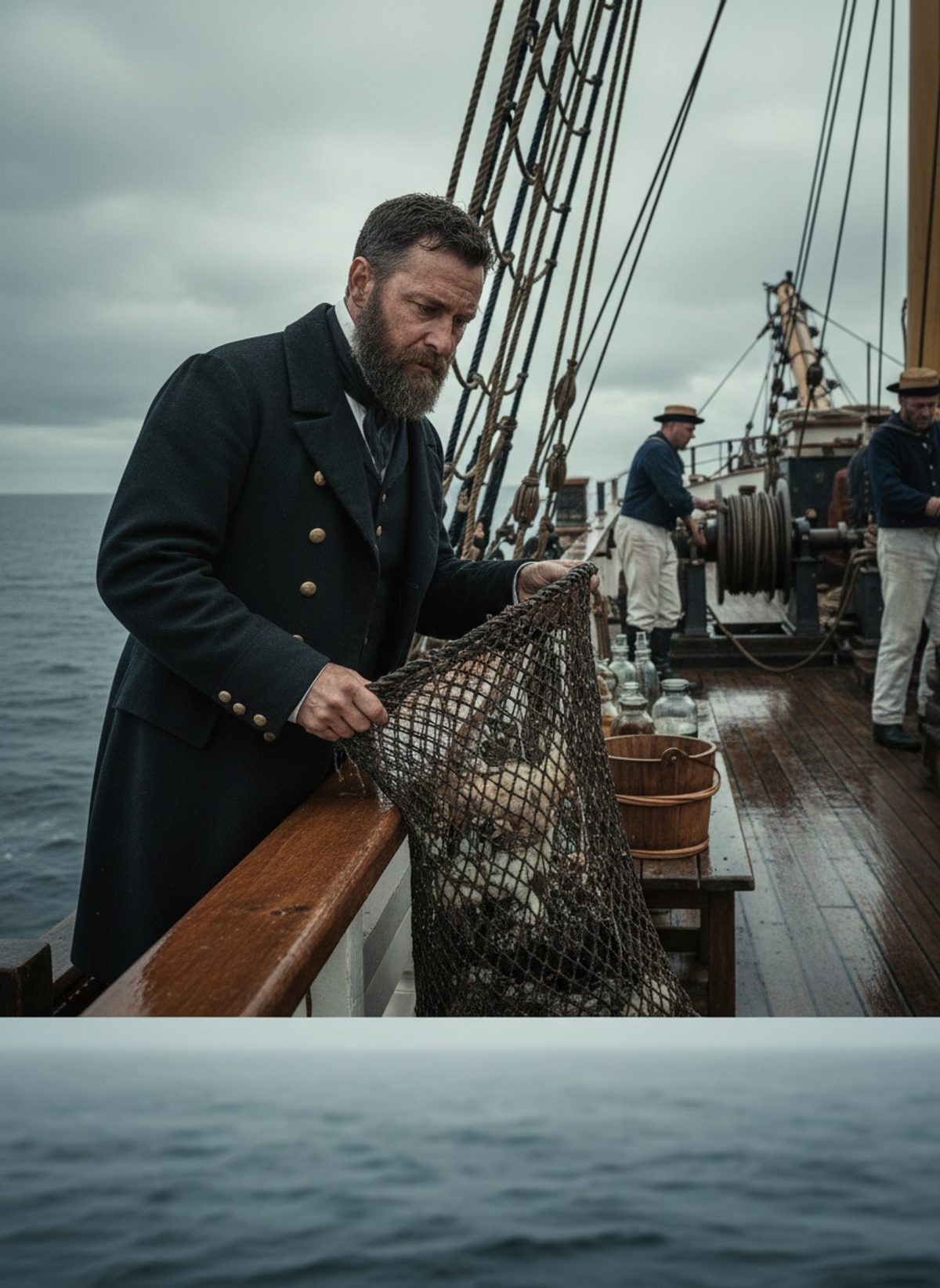
Sailing on a crisp morning in 1872, the HMS Challenger cleared the port of Portsmouth and ventured into the open ocean. The air was brisk, tinged with the scent of salt and possibility. As the ship moved steadily into the endless blue, the dawn was a golden streak across the horizon, painting the crests of waves with shimmering light. Below this serene surface, an unseen world thrived in darkness—a world that John Murray, brought forth by the Victorian spirit of exploration, sought to uncover. This was more than just a voyage; it was the great 19th-century odyssey into the ocean's abyss, challenging the very limits of human understanding.
Into the Depths
The crew of the HMS Challenger faced an expanse of ocean larger than any they had dared to map. As the ship moved past familiar coastal landscapes into uncharted waters, they prepared for undertakings both ambitious and perilous. The mission: to catalog the mysteries hidden below, to measure the depths, and to drag nets through a realm where sunlight never penetrated. Spearheaded by the determined John Murray, the expedition was an unprecedented endeavor to explore the ocean floor, driven by curiosity and a relentless quest for knowledge.
Murray's methodologies, revolutionary yet ridiculed by much of the scientific community, involved an intricate dance with the ocean itself. Vast lengths of hemp rope were meticulously lowered into the water, each marked carefully for precise measurements. Nets and trawls lethargically swept the silt of the deep seabed, capturing living specimens that defied classification. The ship became a floating laboratory, with each collection yielding startling finds: creatures with bioluminescent bodies, bizarrely elongated limbs, and eyes adapted to perpetual darkness.
These findings flew in the face of contemporary belief, which held the deep sea as a barren desert, incapable of sustaining life. Yet, with every haul, Murray sketched a different story—charts and illustrations emerging from his well-traveled mind like a new chapter of a tale long untold. But these discoveries, laid bare before the world, were too fantastic to believe. Leading scientists dismissed them as exaggerations, too embedded in their own scholastic comforts to embrace what lay beyond the visible horizon. This journey into the abyss was one of wonder and skepticism, laying the groundwork for a modern marvel lost on a generation bound to their terrestrial certainties.
Read next: When Dunvegan's Flag Followed the MacLeods to War, 1799
Unseen, Unheard
The return of the HMS Challenger to British shores marked the end of a voyage not just through untraveled waters but against unyielding disbelief. John Murray's collection of charts and specimens, gathered so painstakingly over the years, now sat waiting to be scrutinized, shelved alongside the burgeoning clutter of Victorian curiosities. The scientific elite, optional of their own accolades and acclaim, often shunned Murray's findings. Charts depicting the topography of the ocean floor existed as mere novelties, ideas too radical for a world only just coming to terms with Darwin's revelations.
Despite this resistance, Murray continued his work with quiet resilience. He believed in the paper-bound seas he had drawn, his charts filled with peaks and troughs unseen by human eyes. These maps, more textural descriptions than mere lines and numbers, heralded a future understanding of oceanography—an art not yet appreciated but fully formed within his imagination. His detailed surveys pointed towards undersea mountains, canyons, and ridges that spoke of geological processes unseen but understood.
This resistance to his pioneering research mirrored a broader societal reluctance to grasp the invisible complexities of the world. To the Victorian establishment, confident in their colonial certainties and scientific hierarchies, Murray's findings were as distant and peculiar as the stars. Yet buried within his compendium were insights that, decades later, would redefine academic thought and commercial exploitation of the oceans. The tapestry of the sea, with its intricate details woven by Murray, awaited its time in history—a silence biding its vindication in the annals of future discoveries.
The Ocean Remembers
As time drifted gently onwards into the new century, the overlooked genius of Murray's work began to emerge through the tides of changing thought. It was during these later years that his contributions were recognized as foundational to the field of oceanography, heralding a new era of marine exploration. His maps, once scientific curiosities, became vital resources for understanding the sea’s dynamic systems, crucial for navigational charts and even the budding industry of deep-sea telecommunication.
John Murray's legacy, although birthed in the shadows of skepticism, sprawled outwards like the very currents he once charted. It is a profound reminder that the world is a garden of subtle wonders, hidden beneath layers of ignorance as vast as the ocean itself. His story is emblematic of humanity's ceaseless quest for knowledge, even when that pursuit sails against the prevailing winds of convention.
The HMS Challenger's voyage remains a testament to exploration unbridled by doubt, a whisper through time that echoes the power of curiosity. As modern technologize enabled humans to envisage where Victorian eyes couldn't, they find themselves inextricably linked to a man who dared to document the void. In the grand narrative of discovery, Murray's work stands as an immutable landmark, guiding us through the unseen paths of knowledge he so courageously uncovered.