The sun rose lazily over the narrow pass of Thermopylae, its light slicing through morning mist that clung to the stones like a spectral embrace. The distant murmurs of the sea echoed against the cliffs, a gentle sound that belied the grim reality taking shape. Birds wheeled overhead, ignorant to the dance of fate unfolding below, where men readied themselves for a confrontation unlike any the world had seen.
Here, in this constricted landscape cradled by mountains and coastline, the might of the Persian Empire stood poised to crush a nascent Greek alliance. That vast, glittering force stretched beyond the horizon—a fire-breathing dragon intent on consuming the pride of Greece. Yet it was in this crucible of nature and war that King Leonidas of Sparta contemplated an audacious stand, for he had learned of a path that would wrap the Persians around him like a tidal wave. He knew defeat loomed, yet the choices he made on that day would etch his name into the annals of eternity.
A Narrow Path to Glory
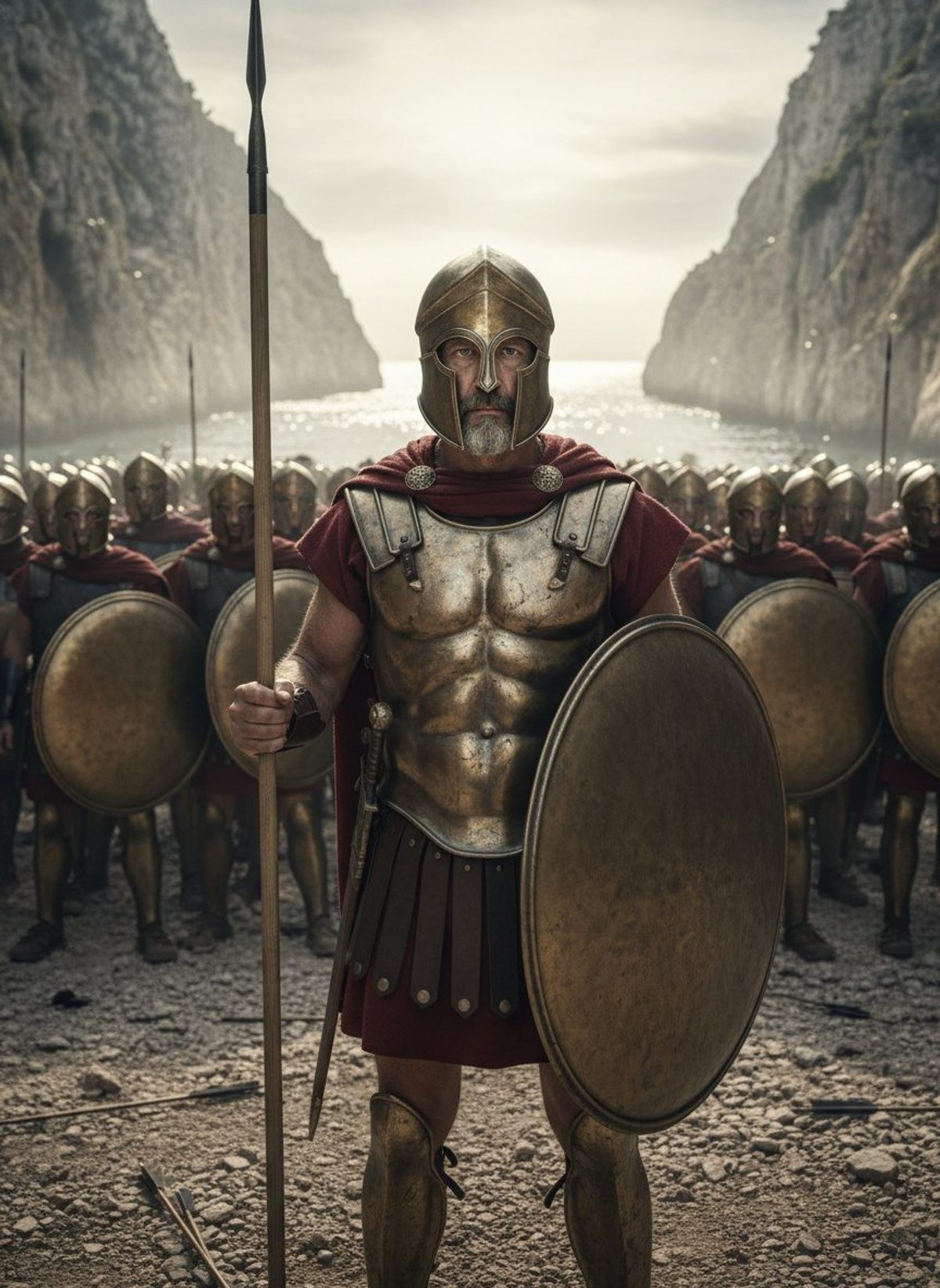
In the haze of dawn, the pass of Thermopylae was a rugged corridor between the mountains and the sea, a choke point that made numbers irrelevant. The harsh ground was littered with the scent of salt and stone, a place where only the daring would stake their claim. It was strategically chosen by the Greeks for this very reason—a spot where a small force could hold back the tides of a massive invader.
Led by King Xerxes, the Persian army was an unstoppable juggernaut, a coalition of nations brought under one command. They had already swept across Asia Minor, snuffing out resistance like candles in a storm. Vast in number, varied in skill, they moved like the shadow of an eclipse creeping inexorably across the land. Yet their ambitions were checked by a stern resolve facing them.
Read next: Damon Walked Into the Cell. Pythias Walked Free.
Leonidas, aware of a traitorous Greek leading the Persians along a hidden path to encircle him, called for a meeting. Should they flee and live to fight another day, or stand firm, swords drawn, to welcome the inevitable with courage? His decision would redefine valor for generations to come.
Honoring the Pact of Blood
The air was thick with tension as Leonidas turned to his men, both Spartan and allied, and delivered his fateful decision. Beneath the steel of his gaze, his warriors saw a depth of resolution that mirrored their own. He ordered the allied Greeks—many of them fathers, sons, and brothers—to retreat. They hesitated, torn between duty and survival, but Leonidas made it clear: this was a battle met not for victory, but for immortality.
To the 300 Spartans at his side, escape was never an option, their sacrifice predestined by duty to their city-state. For generations, Spartan youth had been hardened through rigorous training—a crucible of discipline that crafted warriors with the ferocity of lions. Their entire existence had led to this moment, where the fields of Thermopylae would become their last training ground, their final proving ground.
Such was the Spartan code, a bond stronger than steel, where the concept of phalanx was born—a tactic of cohesion and shield-wall unity. Their commitment to each other ran as deep as the Grecian soil beneath their sandals, and in this resolve, they found a reason transcending life itself.
The Battle Given and Taken
As Xerxes’ forces charged, the ground rumbled under the weight of advancing war machines. Forests of lances pointed skyward, and as swords clashed, the air filled with a symphonic cacophony of metal, cries, and fervent breaths. Amazingly, the Spartans held their enemies at bay, a resolute wall absorbing blow after blow, pressing back against waves as relentless as despair.
The Spartans fought with unimaginable valor, their eyes set on the task, minds engulfed in the rhythm of attack and defense. Spears danced and shields sang; this was heroic death personified—a living testament to resistance against insurmountable odds.
Yet even bravery finds its limits, and as the Persians seized the path around the mountain, Leonidas knew the final act had begun. With their heads held high and shields interlocked, these Greeks died in accordance with their lives—brave, unswerving, and resolute.
The Echoes Beyond Death
The last stand of Leonidas and his 300 Spartans resonates through time not just as a tale of valor, but as a moment of profound cultural defiance. Their sacrifice was more than military strategy; it was a poignant statement of autonomy, a declaration as powerful as a sword’s swing. Sparta itself was put on the map not merely in the context of military prowess but as a bearer of indomitable spirit.
Eulogized by poets and heralded by historians, the memory of Thermopylae stretched like a prideful banner across subsequent battles. Inspired by this audacity, Greek fighters found fortitude in their quest to repel the Persian advance. The etymology of Thermopylae—“the Hot Gates”—might have emphasized heat and burden, but it also symbolized sanctuary, a proof that freedom and honor burn brighter than any pyre kindled in conquest.
The Fires of Memory
Leonidas’ decision to stay and fight—it echoes in the corridors of history as a time-stained lesson, teaching that sometimes resistance gains its own victory simply by choosing to fight. His sacrifice became a beacon, rallying Greeks under the banner of Athenian democracy and Spartan might. It became a linchpin, changing the course of western civilization.
Standing at Thermopylae today, one can almost hear the whispers of forging alliances, hear the clang of conflict rising through the ages. As the modern world continues its battles with ideals of its own, the story of Leonidas and his 300 reminds us of the eternal human desire for freedom, a force that cannot be subdued by any number of armies. It teaches that even when choices seem narrow—when the waters rise and paths close—a firm belief and courage can inspire and illuminate, leading the way to future horizons.