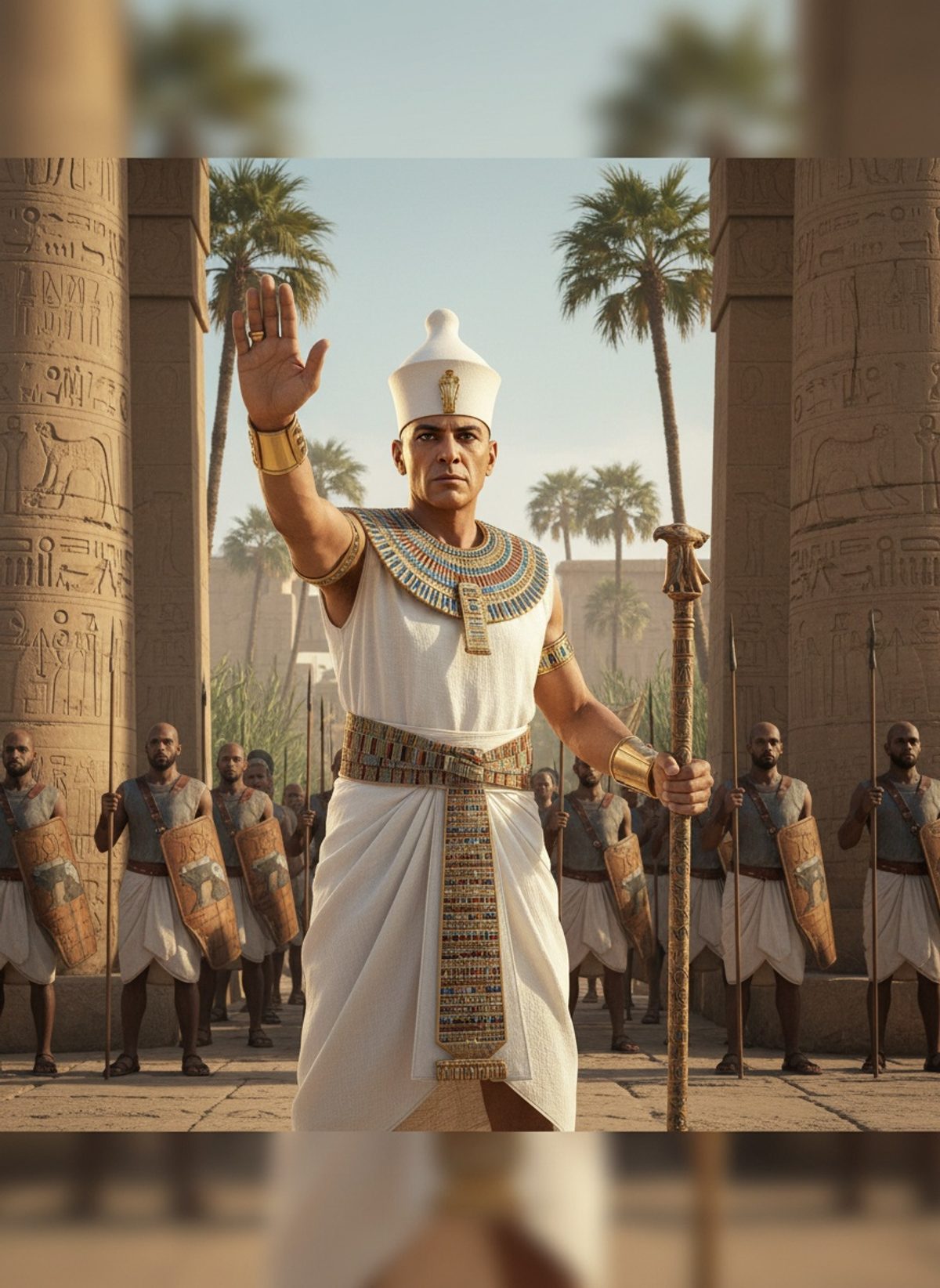
A hot desert wind swept over the sands of Thebes, its fierce blasts weaving through the narrow streets and alleys where life boiled under a relentless sun. It was here, amidst swirling sands and sun-baked mud bricks, that Pharaoh Mentuhotep II looked northward, toward a landscape fractured by a century of discord. Just beyond the horizon lay Lower Egypt, a land ruled from Herakleopolis, its valleys etched by a river that once held a kingdom united. That unity was now a fading memory, and the Nile’s flow through disjointed territories mirrored the tumult above its banks. The First Intermediate Period had seen eleven pharaohs claiming reign simultaneously — an era of neglected pyramids, forgotten rituals, and waning treasures. Yet within this chaos, a windswept silence spoke a promise, the assurance of change brought forth by a man resolved to become more than mortal.
The tale of Mentuhotep II, a pharaoh almost eclipsed by time, starts humbly in Upper Egypt, in the city of Thebes. Born to King Intef III and Queen Iah, his ascent was seen by many as inevitable but destined for the same fate of endless strife. The 11th Dynasty’s lineage carried the burden of uniting the splintered kingdoms of Egypt, a task daunting not just in scope, but in the impossible stretch across the harsh desert and through the rival seats of power. While coiled up high in the cliffs of Thebes, people witnessed his armies amassing strength, Mentuhotep II knew the path before him was treacherous, lined with bones of ambitious predecessors. Yet, that same path was lit by opportunity — a chance to turn discord into empire.
Fourteen years after he took the throne around 2055 BCE, the desecration of the sacred necropolis of Abydos in Upper Egypt by the Herakleopolitan kings sparked a fervor in Mentuhotep II, igniting what would become a decisive military campaign. He sent his armies northward, journeying under a sun that watched over them like a ceaseless sentinel. Each step carried the weight of unclaimed power, the march methodical, fueled more by faith than mere conquest. City by city, the scattered fragments of Egypt's splendor fell under his banner, the flame of unity rekindled where remembrance flickered.
His conquests culminated before his 39th year of reign. By dawn's light, Mentuhotep II was no longer just a southern monarch; the pharaoh had become the undeniable ruler of a reunited Egypt, and in a gesture of power and proclamation, he adopted the title Sematawy, "He who unifies the two lands." Through this new identity, not only did he crystallize his legacy, he also formalized an era that would be defined as the dawn of the Middle Kingdom. This unification was no mere geopolitical rearrangement—it was the end of an era of isolation, the beginning of Egypt as a congruous, resplendent power.
Read next: Seneca Watched Nero Rise. He Chose the Garden.
Determined to undo the perils of decentralization that laid the Old Kingdom to waste, Mentuhotep II centralized the government. Once-autonomous nomarchs found their power curtailed, replaced by men of Thebes who shared unwavering loyalty, appointed to newly minted positions spread throughout the country. Mentuhotep transformed governors from isolated chieftains into pillars of a single state hierarchy, ensuring that the heartbeat of Thebes echoed as far as the delta. Under his stewardship, Egyptian governance took the shape of an integrated body, each segment working in harmony with the throne firmly at its helm.
Yet, Mentuhotep II's reign was defined as much by what he constructed as whom he conquered. Nestled within the Theban desert-scape of Deir el-Bahari, his mortuary temple emerged from the dust, a testament to innovation and tradition. It boasted architectural feats unseen until then, such as grand terraces and intricate covered walkways enveloping a central structure. Here, the pharaoh chose to align himself with the god Osiris, introducing his people to a divine connection that would echo through future dynasties. This temple, a sanctuary for his soul, was not just a resting place; it was a signal — a message to both his people and the heavens that Mentuhotep II was both mortal and divine.
The weight of power bore its scars on the pharaoh, depicted through art showing a man possibly affected by elephantiasis. Swollen legs or not, it did not deter him. His legacy was further cemented by succeeding generations, as evidenced by Queen Hatshepsut’s own temple, which drew unmistakable inspiration from Mentuhotep’s divine architecture. That his body of work influenced the structure of history speaks volumes of a legacy built as much on stone as on soil.
In time, Mentuhotep II found rest within his temple's confines, his tomb a sovereign’s sanctuary in death as much as his Theban regime had been in life. While the shift of centuries subtly eroded the hieroglyphs of his reign, echoes of his accomplishments reverberate still. Historians consider the reign of Mentuhotep II a profound turning point — a transition from erosion to eclipse, from multiple thrones to a solitary seat of power. Perhaps more potent than monuments or conquests, his legacy lays in the union of Egypt itself; an achievement that not only heralded the Middle Kingdom but set a high-water mark for the civilization as a whole.
Though his name may not sit as easily within the pantheon of Egypt’s more luminous gods or more famous pharaohs whose tales are wrapped in gold, his role—shaping a fractured land into a distinguished and stable kingdom—remains undeniably his own. What distinguishes Mentuhotep most are the lessons embedded in the legacy he left behind: to rally the strengths of a divided fabric, to heal what was torn, and to imagine greatness born from discord. As Egypt emerged transformed in Mentuhotep's wake, the unified torrent of the Nile intimately mirrored the unity of the lands. Such stories, carved in stone and sewn into the tapestry of time, remind us that sometimes being relegated to the quiet recesses of history does not diminish one’s divine impact.