Most people have never heard of Musonius Rufus. They should have.
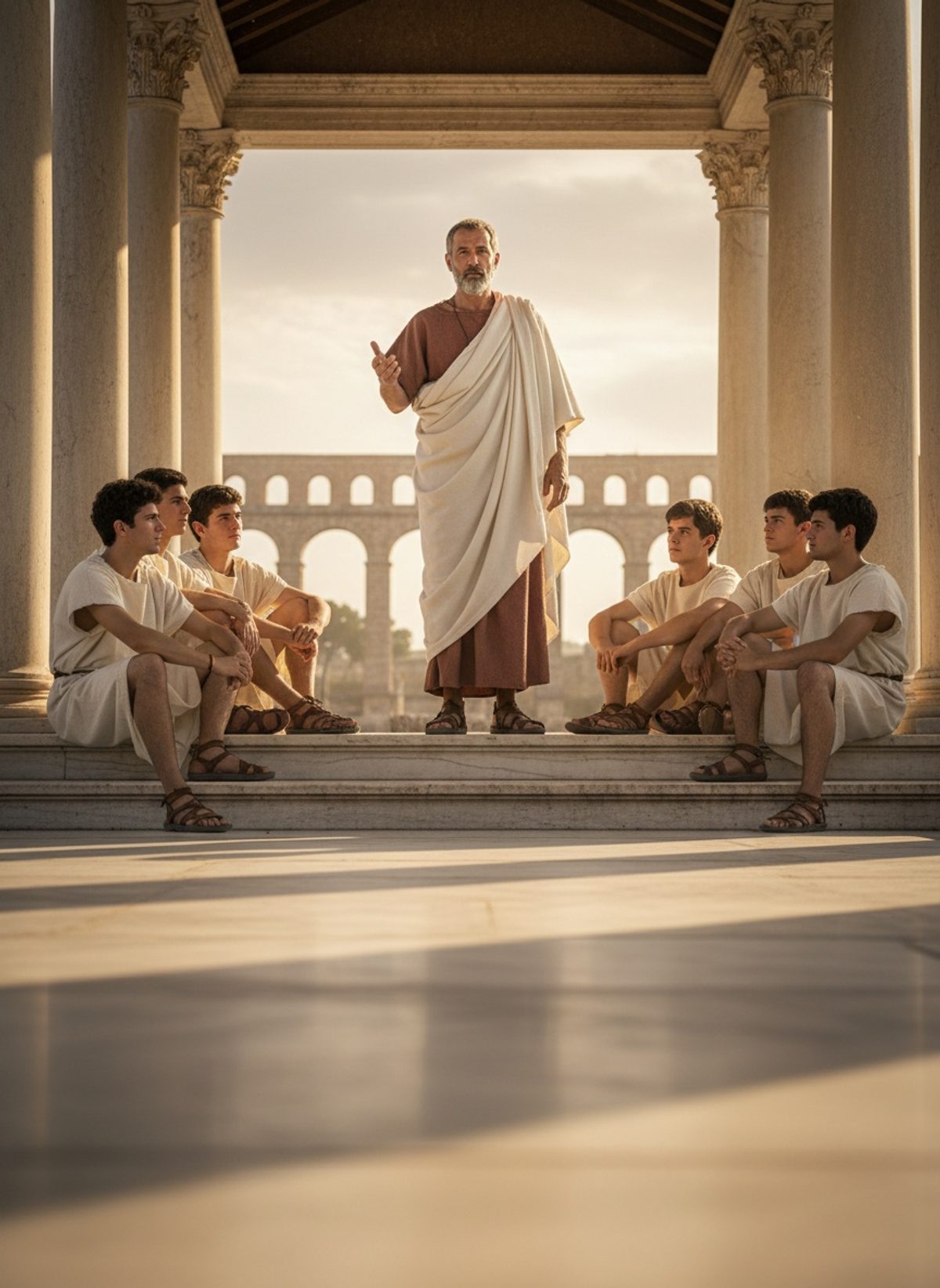
The city of Rome in AD 65 was a place teeming with whispers of betrayal and shadows of fear. Emperor Nero, the capricious ruler of the Roman Empire, was drowning in paranoia, hunting down anyone he perceived as an enemy. Even revered figures like the great philosopher Seneca had succumbed to his ferocious need to silence dissent. In this oppressive atmosphere, where even the Roman streets seemed to listen and report, a lone philosopher stood unwavering. Musonius Rufus, a Stoic philosopher known for his fortitude and moral audacity, defied the prevailing terror. Despite facing exile, imprisonment, and the constant threat of execution, he dared to teach and inspire. His classroom was not a mere building but a sanctuary of thought where even chains could not dim his resolve.
Musonius Rufus, often overshadowed by his contemporaries such as Seneca and Epictetus, was a man of remarkable courage and resilience. A native of the Roman province of Volsinii, Rufus was embraced by the stoic philosophy that championed virtue as the highest good. This philosophy wasn't merely theoretical for him; it was life put into practice. He held steadfast to the belief that life's true purpose was to cultivate virtue and wisdom, a notion he imparted to all who would listen. And listen they did. His students came from various walks of life, drawn to a magnetism that extended beyond words to the very core of living with integrity.
The turbulent political landscape during Nero's rule, however, complicated the lives of philosophers whose teachings encouraged introspection and moral inquiry. Nero, infamous for his extravagance and cruelty, found such introspection threatening. He perceived these philosophers not just as critics but as potential conspirators against his reign. Musonius Rufus, known for his outspoken nature, quickly found himself in the emperor's crosshairs. His crime was being an unwavering advocate for virtue in an age defined by corruption and decadence. His penalty was exile, a common punishment designed not just to remove dissenters from the heart of Rome but also to metaphorically cleanse the city of subversive ideas.
Read next: Sertorius Fed the Deer. The Soldiers Believed.
But exile was never the endgame for Rufus. The cycle of banishment and return defined much of his life. After every exile, Rufus returned undeterred, each reappearance marked by a stimulating continuation of his teachings. It was as though he bore a silent oath that transcended earthly decrees, continuously rallying his students to uphold truth over power. No fortress could contain his spirit, and no edict could mute his voice. His presence on the Roman scene, whether allowed or surreptitious, was a testament to his belief that philosophizing was more than just an intellectual exercise; it was a necessary societal palliative.
Rome itself, a city of grand architecture and sprawling forums, offered him an unconventional stage. Even within the confines of a prison cell, even when shunned to the outskirts of civilization, his thoughts and teachings found eager ears. His students risked their lives to seek him out, forming gatherings that became less about one man's words and more about embodying a philosophical defiance against despotic rule. Rufus taught of endurance and virtue, lessons Rome so desperately needed during Nero's increasingly tyrannical reign.
The philosopher's most daring act, perhaps, was his willingness to engage with Nero directly, to stand before the emperor when most sought to avoid his gaze. Rufus's discussions with the emperor were not merely acts of personal bravery but a symbolic gesture. They epitomized the perennial struggle between free thought and authoritarian rule—a struggle not confined to any single era, but one that resonates through history into the modern age. While many lost their lives to Nero's whim, Rufus's survival spoke volumes about the power of intellectual resilience. His conviction was an unyielding force, challenging not just Nero but the very nature of oppressive governance.
Musonius Rufus's story is an intricate tapestry woven into the narrative of Roman philosophical tradition. Though often eclipsed by legends of military conquests and political machinations, his contribution to Roman thought and, indeed, to the world of philosophy, remains significant. He underscored the potency of quiet defiance, teaching us that wisdom and virtue need not shout to be heard, but merely ceaselessly persist. His challenges to Nero weren't just personal triumphs but legacies of courage, reminding future generations of the capacity to resist tyranny with truth and intellect as their only armories.
In the annals of Roman history, Musonius Rufus is not merely a footnote. He is a voice echoing through the halls of time, advocating a stoic resilience that remains profoundly relevant. At a moment when silencing was the ruling order of day, Rufus's persistence illustrated that ideas, once birthed, are indomitable. That lesson, as applicable today as it was in first-century Rome, invites us to ponder the eternal dance between oppressive power and the undying spark of free thought. While much of his life might slip through the cracks of popular history, Musonius Rufus stands as a quiet giant whose life whispers a truth that deserves not just to be heard, but remembered. His story, long overshadowed, now invites us to listen more closely.