July 615 AD. The humidity hung thickly in the air as the ancient city-state of Palenque awaited the crowning of its new ruler.
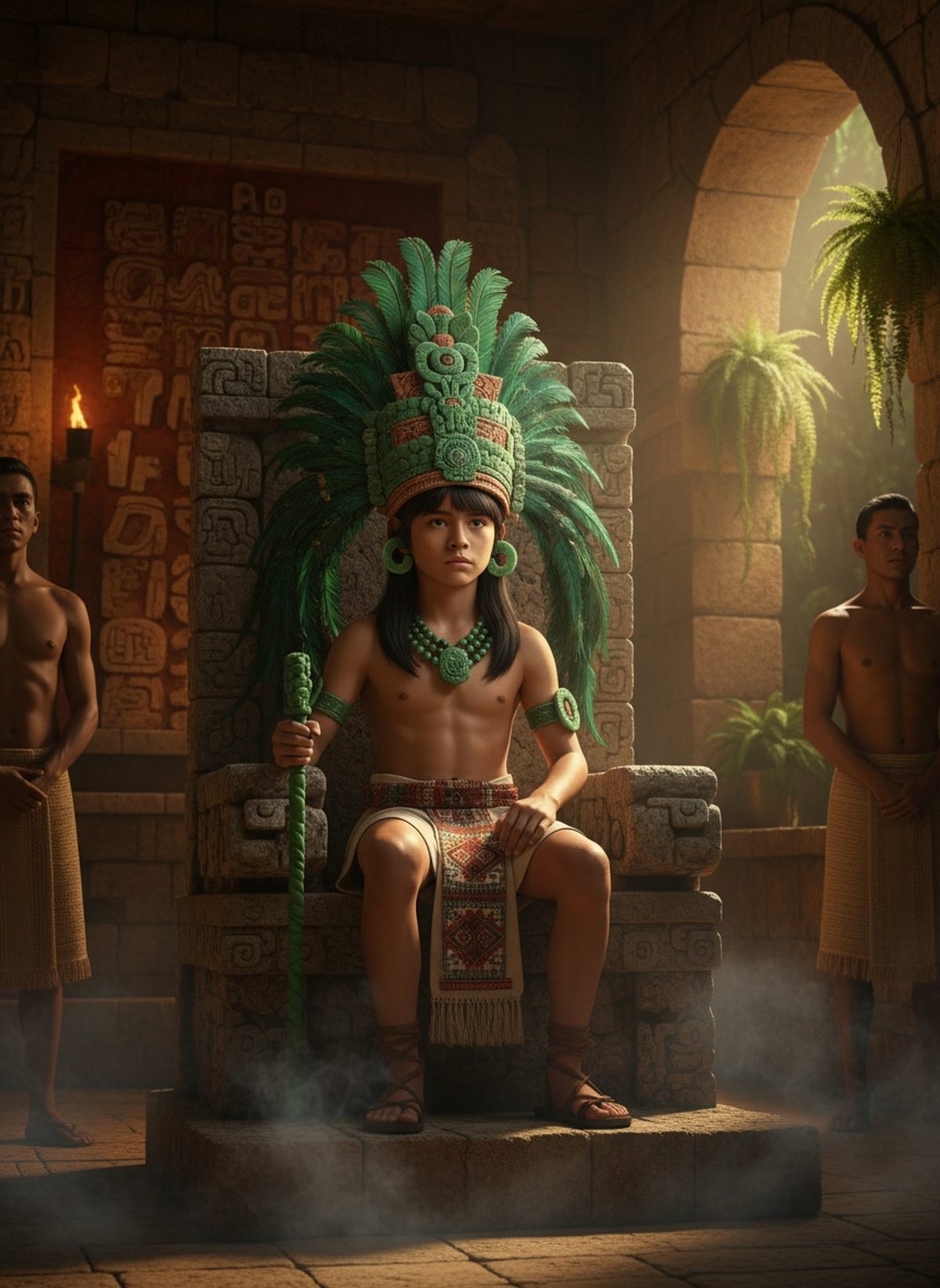
In the heart of the dense, emerald jungles of what is now southern Mexico, a particularly significant ceremony was taking place. Standing before the high priests, nobles, and elders of the city was a boy not yet in his teens. His name was K'inich Janaab' Pakal, and at twelve, his shoulders bore the weight of a fragile kingdom. Palenque, once radiant with power and prosperity, had dimmed under the long shadow cast by its neighbors, especially the might of Calakmul. The ruins of past battles loomed large, fresh scars from repeated assaults that left both the city and its spirit in ruins.
As Pakal ascended the stone steps to his new role as ajaw, or king, every eye in the city was upon him. His mother, Lady Sak K'uk', who had navigated the turbulent waters of leadership as a regent, must have felt the tug of both pride and apprehension. There was no ceremonial fanfare today, just the quiet resolve to endure and perhaps, to rise again.
Palenque's troubles had started before Pakal's reign, back in the time of his grandfather, the elder Janahb Pakal. The fortunate inheritor of a rich legacy, his rule too was marred by Calakmul's aggression, leading to a siege that decimated much of Palenque's defense and left its people in fear. When Pakal's grandfather passed, the chaos of succession enveloped the city like a fever, one that only subsided with the anointment of young Pakal.
Read next: Maharbal Offered Hannibal Rome. He Refused.
The adolescent king was not an ordinary child. Raised in the ways of his ancestors, his education included astronomy, mathematics, and leadership—the lifeblood of Maya knowledge. Yet it was his lineage that commanded the trust of his subjects. Even at a young age, Pakal had the regal bearing forged by the hands of Maya tradition, including his elongated skull, a mark of nobility, and his carved teeth, filed to sharp points. Such practices might strike modern eyes as unusual, but they were deeply tied to identity and prestige among the Maya elite.
Although inheriting a crown of thorns, Pakal envisioned something greater. Whether driven by the wisdom imparted by his mother or personal ambition that burned quietly within, his resolve to rebuild was unmistakable. His strategy was not just fervor and dreams; it was a masterfully orchestrated campaign of diplomacy and architecture, the very pillars of a civilization that would sustain not just his reign, but the impression of his greatness for centuries.
The first decades of Pakal's rule were spent consolidating power. The tightrope between war and peace was navigated with cunning alliances and occasionally, well-judged skirmishes. He repositioned Palenque not just as a city but as a beacon of stability amid a fractured landscape. Realizing that strength lay not only in numbers but in imposing presence, Pakal initiated a series of monumental building projects that would announce Palenque’s resurgence to the Maya world.
Among his many accomplishments, the Temple of the Inscriptions stands as a testament to Pakal's ambition and reverence for legacy. This magnificent pyramid was not simply an architectural wonder, but also a heavenly monument to Maya cosmology and history. It encapsulated the spirit of a ruler who looked far beyond his own reign. Below lies his sarcophagus, engulfed with intricate carvings that to some, spurred theories of ancient astronauts, yet to those who truly understood, it was a spiritual roadmap to the ancestors.
Pakal's city became a stage upon which mathematical and astronomical prowess were showcased with audacious strokes—his constructions were aligned with celestial bodies, a gesture that echoed both his precursors and aspirations toward divinity. Under his hand, Palenque transformed into a hub of artistic and intellectual production, producing some of the finest carvings and stuccos within the Maya realm. Scenes of myth intermingled with vivid history embellished the walls, offering a narrative woven from the threads of time and legacy.
For sixty-eight years, Pakal ruled with a blend of inherited wisdom and his own innovations, a reign that until Byzantine Emperor Basil II, remained unmatched. The resolve and ingenuity of this child king eventually flourished into a majestic crescendo, elevating Palenque to one of the preeminent city-states of Classic Maya civilization. He transformed what was once nearly rubble into a trove of lasting beauty and strength, ensuring continuity in times of uncertainty.
When Pakal passed away in August 683, he knew he had crafted a legacy that interwove his life with the tapestry of the cosmos. For centuries after, his city thrived, a beacon amid the ever-changing jigsaw puzzle of Mesoamerican polities. His accomplishments and relics tell us about a king who once stood affixed by the gaze of his people and more incredibly, stood the test of history.
As modern excavators brush away centuries of jungle reclaim, they unearth not only his temples but the whispers of his empire-building genius. In a world that often concedes to the abruptness of youth, Pakal was the exception—one who wielded vision as deftly as a sword. The lessons of his reign, those of resilience and rebirth, remain as relevant today as they were some fourteen centuries ago.