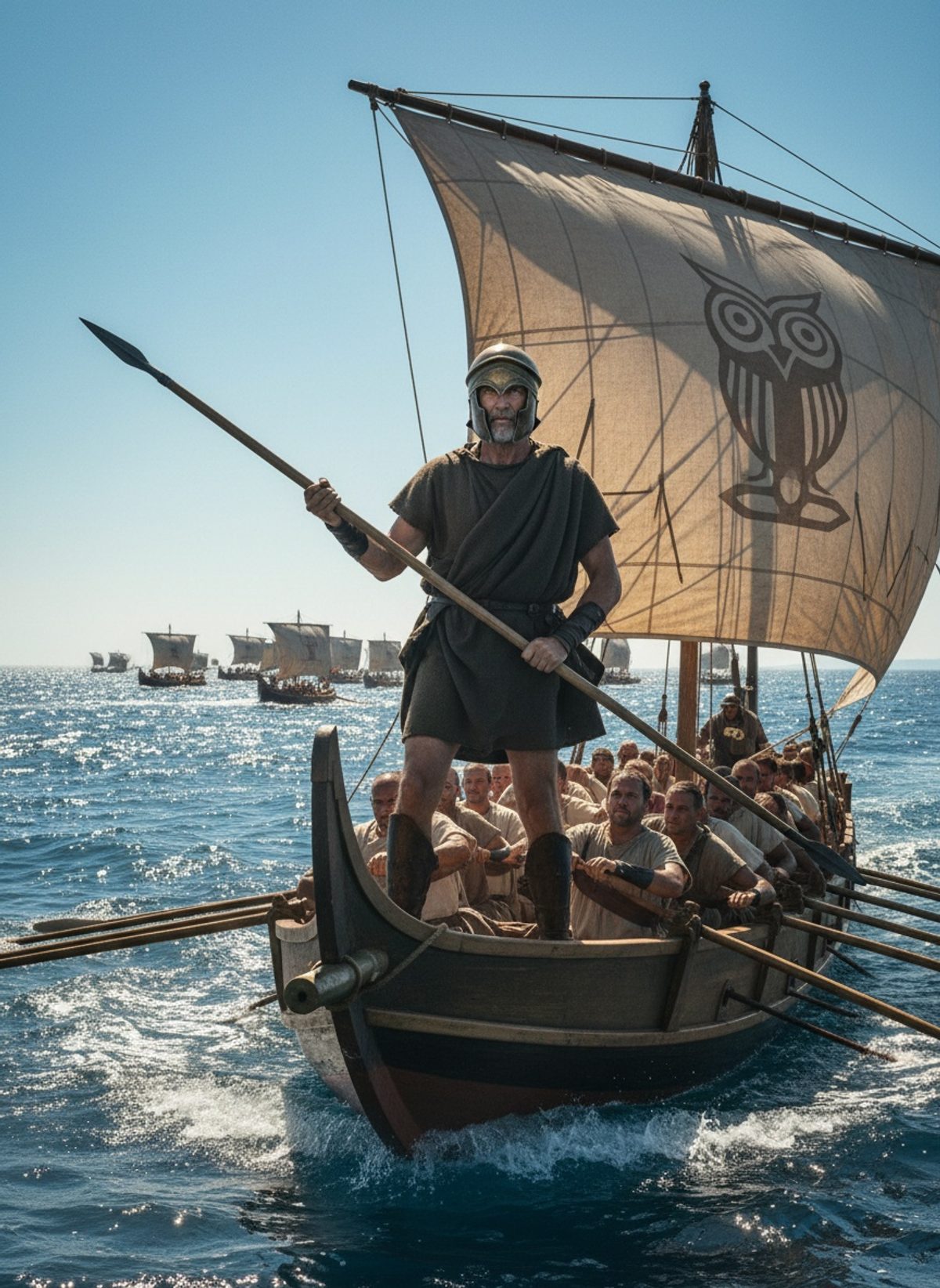
The horizon blurred in a whirlpool of spray and shouts as the Athenian trireme rocked beneath Phormio's feet. The air bristled with tension, the thin scent of salt spray mingling with the sweat of rowers who strained against their oars, muscles bunched and taut. Above the din, Phormio's voice rose clear, slicing through the cacophony like a blade. The enemy fleet lay before him, hulking and numerous, their forty-seven Spartan-aligned ships a formidable wall of wood and bronze. But the Athenian admiral, with only twelve triremes under his command, showed no sign of retreat. Instead, he executed a maneuver so audacious that the histories would echo with it for centuries.
Phormio's eyes, sharp as an eagle's, were fixed on the enemy formation. The Peloponnesians had arranged their ships in a protective circle, a defensive tactic that might have intimidated another commander. But Phormio understood that the circle, while seemingly impregnable, was also a cage. He ordered his ships to circle the enemy in two lines, moving with a precision that belied their numbers. Under his command, the Athenians tightened their grip, sailing closer and closer, as though winding an invisible noose around the larger fleet.
The winds picked up, as if summoned by the gods themselves, and the sea began to churn. The novice crews of the Spartan vessels struggled to keep formation; their inexperience showed glaringly under the onslaught of gusts and waves. The once-stout circle of ships now seemed a chaos of flailing oars and splintering wood. It was the moment Phormio had been waiting for, a moment crafted through a perfect synergy of audacity and timing. The Athenian triremes darted in with the agility of hawks diving on panicked prey. Amidst the confusion, twelve enemy ships were seized, their crews floundering, unmoored, in the blue expanse of the Gulf of Corinth.
No Athenian lives were lost that day. It was a testament to Phormio's mastery of naval tactics that his smaller force emerged unscathed from what had appeared to be a desperate gambit. His willingness to engage the enemy when others would have turned tail displayed not only his iron nerves but also his strategic genius, forever changing the course of naval warfare. The tactics used in that skirmish were not merely innovative; they would be analyzed and emulated by naval officers long after spears and shields had given way to gunpowder and steel.
Read next: Vo Thi Sau Faced the Firing Squad. She Refused the Blindfold.
Phormio's triumph was not a chance victory in a solitary campaign. Based at Naupactus, his fleet of twenty triremes was charged with blocking Corinthian shipping in winter 429/8 BCE. The pressure was immense; Spartan ambitions were vast and territorial, eager to carve through Athenian spheres of influence in the Acarnanian region, capture Cephallenia and Zacynthus, and possibly even oust the Athenians from Naupactus. But Phormio's vigilance extended far beyond the protective walls of his temporary headquarters. Forewarned by allies on land, he tracked the movements of the Peloponnesian fleet along the southern shore, shadowing them until the moment arrived to strike.
Their days were filled with the constant rhythm of oars against the sea, the tireless patrolling that marked the life of an Athenian sailor. By the time the Spartans steered in hopes of crossing to Acarnania, the Athenians were ready, every sailor and commander alert with a battle-hardened focus born of necessity and survival. The ensuing battle not only confirmed Athens’ strength in naval combat but reinforced the superiority of her strategies—a fundamental contrast to the traditional, more rigid Spartan approach to warfare.
The saga did not end there. Following the initial victory, Phormio faced an even larger Peloponnesian fleet of seventy-seven ships. Here too, his leadership and tactical acumen forged victory from the brink of disaster. As the Athenians found themselves driven towards the narrow waters of the Corinthian Gulf, it appeared that fortune had turned against Phormio. Their slim hope rested on eleven remaining ships, corralled into Naupactus’ harbor, but even cornered, Phormio saw opportunity. As their enemies pursued them in a frenzied stampede, one Athenian ship, in a stroke of both daring and desperation, turned around and launched a counterattack. The Peloponnesian fleet, ensnared in overconfidence, collapsed in disarray. Phormio’s forces peeled the invaders apart, causing havoc from their suppressed positions, and saved Naupactus from certain capture.
This stunning command performance secured Athenian dominance in the waters of the Corinthian Gulf. It was not merely a defense of territory, but a vivid assertion that Athenian ingenuity and audacity could counterbalance the weighty gravitas of Spartan numbers and reputation. These encounters were battles won not by the brute arithmetic of conquests and ranks, but by a superior understanding of the land beneath their feet and the winds above their sails.
After these twin triumphs, Phormio’s story fades from the annals, his name rarely penned alongside the living. He undertook a solitary land engagement in 428 BCE, and thereafter, records of him desist. Yet his legacy lived on, enshrined not only in sculptures raised posthumously upon the Acropolis but in the ethos of the Athenian naval tradition—an eternal beacon guiding naval tacticians through eons. In the city of Athena, a general who wielded wind and wave as his tools ensured his place among the greats of Athens such as Themistocles and Cimon.
In recounting Phormio's victories, we unravel more than just a narrative of gallant maritime exploits; we glimpse the intrepid spirit of Athens at her zenith. His story underscoring that strength in war can emanate not simply from the ranks of numbers but the resolute heart of courage, strategy, and fate's unpredictable bless—a profound reminder that in history, as in life, valor involves facing the tempest with unwavering resolve.