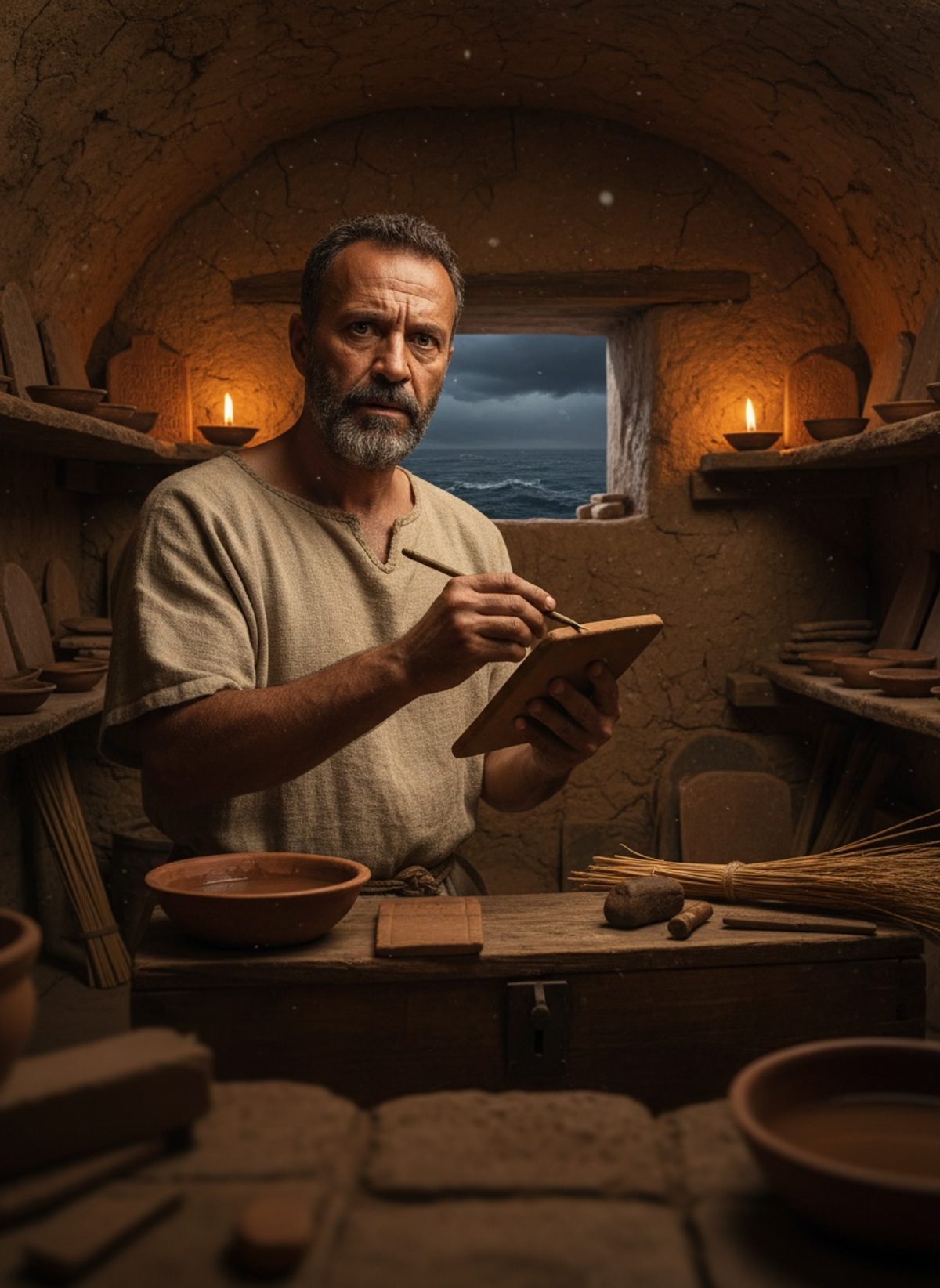
December 3, 1872. The damp air of London pressed in as George Smith huddled over a crumbling clay tablet in the British Museum's dimly lit Assyrian Gallery. His eyes moved slowly over the cuneiform script, careful to parse the jagged marks with precision and reverence. The tablet, excavated from the dust of ancient Nineveh, echoed a tale that seemed hauntingly familiar yet uncannily ancient.
The Day the Past Speaks
For George Smith, an Assyriologist who had started his career as a humble engraver and taught himself the ancient Babylonian language, the day had begun like any other at the British Museum. The institution was embalmed in history, with walls crammed with relics from times long past, but that day, as Smith deciphered a significant text, something extraordinary unfolded. His pulse quickened as he realized the narrative unfolded in his hands—a tablet that spoke of a great flood, an ark, and a hero much like Noah. The realization shook him: he had encountered the Babylonian "Epic of Gilgamesh" and its ancient flood narrative detailing the adventures of Utnapishtim, a hero who was forewarned of a great deluge and who, like Noah, built a saving vessel.
This tablet, unearthed from the ruins of Nineveh in present-day Iraq, was more than 3,000 years old, belonging to the Mesopotamian civilization of ancient Assyria. Nineveh, once a flourishing metropolis on the Tigris River, had been a sprawling cultural and commercial seat of the Assyrian Empire. It now lay in ruins, buried by the sands of time, until British and French archaeologists resurrected it in the mid-19th century.
The Assyrian Empire had stretched across a vast area, where myths and legends were carved into countless clay tablets. Smith's find was among these tablets, the eleventh in a series that constituted the Gilgamesh epic—an account older than the Book of Genesis. The world held its breath as word of Smith’s discovery spread. The very foundation of biblical history teetered, challenged by the ancient script.
Read next: The Tablet Was Broken. The Merchant Had Kept the Receipt.
Unearthings and Unveilings
The scene shifted back to decades earlier when Austen Henry Layard, another pioneering British archaeologist, spearheaded expeditions to find the long-buried cities of the Mesopotamian empires. The 1840s were alive with the fever of discovery as Layard and his team sifted through the earth to unearth forgotten treasures. It was in 1849 when Layard and his successor, Hormuzd Rassam, discovered the once grand library of Ashurbanipal at Nineveh, where the tablets were later extracted.
In these chaotic years of excavation, fragile tablets emerged, filled with ancient wisdom and myth. The library's clay riches spelled out an array of works, but none proved as world-shaking as the Gilgamesh flood tablet. Written in Akkadian, the language of ancient Babylon, the script detailed a deluge narrative eerily similar to Genesis's tale of Noah. As the floodwaters rose in the tale, leaving destruction in their wake, Utnapishtim dispatched a dove to seek dry land. History seemed to echo this narrative like a chorus from millennia past, its resonance found in regions far beyond ancient Mesopotamia.
Intriguingly, these discoveries signaled not just a story of ancient parallels, but also a testament to humanity's deep-seated desire to record, narrate, and interpret the chaotic forces of nature that have defined existence. The idea of a great flood, by some twist of fate, had seeped into disparate cultures across time—from the Mayans to the Sumerians, and indeed, the Hebraic traditions. Yet, until Smith’s reading of the tablet, few had imagined such depth to the historical crossovers of biblical accounts.
A Story Older Than Time
The revelation of the flood narrative within the Epic of Gilgamesh forced many to reconsider ancient Near Eastern civilizations. These cultures had fostered complex societies capable of profound intellectual achievements. The tablet bore testament to linguistic prowess and the sophistication of literary traditions that preceded the biblical scriptures by centuries.
When George Smith first presented his deciphered treasure to the public, the late Victorians were entranced. The discovery ignited debates and even crises of faith as it pried at the intersection of religion, history, and archaeology. Yet beyond theological and academic circles, it captured the collective imagination, challenging preconceived notions of cultural genesis and the universality of storytelling.
The importance of this historical revelation extends far beyond its scriptural implications. It forces us to recognize how stories we take for granted today—embedded in sacred texts and deeply rooted in our collective psyche—have been told and retold long before they reached their modern forms. They remind us that history is not a fixed account but a tapestry of stories, threaded together in unexpected patterns across time and space.
In contemplating the dusty script deciphered by Smith, we are reminded that the stories of the past endure, woven through human experience regardless of borders or epochs, resonating with our shared struggles, hopes, and mysteries. These tales, in their ancient echoes, continue to shape how we understand our place in the world, challenging us to see the interconnectedness of all human history.