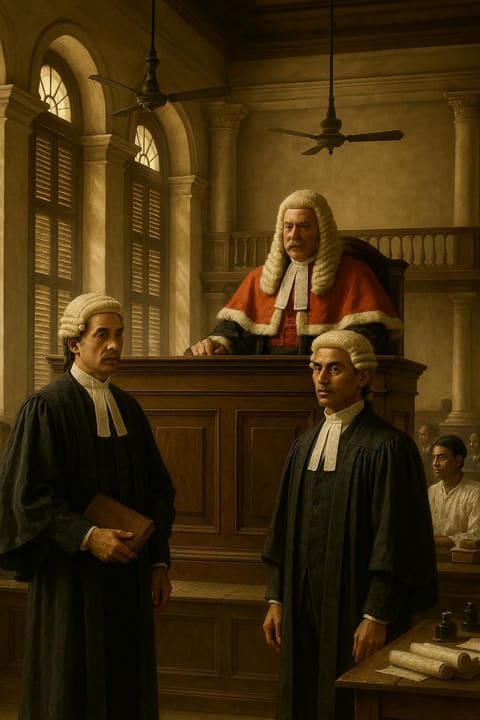
The monsoon deluges of 1861 had left the city of Calcutta permeated with the smell of damp earth and the perpetually looming fog of humidity. The crowded streets reverberated with the sound of horse-drawn carriages clattering across cobblestones, mingling with the cries of the bustling bazaar where traders haggle under makeshift awnings. Amid this swirl of activity, an undercurrent of momentous change was quietly taking root in the courts of British India—an alphabet of justice that would echo across centuries. The Indian Penal Code of 1861, curated under the watchful eye of Thomas Babington Macaulay and his conviction in the universality of English Common Law, was set to alter the course of an emerging nation.
Macaulay, sitting in his well-appointed office, his mind was a cauldron of Victorian ideals and Enlightenment utopianism, saw the subcontinent through the prism of a singular legal vision. He believed in the power of law as a civilizing force, seeing India less as a conglomerate of diverse cultures and more as a canvas for British legal and moral philosophy. The code he championed was intended to be exhaustive and impartial, embracing a system where legal precedents, built on reason and legislation, would replace the disparate strands of indigenous legal customs.
The endeavor to implement such a sweeping legal transformation was nothing short of Herculean. The subcontinent boasted an intricate tapestry of centuries-old local customs, religious doctrines, and princely decrees—a cacophony of legal traditions that had long governed a diverse set of people. Yet, into this intricate weave, the British injected another thread: a standardized code that sought to bring every citizen, from the Punjab to the tip of Sri Lanka, under its jurisdiction. This ambition unfolded across the teeming cities and winding river valleys where the colonial administration sought to inscribe British order onto the existing socio-cultural matrix.
The code itself was an extraordinary legal document, structured with precision, written in language that aimed to be both accessible to the burgeoning class of Indian legal professionals and impervious in the face of challenges rooted in local complexities. It encapsulated numerous facets of what the British perceived as necessary for governance, covering everything from the severity of crimes to the moral guardianship of the populace. Yet, the structure of this code was foreign, even alien, to the land it sought to govern, resembling a meticulously crafted, albeit austere, cathedral erected on an ancient, varied landscape.
Read next: When English Law Gave the World Its Courtroom, 1215
As judges and barristers—many of them young Indian men educated in the liberal arts and law schools established by the colonial authorities—began interpreting cases through the lens of this new legislation, they navigated a transitory labyrinth. British administrators believed that through this codification, they were imparting a rational spirit to the nation—a spirit where justice was blind to caste, creed, and religion. Yet in truth, the penal code not only introduced a new legal framework but also indirectly perpetuated sequestered rings of British influence, binding future generations to decisions penned in an alien tongue.
While Macaulay's textbook-like ideals may have seemed, to some, academically sound, on the ground, the realities were often fraught with inconsistency. The application of English legal precedents within a culture of patriarchal hawala networks, caste hierarchies, and tribal loyalties inevitably led to challenges. Some argued that the code was an imposition of the colonizers' will more than a tool of liberation, highlighting the continuing dissonance between broadly scripted laws and daily lived realities.
Once Britain bid adieu to the Indian subcontinent in 1947, with its partition scars and newfound political self-consciousness, the structures left in place were far from skeletal. Railways wound through expansive vistas just like arteries, the game of cricket persisted in fostering both competition and camaraderie, and the English language acted as a linguistic bridge. But it was the legal girders of the Indian Penal Code of 1861 that quietly but robustly endured—woven tightly into the fabric of newly independent India’s hopes and legal proclamations.
Read next: When English Common Law Became the Voice of Hong Kong, 1842
As contemporary India—the world's largest democracy—continues to chisel its identity, the specter of the 1861 code hovers in courtrooms from the chaotic lanes of Dharavi to the sandstone palisades of Jaipur. The comprehensive legal edifice has undergone numerous amendments to reflect the evolving social and political ethos, yet its vertebrae remain undisturbed, reminiscent of the imperial ambition to sustain law's inviolable demand for equity. While legal scholars, activists, and politicians engage ceaselessly in dialogue over law's relevance and reinvention, the code remains an indelible legacy of a time when Britain's dominion stretched far beyond the Thames.
The India of Macaulay's dreams—one shaded by the rule of law—metamorphosed into a reality far richer than he could have envisioned, with a robust legal framework descended from his 19th-century blueprint yet deeply entrenched in the democratic ideals of the Indian Constitution. Today, as India's judicial system wrestles with cutting-edge quandaries from cybersecurity to gender justice, the 1861 code stands as a testimonial to the throne's saegrious endeavor to transplant an entire legal system across continents.
In the cacophony of modern legal challenges, the story of India's ongoing relationship with a legacy that was never truly theirs becomes illustrative. It prompts us to question the colonial assumptions that still oscillate beneath the surface of post-colonial societies. The echoes of British legalese—stripped down, localized, yet hauntingly enduring—challenge us to rethink power, justice, and identity in a world that's both shrinking and expanding beyond the limits imagined by Macaulay under the hazy Calcutta sun of 1861.