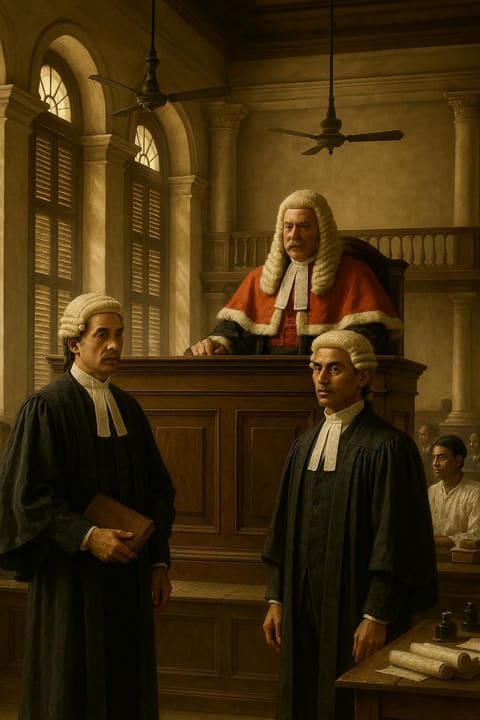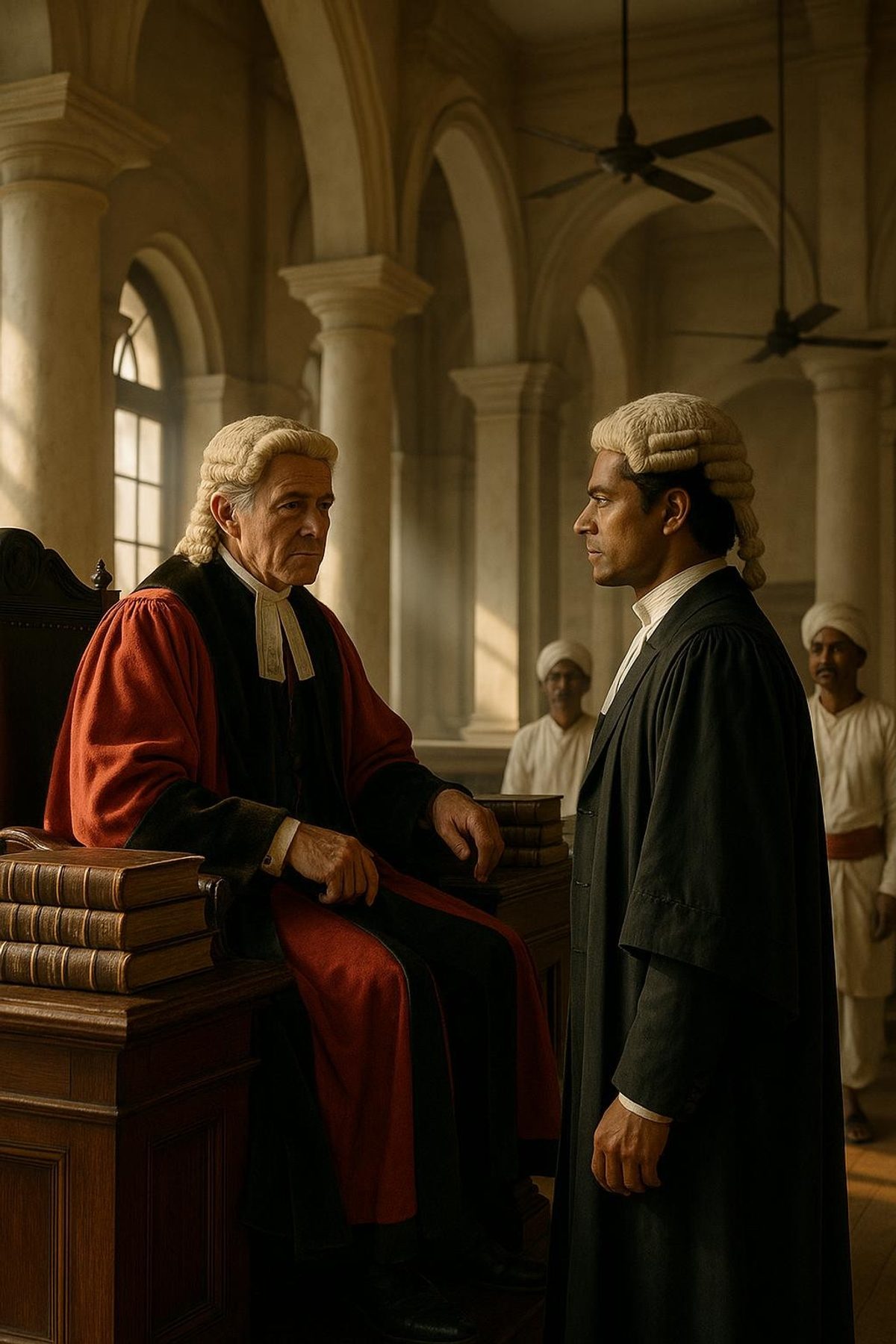
The courtroom crackled with anticipation, a thrumming murmur beneath solemn proceedings. Judge George Morton, clad in his crisp robe of justice, leaned forward. He could sense the room's feverish energy. Outside, the bustling streets of Calcutta sprawled like a chaotic tapestry, but within these walls, a new order was taking root—a legal revolution that would leave an indelible mark on the Indian subcontinent.
The Birth of the Indian High Courts
In 1861, the passage of the Indian High Courts Act forged a new path for law and justice in British-occupied India. One single, decisive Act of the British Parliament initiated a sweeping reform, replacing the ancient Mughal legal systems that had long governed the land. For centuries, regional courts administered such justice as local custom and imperial mandate allowed. Now, the pages of clergymen's books and dusty codices gave way to the articulated syllables of English common law.
The High Courts established in Calcutta, Bombay, and Madras were not mere buildings but symbols of British legal philosophy. Their frameworks were unmistakably foreign yet meticulously efficient, creating a curious blend of regulations that brought consistency across linguistic and cultural boundaries. As the once-dominant Mughal courts faded into history, the British legal legacy in India began its centuries-long permanence.
The Grand Halls of Justice
Picture a British courtroom: solemn judges seated high upon their benches, their black robes cutting an imposing figure against whitewashed walls, with clerks bustling like dutiful ants. The architecture of these High Courts stood proudly, an amalgamation of Gothic and classical styles evoking Britannia's imperial dominance. Yet, within these towering halls, the very air felt different, electric with the possibilities and perils of justice administered to millions.
Read next: When English Law Gave the World Its Courtroom, 1215
The High Court in Calcutta, its stone facade adorned with intricate carvings and towering columns, spoke of stability and authority—a beacon of order amidst the cacophony of a bustling colonial city. Meanwhile, across the subcontinent in Bombay and Madras, similarly imposing edifices rose, echoing the tenacity of British engineering.
These courts served a purpose beyond simple justice; they were instruments of control, ensuring the empire's grasp on its territories. By implementing English common law, the British fused their administrative machinery with colonial governance, instilling a judicial system capable of managing complex legal disputes with precision and clarity.
A Subcontinent Transformed
The transition was neither seamless nor swift. The introduction of British law reshaped the indigenous justice systems, bringing with it an era defined by rigorous legal codes and a bureaucracy that prioritized documentation. For many in India, the path to justice now involved navigating the labyrinth of British legal terminology, translating personal grievances into the formal language of writs and motions.
However, alongside the heavy-handedness of colonial rule, there was a flicker of progress. The new legal system offered a degree of uniformity previously absent from India's patchwork of princely states, regions, and countless communities. The establishment of the High Courts ensured oversight, creating an avenue for appeals and recourse previously unavailable to many of India's inhabitants.
Though the British legal overlay could be rigid and saw many parts of the old system marginalized, it ultimately served to unify India's diverse populace under a single framework. It leveraged the power of precedent, building a structured narrative of law that began to transcend local peculiarities.
Voices of Change
Within the courtroom, English echoed as the language of power, law, and order. Verdicts were pronounced in a foreign tongue that gradually became integral to India's legal proceedings. Yet, while the British sought to reinforce their hegemony through this linguistic imposition, they inadvertently sparked a new public discourse.
Prominent Indian lawyers emerged over time, their insights and arguments bridging the cultural chasm between the colonizers and the colonized. They embraced the ideals of justice and fairness on which British law was predicated, reshaping them through an Indian lens. Figures of immense legal acumen, such as Mahatma Gandhi and B.R. Ambedkar, later walked these halls, their voices rising in steadfast pursuit of equity and reform.
Read next: When English Common Law Became the Voice of Hong Kong, 1842
Legal proceedings began to fuel new national consciousness, giving birth to a generation of advocates who would one day challenge the empire's very foundations. The courts became arenas for social change, where the seeds of independence found fertile soil.
The Foundations of a Modern Democracy
Today, the legal architectures established back in 1861 stand as steadfast pillars of India's democracy, the largest in the world. Beyond their colonial origins, the High Courts of Calcutta, Bombay, and Madras endure, their legacy captured by a shared pursuit of justice across a diverse and vibrant nation.
While the empire that birthed these institutions has long since faded into the annals of history, the legal codices it brought survive, echoing the imperial past while underpinning the democratic present. That which began as a tool of colonial might became the backbone of India's aspirations for a just society, an enduring testament to resilience and adaptation.
As millions across India seek justice in courts rooted in a distant time and place, history witnesses the confluence of change—a transformative journey from the imposition of foreign sovereignty to the indelible power of self-determination. The British legal system, once a voice of control, now speaks the language of a nation free, continually defining and redefining the rule of law in the heart of Asia.