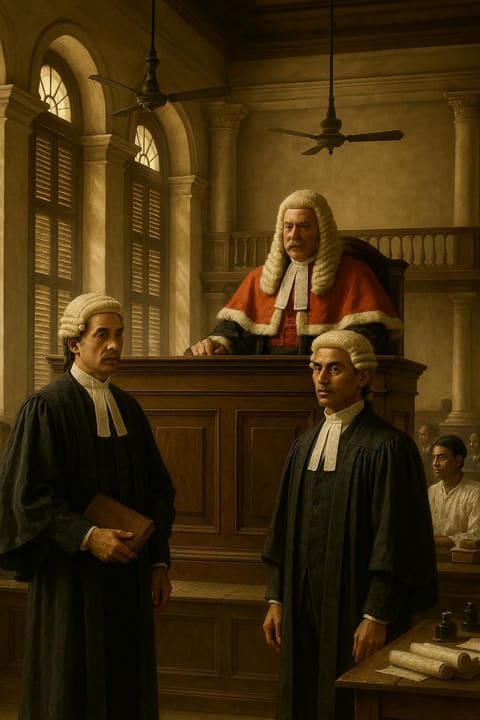
English common law found a new home in an unlikely corner of the world. But it was a tent, not a courtroom, that set this unprecedented journey in motion.
The Treaty Tent
February 1840. The Bay of Islands, kissed by rolling waves under a sun baked sky, played host to a historical encounter unlike any before it. Civil and foreign, the scene juxtaposed Maori chiefs cloaked in traditional finery with the crisp uniforms of British officials. In a makeshift tent, with the vibrant backdrop of New Zealand’s rugged landscape, they gathered for a meeting that would blur cultural lines and sow the seeds of a dual legal legacy.
The British official slowly unfurled the document that would change everything: the Treaty of Waitangi. The chiefs leaned in, their moko—intricate facial tattoos marking heritage and status—contrasting starkly against the crisp white parchment. This was their first true encounter with the notion of a written agreement, a method of binding promise foreign to their oral tradition. Yet, these indomitable leaders understood the gravity; this agreement was a lifeline amid the growing tides of European encroachment, a chance to safeguard their land and sovereign rights amidst the chaos of expanding colonial desires.
The document itself was a marvel of diplomatic symbiosis: an English version laden with notions of sovereignty and governance crafted alongside a Maori translation that promised protection and partnership. The chiefs and British officials found common ground, if only linguistically. The Maori wāhi tapu (sacred sites), taonga (treasures), and kawa (rituals) were enshrined with promises of preservation through king and crown. In that hallowed tent, tension brewed alongside hopeful cooperation, bound in the ink the chiefs impressed upon the page with their uniquely stamped signatures.
Read next: When English Law Gave the World Its Courtroom, 1215
Common Law Across the Sea
In that moment, English law embarked on a journey over the seas, anchoring itself in fertile ground. While Britain’s reach had extended over lands distant and diverse, New Zealand presented a unique challenge—a land uncharted by the traditions of bilaterally agreed Western legal frameworks. English common law came not as an imposition, but as a framework through which both colonizers and the colonized could navigate their new reality.
The influence of this transplanted legal system was immediate, shaping the governance, property rights, and civil processes in the burgeoning colony. The first courts in New Zealand were established soon thereafter, echoing courtroom practices and judicial norms familiar to those of the British Isles. Each case settled, dispute resolved, and contract enforced contributed to the shaping of a mixed judiciary landscape; one where English common law and Maori custom began to intermingle, not always peacefully, on the fringes of newly formed settlements.
What transpired in New Zealand was a legal experiment in which Eastern wisdom met Western methodology. Maori customary law brought simplicity and balance—a community-focused approach that was starkly different but no less logical than its English counterpart. Despite this, challenges persisted. Land issues were most contentious, with common law principles overwhelming customary landownership concepts. Maori land, which was traditionally shared in common by tribes, faced pressure from individual property rights and ownership deeds that fit uneasily within New Zealand’s indigenous framework.
Read next: When English Common Law Became the Voice of Hong Kong, 1842
A Legacy That Endures
The impacts of that February 1840 meeting ripple across time, seen across New Zealand’s modern legal and cultural landscape. Beyond its role as a foundational document, the Treaty of Waitangi became a symbol—a living document that came to denote not just the letter of the law, but the spirit of partnership between the nations residing in Aotearoa’s embrace.
Today, New Zealand courts recognize the importance of the Treaty not merely as a historical artifact but as a guiding compass in legal matters concerning Maori rights, resources, and relations with the state. Landmark decisions and governmental redress processes have hinged on interpretations of this pivotal agreement, reflecting its enduring strength and adaptability. English common law, carried across windswept waves and tempered by centuries-long evolution, persists as a backbone of New Zealand’s legal system, enhanced by the rich narrative of its bicultural dawn.
The tent on that windswept beach sewed the seeds of connection, comprehension, and collaboration. The law Britain carried across the oceans endures not only in New Zealand courtrooms but in the country’s collective consciousness—a testament to balance struck and bonds forged in uneasy alliance. In a world yearning for understanding across divides, the enduring legacy of that 1840 gathering offers a testament to the power of shared pathways and the resilience of dual heritage in crafting the future. New Zealand, a sovereign nation of diverse influences, continues to honor and navigate this complex legacy as it charts its course through both history and tomorrow.