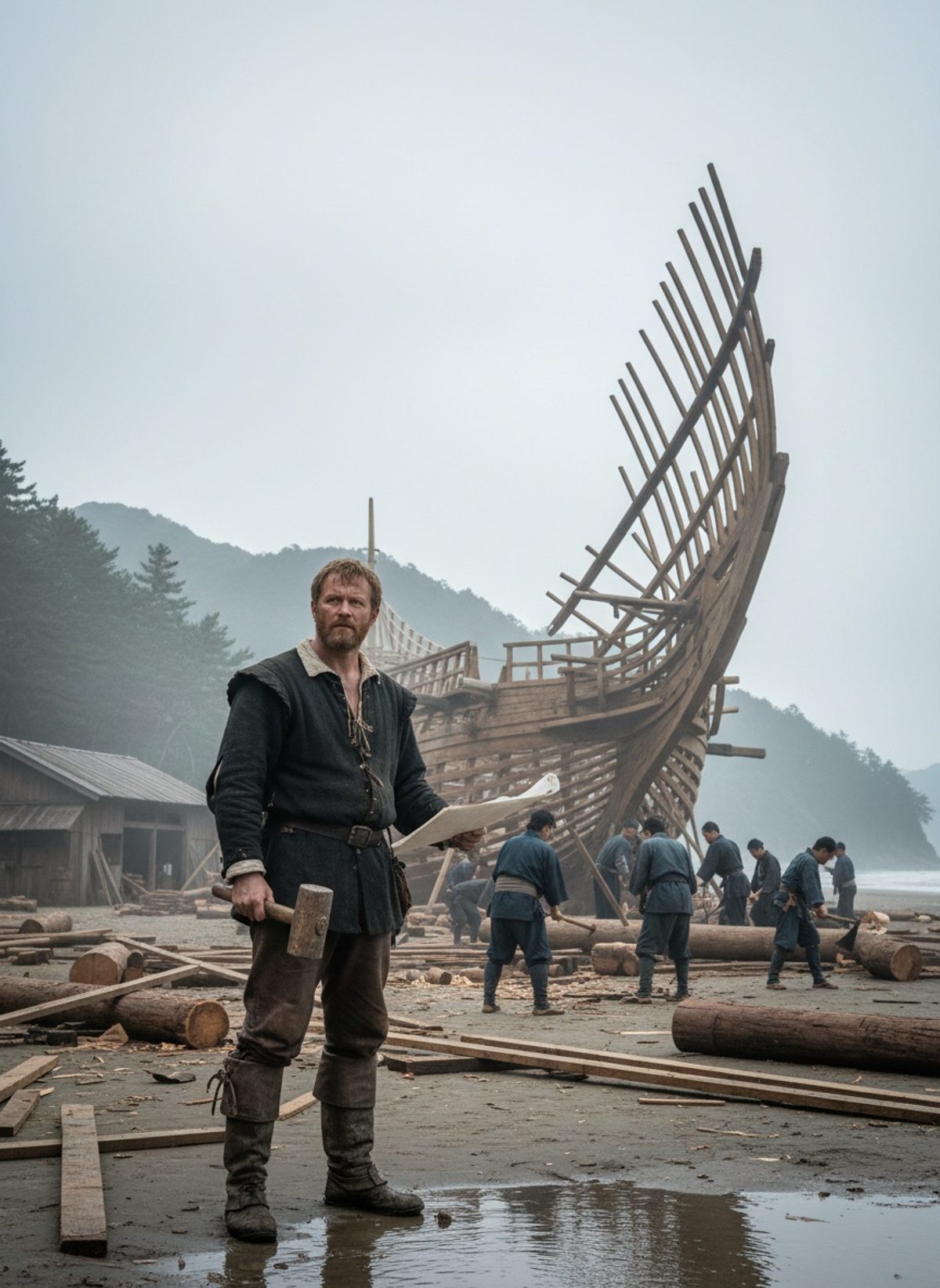
Briny salt air filled William Adams' lungs as he stood on the rocky Japanese beach, a stark contrast to the green fields of Kent he once called home. The skeleton of trees and the rhythmic crash of waves set a natural tempo around him. Here, thousands of miles from the life he had known, he faced a task that defied convention. Most men would have turned away, but not Adams. He surveyed the shore, a space where Tokugawa Ieyasu, the most powerful figure in Japan, envisioned something extraordinary: a European-style ship.
Adams had arrived in Japan not by choice but by fate's cruel hand. In 1600, an ill-fated journey aboard the Liefde had thrust him upon the shores of Kyushu as the sole survivor of a crew decimated by treacherous sea and disease. Fortune played its paradoxical role, for his misfortune became his opportunity. Tokugawa Ieyasu, then a daimyo on the threshold of becoming shogun, recognized in Adams a chance to further his own ambitions. Intrigued by Western innovations, Ieyasu saw strategic potential in the design and craftsmanship of European ships, which could broaden his dominion’s maritime capabilities.
The request was clear: build me a ship like no other seen in Japan. For Adams, it was an ignited spark of possibility within the boundaries of foreign land. Lacking the navigational charts, companions, and familiar tools of his past, his was an arsenal of mind, skill, and an English sailor’s resolute spirit. Here among the misty cliffs and enclaves of Japan, Adams irreversibly entwined his fate with that of the shogunate's burgeoning empire.
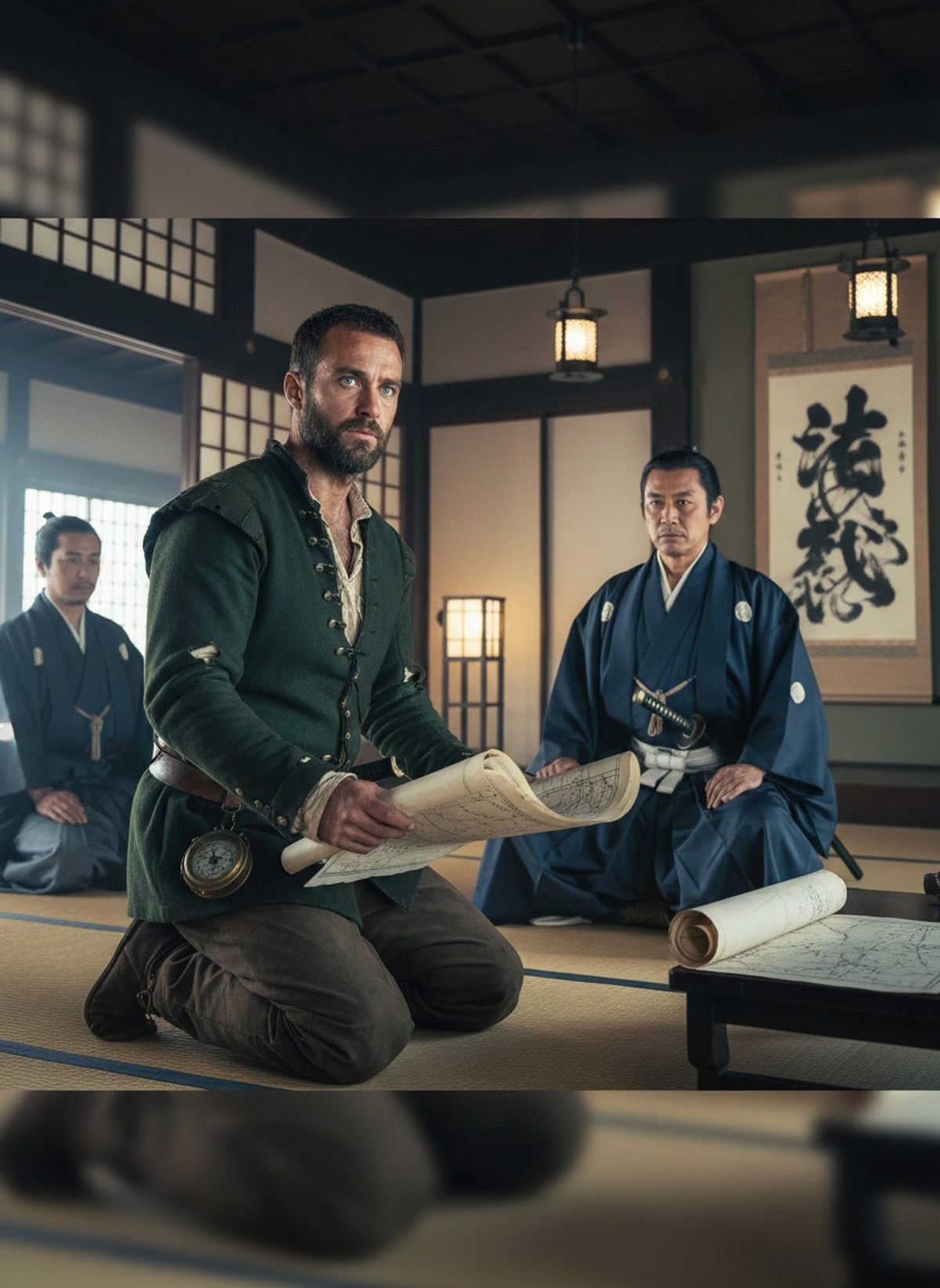
Adams began not in fullness but by forging links—that of trust with those around him, whose language was still a mystery, yet whose intent seemed clear. With Tokugawa’s newfound shogunate power in Edo, a region pulsating with ambition and shifting tides, the prospect of this ship meant more than mere wood. It was an act that mirrored the evolution of Japan as it peered curiously into the wider world.
Read next: When Martin Frobisher Knelt Before Elizabeth With Arctic Gold, 1576
In time, the laborious task of shipbuilding commenced on the beaches near Uraga. Under Adams’ direction, local craftsmen, unaccustomed to European ship design, translated designs into reality. They felled timber from the bountiful forests, shaping it into curves and corners dictated by Adams’ knowledge of Western maritime architecture. The cacophony of hammers resonated with the whispered promise of the sea.
Adams found himself a bridge—a conduit between the structured, hierarchical world of Japan and the enterprising, sea-worn courage of his own England. Instruments essential to navigation, the heart of any Western ship, were manufactured with deft precision. Diverse wood types met across the hull in an intricate dance of joinery; strong oak formidably stood as the backbone, reinforced by the more pliant cedar well-suited to the seasoned Japanese craftsman.
In close quarters, a diverse group became his allies. Japanese craftsmen expanded their concept of shipbuilding, while Dutch knowledge, transmitted through Adams, influenced their methodology. He was unrivaled in his role—not as an overseer but an innovator who translated curiosity and uncertainty into shared understanding.
Over months blending into seasons, the vessel took shape, its form capturing light and shadow over the water's edge. The keel formed the spine, spirits rose with each plank affixed and each day closer to harnessing the fabled wind-spun journeys spoken of in unwritten histories. The hull, broad to brave open seas, resembled a vision conjured and delivered by Adams’ unyielding spirit.
Adams offered more than technical skill; he bestowed a legacy of cultural understanding. His being an outsider did not deny him influence; instead, he catalyzed intellectual exchange. The ship embodied imperfect fusion—a synthesis of Western ingenuity and Eastern adaptation. In 1604, the wooden leviathan slipped into the blue, a silent ambassador whispering of progress and possibility.
The launch marked a symbolic threshold. It was a moment of silent fanfare, one where spectating samurai and laborers alike felt the precedent that trembled through history’s very fabric. This new ship, a vision wrought from disparate lands, sailed beyond its utility as a trading or war vessel. It embodied changing winds of interaction and knowledge in an era often dominated by stoic barrier and suspicion.
For William Adams, the ship was a testament to himself—to adaptability and courage, qualities forged by both circumstance and choice. Over time, his stature grew from a humble pilot stranded ashore to Anjin-sama, a title denoting esteemed advisor, a testament to his impact and acceptance within Japanese society.
This fusion of elements—drawn from horizon-spanning panel and canvas—spoke of a world becoming ever complex and interconnected. It prompted the shogunate to reconsider their oceanic potential, and for Adams himself, offered a redemption arc so often denied by history’s linear path. He spent the remainder of his days on Japanese soil, a revered figure in a new story written across two shores.
In considering why this chapter matters, it illustrates the value of perseverance in the face of adversity. When most would have seen a shipwreck as an end, Adams saw a beginning. His legacy is not just technical proficiency but embodies the timeless quest for understanding amid diversity. This sea of circumstance, once chartless and hostile, introduced a new kind of exploration—one of heart and mind—that left an indelible mark on Japan and inevitably, on the world stage.