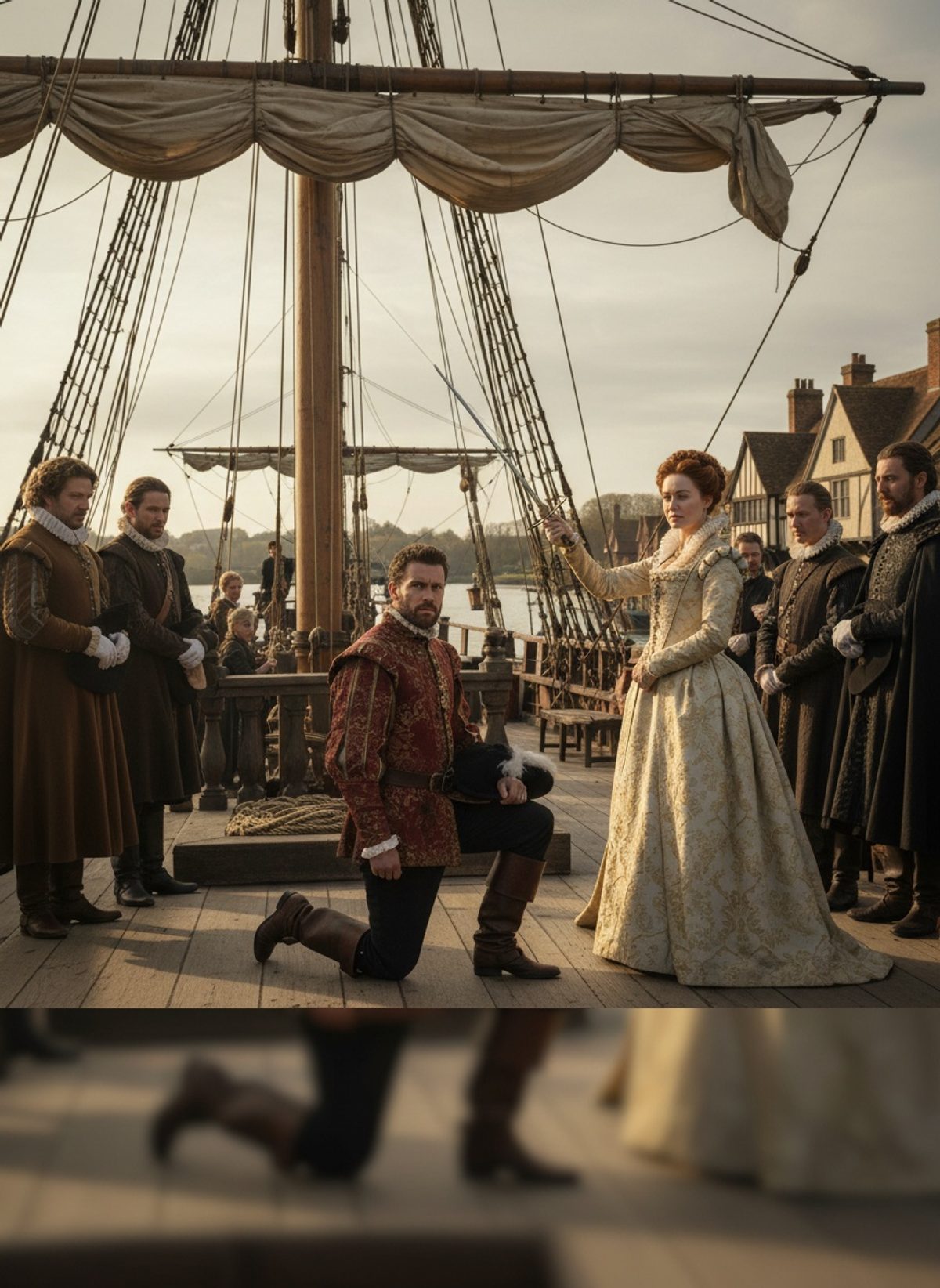
Francis Drake was a pirate. Queen Elizabeth I made him a knight.
The Voyage of Ambition
It was a time when the seas were as unknown and treacherous as the heavens, and only a few dared to challenge the horizons. In 1577, Francis Drake took to the seas with five ships, leaving England with a mission both clandestine and daring. Queen Elizabeth sanctioned this adventure as a direct affront to the Spanish crown, underlining the ever-present tension between the Protestant English and Catholic Iberians.
Drake's fleet departed with a clear directive: disrupt Spain’s grasp on the New World and its wealth. The undertaking was dangerous, not just due to the potential wrath of Spain, but also the mysteries held by the sprawling, uncharted ocean. This voyage was one of desperation and supremacy, with each wave against the hull echoing England's hunger for power and treasure.
Yet, underutilized is the story of the man who steered this venture. Drake’s past was riddled with experiences that etched his aptitude for adventure. A man of maritime cunning, he understood more than just the maps before him; he read the winds, sensed the mood of the sea, and steered a course not drawn in any book. Every harbor he raided and every Spanish galleon sacked spoke less of Spain's loss and more of England's potential gain.
Read next: When Henry Hudson Sailed Past the Edge of the Known World, 1610
The Golden Hind: A Relic of Survival
As the sun set on September 1577, Drake departed with five ships. When he returned to Plymouth Sound in September 1580, the sight of only one vessel emerging from the mist lingered in hush across England. This ship, the Golden Hind, like the mythic beast it was named after, had become a beast of legend—a vessel of all fortunes captured and an emblem of tenacity.
Amidst its wooden frame, layers upon layers of escapades were sewn, each plank carrying the weight of ventures unrelenting. The other four ships, lost to the wrath of sea or circumstance, had fallen, but not the Golden Hind; it sailed on. It carried the treasure trove of silver and gold from Spanish settlements and engagements, a metallic testament to Drake’s successful raids. Yet, buoying it above the waterline was something more precious than silver—it was England's burgeoning naval pride.
This inconspicuous ship, barnacle-laden and scourged by the elements, became a witness to a geographical revelation and brought back stories that would soon inspire generations of English mariners and mapmakers. The battered ship was not just a holder of riches but a chronicle of audacious dreams fulfilled and ambitions kindled beyond imagination.
A Royal Welcome Amidst Shadows of Piracy
On a gloomy day, when Queen Elizabeth I stepped aboard the Golden Hind at Deptford, it was not a mere return greeting. Monarchistic silence filled the air, pierced only by the creak of the ship's weathered boards. The air was charged with anticipation; would she condemn the man people openly called a pirate?
Instead, a sword was drawn, its glint anointing Drake, not condemning him. In a gesture laden with symbolism, Elizabeth dubbed him Sir Francis Drake—a title that transformed his image instantaneously from arguably a route man to a revered hero of the crown. The decision was contentious, for piracy and knighthood could scarcely be imagined as kin.
This act was no mere honor; it was a signal to Europe and beyond. England acknowledged no authority but its own and chose heroes by its standards. Thus, the mariner who bent knee on a stolen ship was heralded as a pillar of burgeoning imperial ambition. For Elizabeth, bestowing this accolade was a political maneuver with resounding effects. It said: England was not to be trifled with.
Echoes of a New World
The ripples of Drake's circumnavigation extended far beyond the realms of nautical achievement and wealth acquisition. They reached socio-political dimensions that began to alter England's self-perception. Here lay the premise of an empire—a nascent geopolitical narrative built on the shoulders of daring explorers like Drake, whose footfalls shaped the course of history.
Mission complete, Drake's return stirred a new age of terrestrial vision. Maps were redrawn, and once-rumored lands became tangible prospects for future colonization. It was an era where geographical ignorance was steadily supplanted by ambitious agendas of exploration and settlement, inspired by the path Drake had boldly charted.
The tangible wealth brought back paled in comparison to the intangible legacy seeded by Drake's voyage. It was not just the shores he touched but the minds he impacted—those aimless, uncharted shores they might inspire the next generation of seafarers to conquer in England's name.
The Untold Empire
Francis Drake’s knighthood aboard the Golden Hind, an event rich with irony and bold symmetry, revealed the complexity and audacity behind England's imperial pursuits. It showcased the precarious yet daring tightrope walk of early empire builders, navigating through realms of morality, pragmatism, and statecraft. Here lay the inception of a narrative woven not merely by conquest but by calculated gambles, cunning, and bravado.
Drake's journey set the stage for a broader exploration era, where the seeds of the British Empire were watered by courage, curiosity, and, in truth, the follies of men who saw opportunity on the horizon. The Golden Hind was more than a ship—it was an omen. That kneel upon its deck was not just an elevation in social class for one man but a harbinger of centuries to come.