
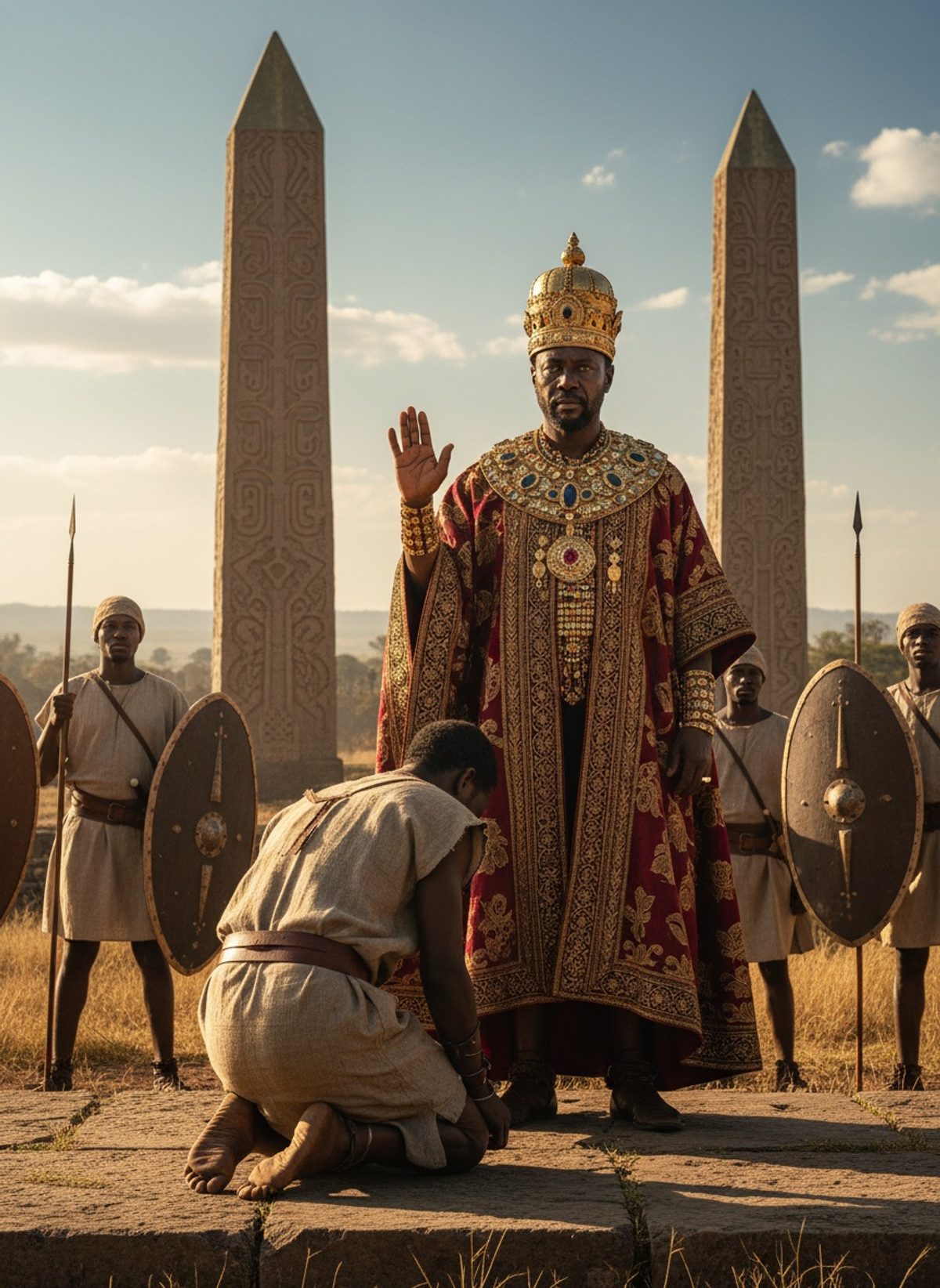
525 AD. A harsh wind swept over the Red Sea, driving waves against the hulls of the Aksumite fleet. Beneath the white crests, the ships moved with purpose, cutting across the angry waters that separated Africa’s mighty kingdom from the Arabian Peninsula. On board, warriors armed with shield and spear were ready to carry out the orders of their resolute leader, King Kaleb of Aksum.
Their destination was Yemen, a land gripping the edge of the Arabian Peninsula. The smoke from the burned churches of Najran could almost be seen on the horizon—a haunting reminder of the massacre that had called them to arms. Here, among the sands and mountains, a tragedy had unfolded that echoed back to Aksum, igniting the wrath of its devout Christian king.
King Kaleb had heard of the deeds of Yusuf As’ar, the fierce ruler of Himyarite Yemen—and the horrors he had unleashed on those who shared Kaleb’s faith. The stories told of churches razed and Christians slaughtered, tales that reached the ears of the king and stirred deep within him a need for justice. These were not just his people by faith, but in spirit, and their crucible was one Kaleb could not ignore.
Mobilizing the strength of Aksum, one of Africa’s most powerful and prosperous kingdoms, Kaleb determined to cross the swells of the Red Sea. It was a daring expedition, not only for the vastness of the ocean they had to cross but for the opponent they were set to face—a warrior king driven by zeal and disdain for the Christian faith.
Read next: Ahmad Baba Was Dragged in Chains. He Taught Anyway.
The landing in Yemen was swift and tactical, with Aksumite forces pouring across the beaches, their banners whipping in the relentless breeze. At the forefront of Kaleb's invasion was General Abraha, a man of formidable prowess and cunning. Under his command, the Aksumite warriors advanced, leaving the terrified Himyarites in their wake.
The decisive confrontation occurred not long after their landing. The strategic acumen of Abraha and the divine conviction of Aksum’s soldiers collided with the fierce resistance of Yusuf As’ar’s army. Yet, despite their ferocious defense, the Himyarites could not withstand the disciplined might of their adversaries. Rains of arrows darkened the sky, and the clash of iron reverberated across the arid landscape.
Yusuf As’ar, the fiery king of Himyar, found himself ensnared by the very resolve he underestimated. His forces scattered like sand in wind, and he was captured, iron chains replacing his once-majestic regalia. The march back to the camp was one of disgrace, the noise of battle replaced by an ominous quiet as the defeated man was led before Kaleb.
In the royal tent, opulent in its simplicity, Kaleb stood. The air hung heavy with the gravity of what was to come. When Yusuf was brought before him, his pride seemed momentarily unyielding, but ultimately, he could do nothing but kneel before the Aksumite king whom he had previously maligned and mocked with his cruelty.
Expectations were clear. This was a world where conquest often met with the swift hand of vengeance. A king like Kaleb, whose power had crossed the seas to meet him, would be expected to dispatch his enemy without a second thought—a stark warning to all who might challenge Aksum and its divinely inspired mission.
Yet, Kaleb’s decision echoed a different kind of power, one of mercy and resolve not often seen in the ruthless calculus of war. As Yusuf knelt, contemplating his imminent fate, Kaleb chose a path that surprised even his own commanders. Instead of the sword, he offered clemency, commanding that Yusuf’s chains be removed, offering him a life spared but forever altered.
This act of mercy was not just an expression of the king’s Christian faith but also a strategic stroke, demonstrating the enlightened side of Aksum's reign. By sparing Yusuf, Kaleb signaled a complexity and sophistication that set Aksum apart—not only as a power to be reckoned with in arms but also in principle.
The ripples of this decision would move through the region, rewriting the narratives of power and justice. Aksum’s victory was not just in battle but in showing a benevolent side to its dominance, a statement that spoke louder than cannon or catapult could ever hope to achieve. Kaleb’s mercy would reverberate in the histories and minds of those who witnessed it and lived on to tell its tale.
The Kingdom of Aksum, in its height, was a center of trade, culture, and power, a beacon that shone brightly across Africa and beyond. It was a place where influences converged, from the Roman Empire to India, creating a rich tapestry of interactions and exchanges. Amidst this, Kaleb’s actions contributed deeply to the legacy of Aksum—a lesson in governance fueled not just by strength, but also by compassion.
As we look back on that pivotal moment in 525 AD, the story of Kaleb and Yusuf As’ar offers more than just a chapter in history. It is a profound reminder of the decisions leaders face, the momentary power to create or destroy, inspire or intimidate. In a world often drawn to the violence of history, sometimes it is the quiet grace of mercy that resounds the loudest.