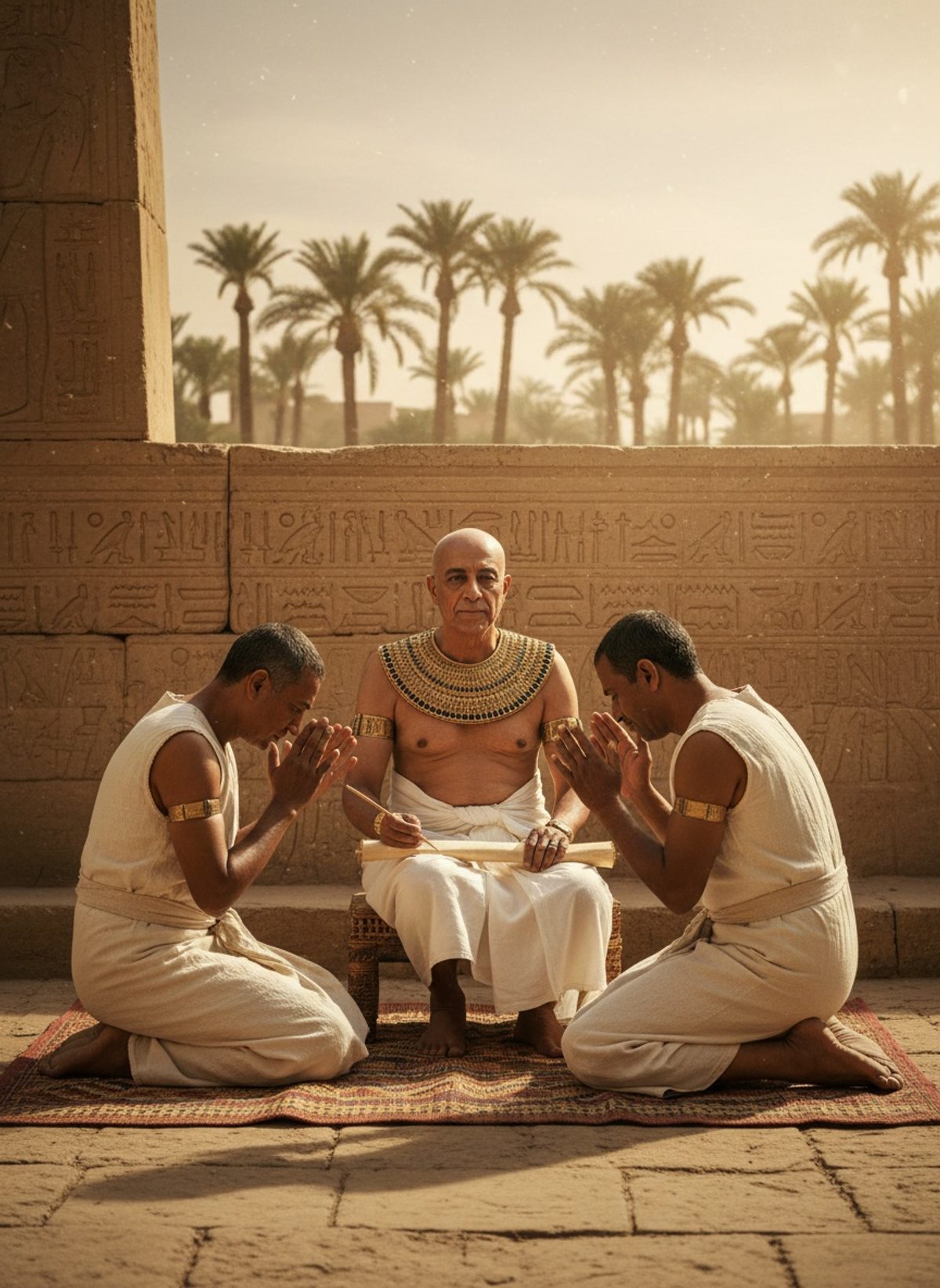
The heat was oppressive in the packed room, amplifying the murmurs of the gathered crowd. Dusty sandals shuffled on the stone floor as a man's voice rose above the rest, quivering slightly with unaccustomed authority. This was one of Amenhotep son of Hapu's courts, and it was alive with anticipation. Hapu himself, an imposing figure with the air of both scribe and sage, sat amidst the clamoring voices, quill in hand, ready to capture the grievances of those who had never before felt they had a right to speak.
Born around 1390 BC in the city of Athribis, Amenhotep son of Hapu was not destined to be a pharaoh or a mighty general; his station was one of humble beginnings. Yet, through intellect and purpose, he ended up wielding a far more extraordinary power. He moved through the ranks from scribe to become the overseer of all works under Pharaoh Amenhotep III, the sovereign who ruled during the glorified days of the 18th Dynasty. But it was not just temples, palaces, and statues that Amenhotep son of Hapu constructed — he built something much more enduring in Egypt's social landscape.
The notion of an official caring deeply for ordinary people was an anomaly in ancient Egypt’s rigidly stratified society. While the pharaoh, considered a living god, communicated directly with the divine, the common people lived in the shadows of power. Yet, Amenhotep son of Hapu dared to listen to the whispers of these commoners. In a period marked by monumental achievements and the consolidation of wealth and power, he did the unthinkable: he set up spaces where the grievances of the poor could be heard, written down, and, remarkably, acted upon. This act of bureaucratic grace was sanctioned by Pharaoh Amenhotep III himself, a gesture as audacious as it was progressive.
It was in Thebes, the heart of New Kingdom Egypt, where Amenhotep son of Hapu’s reputation truly flourished. Known for its grand temples that reached toward the blazing sun, Thebes was a city spangled with stonemasonry and ceremonial processions. But within its sandstone courtyards, where the poor flocked to tell their tales, Amenhotep son of Hapu heard stories of hardship that were as old as the sands themselves. These trials were etched into papyri long after the individuals had left, forming a mosaic of testimonies that captured the human experience — marks of dignity in a time that rarely afforded such luxuries.
Read next: Sennefer Walked Into the Tomb. He Left a Garden.
His appointed judges were hand-picked, meticulous scribes who would document every grievance with precision. What the people found when they entered Amenhotep son of Hapu’s court was something immensely valuable: the chance for rectification or, at the very least, acknowledgment. It was here that the wheel of justice slowly began to turn, not just for the pharaoh and his kin but for the farmers, bakers, stonemasons, and weavers whose labor built the bedrock of Egyptian society.
Amenhotep son of Hapu's influence was not merely administrative; it bordered on the divine. After his death, he was deified, an honor bestowed only upon a select few. Temples were erected in his name, and he was worshipped as a demi-god for over two thousand years, revered for his wisdom and compassion. Remarkably, Amenhotep son of Hapu was the sole commoner granted the privilege of a mortuary temple akin to that of the pharaohs. This was a physical symbol of his enormous contribution to society; his was a legacy interwoven with the granite and gold of Egyptian temples, as much as with the community he served.
His name lingered in the recitations of the living, a preserver of justice whose spirit was invoked for centuries by those seeking solace and protection. It is said the pharaohs of later dynasties sought his counsel via dreams, hoping to draw wisdom from the corridors of time. Through his extraordinary vision and actions, Amenhotep son of Hapu's legacy became inseparable from the legacy of Egypt itself.
Amenhotep son of Hapu's life and work offer a glimpse into the heart of Egyptian civilization — a civilization that was, in many respects, way ahead of its time in recognizing the value of justice and documentation. It challenges us to consider the importance of voice and inclusion in powerful institutions, an issue that continues to resonate today. His endeavors stand as a testament to the power of empathy and the written word. In him, we see the power of transformation as unleashed by dedication and foresight, as much now as it was over 3,000 years ago.