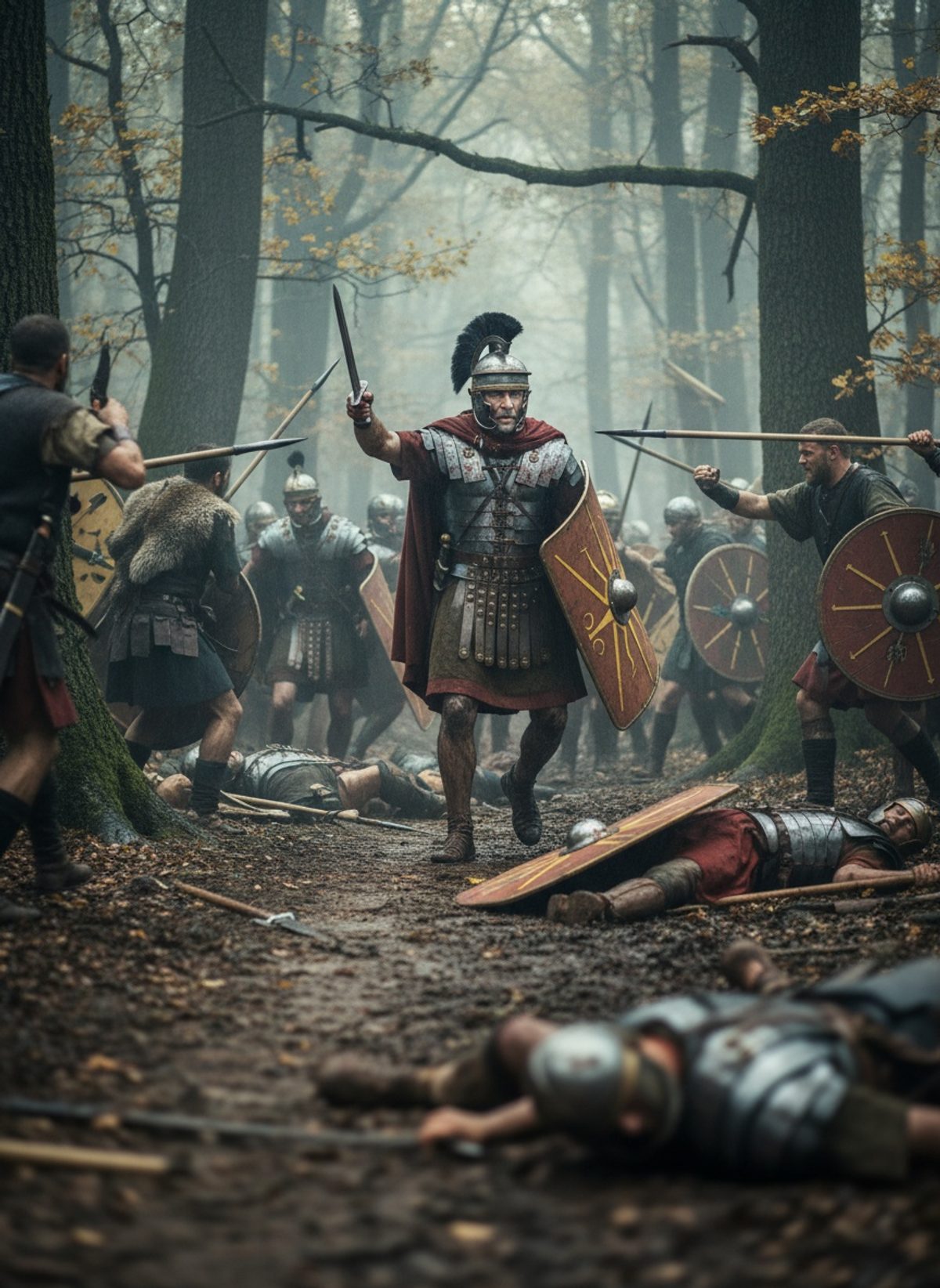
He was not a Roman. Yet he held Roman citizenship and was trusted with military command. Arminius, a young Germanic chieftain of the Cherusci tribe, used his intimate knowledge of the Roman military machine against it, orchestrating a battle that would reverberate throughout history.
The Battle of Minds: A Germanic Prince with Roman Training
In 9 CE, the Cherusci prince, Arminius, found himself straddling two worlds. Born into a tribe dealing with the encroaching power of Rome, Arminius was an emissary between cultures. While serving the Roman army, he became fluent in Latin and understood the intricacies of Roman strategies, gaining Roman citizenship and achieving the equestrian rank. This dual allegiance sowed the seeds of a grand deception.
Publius Quinctilius Varus, the governor of the Roman territories in Germania, relied on Arminius as a trusted ally. The young chieftain leveraged this trust to meticulously weave a plan that would lead Varus into the trap. Arminius knitted together an alliance of Germanic tribes, united in their desire to expel the Romans from their land. Varus, oblivious to the impending betrayal, moved his legions into the dense and ominous Teutoburg Forest, guided by the very man plotting their demise.
The Trap Set: Into the Maw of Teutoburg
The forest was no place for Roman legions accustomed to open combat. Its labyrinthine paths and towering trees swallowed the soldiers as they marched, forced into a narrow procession that dismantled their usual tactical formations. As they advanced deeper into the woods on that fateful September day, they were utterly unaware of what lay ahead.
Read next: Varus Marched Into the Forest. He Never Came Out.
The ambush sprung over three relentless days, an ordeal of chaos and blood. Arminius utilized every ounce of his tactical acumen honed under Roman tutelage. The well-coordinated assault by allied Germanic tribes plunged the Roman forces into disarray.
Panic spread as heavily armored soldiers floundered in the thick underbrush, unable to mount a coherent defense. The cacophony of battle cries mingled with the rustle of leaves and the clash of arms. Varus, overwhelmed and taken by the shocking turn of events, chose suicide over capture, an indication of the complete Roman collapse.
Aftermath and Acknowledgement: Rome's Stunned Retreat
The Teutoburg debacle left an indelible mark on Rome's consciousness. The loss of three legions—comprising over 20,000 troops—and their eagle standards was catastrophic, a blow not only to Rome's military might but to its imperial aura. Emperor Augustus, upon receiving the news, was driven to despair, mourning the massacre and pleading for the return of his soldiers.
This monumental defeat forced Rome into a strategic reevaluation. Never again would Roman forces venture beyond the Rhine with the same ambition. The Rhine became a symbol of Rome's frontier in Europe, a natural divide that prompted a defensive posture rather than one of expansion. The notion of a Romanized Germania was abandoned, shaping the future course of Europe.
Read next: The Roman General Who Crossed the Rubicon and Changed History Forever
The Wider Impact: United by Division
Arminius had achieved the seemingly impossible. By orchestrating a chaotic melee in the heart of unfamiliar terrain, he not only halted Rome's expansion but also sewed a fragile unity among disparate Germanic tribes, albeit momentarily. His actions inspired generations of Germanic warriors and redefined the relationship between Roman and native powers on the continent.
Yet the victory also planted seeds of discord within the region. Arminius faced opposition from local rivals and former allies, culminating in his assassination in 21 CE. Although short-lived, his success at Teutoburg left an enduring legacy. It cast a long shadow over Germanic and Roman interactions, serving as a powerful reminder of the limits of Rome's reach.
A Turning Point in Human History
The Battle of the Teutoburg Forest was more than a military disaster for Rome. It was a turning point that forever altered the trajectory of European history, preventing the Romanization of the Germanic landscape and preserving distinct cultural identities. This encounter in the shadowed woods serves as a lesson on the unpredictable nature of power and influence.
Arminius' bold strategy and intricate understanding of his former patrons transformed him from a trusted Roman officer into a legendary liberator. His tale underscores the complexity of allegiance and identity in a world shaped by conquest and diplomacy. As the forest whispered its age-old secrets to the fallen legions, history recorded a moment when the balance of power shifted with the movement of shadows among trees.