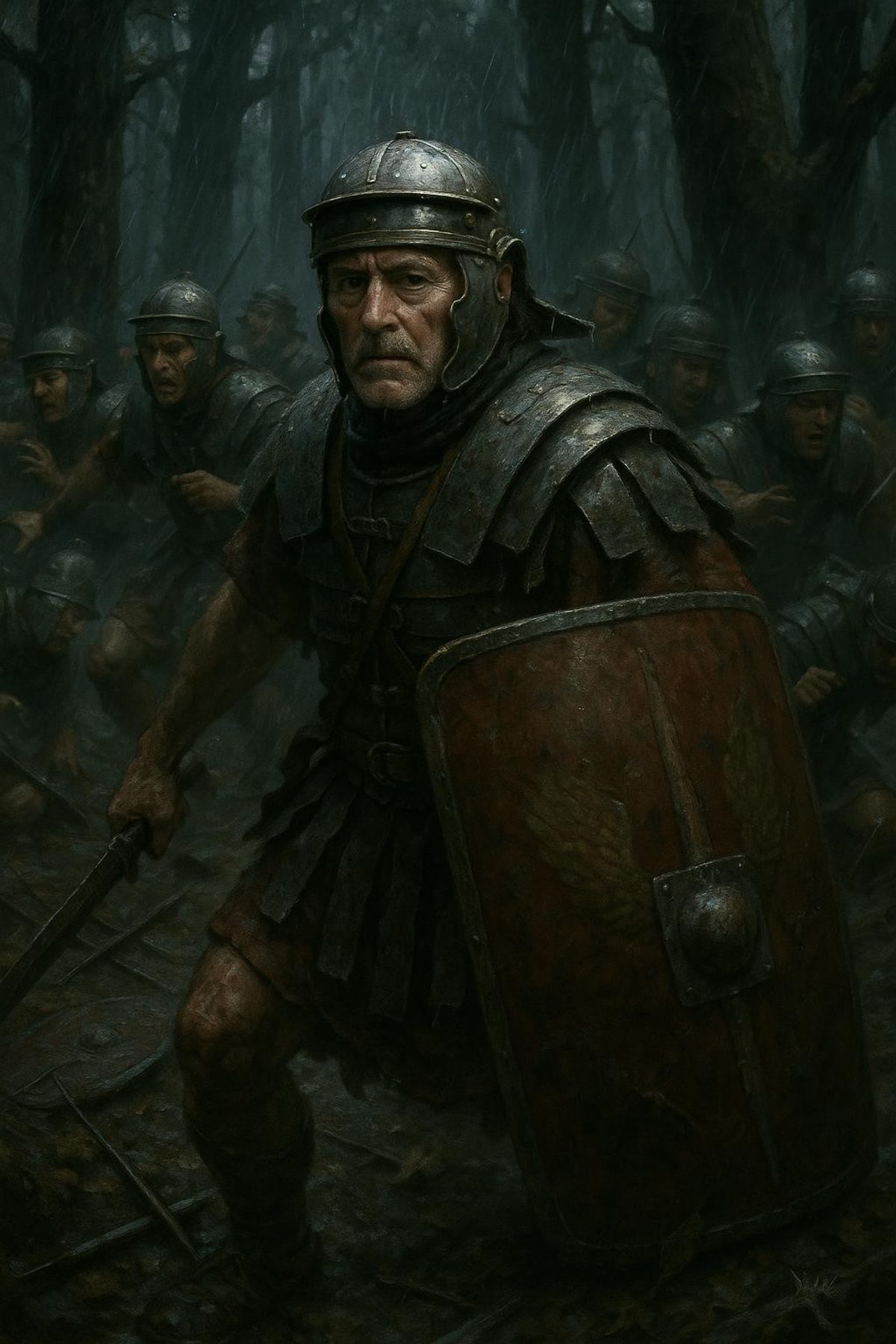
He was a Roman general and a consummate politician, but perhaps most surprisingly, Publius Quinctilius Varus was once celebrated for his affability and charm. Yet these very traits, which had served him so well in the salons of Rome, would prove disastrous in the dense, foreboding forests of Germania.
In the year 9 AD, Varus stood at the helm of three Roman legions, approximately 20,000 strong, as they plunged into the mysterious heart of Germania. This region, stretching beyond the well-trodden reach of the empire, was a land of thick, impenetrable woods and river-laced bogs entirely unfamiliar to the disciplined contingents under his command. Rome had long viewed Germania with a mix of distaste and desire, seeing its untamed expanse as both a threat and an opportunity for expansion.
Varus's mission, ostensibly to consolidate newly annexed territories and prepare them for integration into the Roman sphere, was more than a routine exercise in imperial administration. It was part of a broader intention to extend Rome's influence further eastward beyond the natural boundary of the Rhine. But this ambition hinged on the loyalty and guidance of local tribal leaders, none more critical than Arminius, a chieftain of the Cherusci tribe who had seemingly embraced Roman laws and customs.
Arminius, educated in Rome and a member of its elite auxiliary forces, had been given Roman citizenship and a groomed military pedigree. To Varus, Arminius was the linchpin in his understanding of and dealings with the Germanic tribes. With his fluent Latin and cultivated demeanor, Arminius was the archetype of the "Romanized barbarian" — a notion appealing and re-assuring to Roman leaders who believed in the transformative power of their empire.
Read next: Curtius Rode Into the Chasm. Rome Held Its Breath.
However, Arminius's outward allegiance concealed a simmering resentment and a clandestine cunning. As the legions marched deeper into Germanic territory, he set his trap. Under the guise of solidarity, he whispered warnings into Varus's receptive ear, of potential revolts and unrest beyond the immediate forest ridge. The general, reliant on Arminius's intelligence, diverted his troops—a fateful decision borne of naivety and misjudged trust. This detour led the legions away from the known safety of clearer pathways and into the dense, labyrinthine expanse of the Teutoburg Forest.
The assault, swift and brutal, began under the veil of rain and the cacophony of sudden chaos. It was not a pitched battle that unfolded but a massacre orchestrated with precision. The Roman soldiers found themselves ensnared in a hellish theater of war they neither anticipated nor understood. Hemmed in by the towering trees and tribal fighters surging like wolves through the woodlands, the legions' renowned formations and regimental discipline counted for little.
Over three harrowing days, the skies wept upon blood-soaked earth as constant guerrilla strikes shattered the Roman lines. Desperation mounted with the falling legions, their pride and survival subsumed in the swampy quagmires and covertly laid traps. To the Germans, these woods were a fortress of their own making, teeming with strategic versatility and the advantage of concealment. For Varus and his men, it was a foreign abyss that swallowed whole their might and morale.
The culminating tragedy was undeniable. The Roman formal retreat spiraled into a rout as scores of variegated standards toppled and once-disciplined commanders fell either to the enemy or their own blades — choosing death over the disgrace of capture. Varus himself met a grim and self-imposed end, a last act befitting the Roman ethos but futile amidst the larger annihilation.
Word of the catastrophic defeat took weeks to reach Rome, traversing through the network of frontier nodes and outward to the city’s heart. The empire shivered under the weight of loss unprecedented since the Cannae debacle centuries prior. Augustus, the revered emperor whose reign had hitherto been marked by stabilization and expansion, was seized by rage and grief. Repeatedly banging his head against palace walls, the emperor uttered the cry that echoed through history: “Quintili Vare, legiones redde!” — “Quinctilius Varus, give me back my legions!”
The repercussions of this Germanic triumph were profound and enduring. It drew a proverbial line in the Teutonic soil and forced Rome into a recalibration of its imperial ambitions. The Rhine would remain the diaphanous border, a bulwark as much of Rome's insecurities as of its military prowess. The region beyond became, in Roman eyes, a wilderness painted less with opportunity than with the blood-stained cautionary tale of Rome's overreach.
This demise of legions in Teutoburg's engulfing forest did more than halt an eastward expansion it sounded a clarion to the limits of empire and the hubris of conquest. Amidst the thick canopy and unyielding terrain lay buried an archetype of colonial overreliance on collaboration and the fatal gamble on goodwill. Arminius, hailed as a hero among his people, would live on as a symbol of resistance against oppression—a reminder that no civilization's march is inexorable.
In the annals of history, Varus stands as a metonym for Rome's lost certainty and the beginning of its quest for more measured governance. His story, one of betrayal and tragic ignorance, underscores the enduring theme that in the dense shadows of power, trust, like a fragile wisp, can unravel all that is held dear. The echoes of Varus's failed command and his fateful march linger as a testament to the empire, whispering lessons of prudence, integrity, and the volatile nature of conquest that neither time nor history may ever fully dispel.