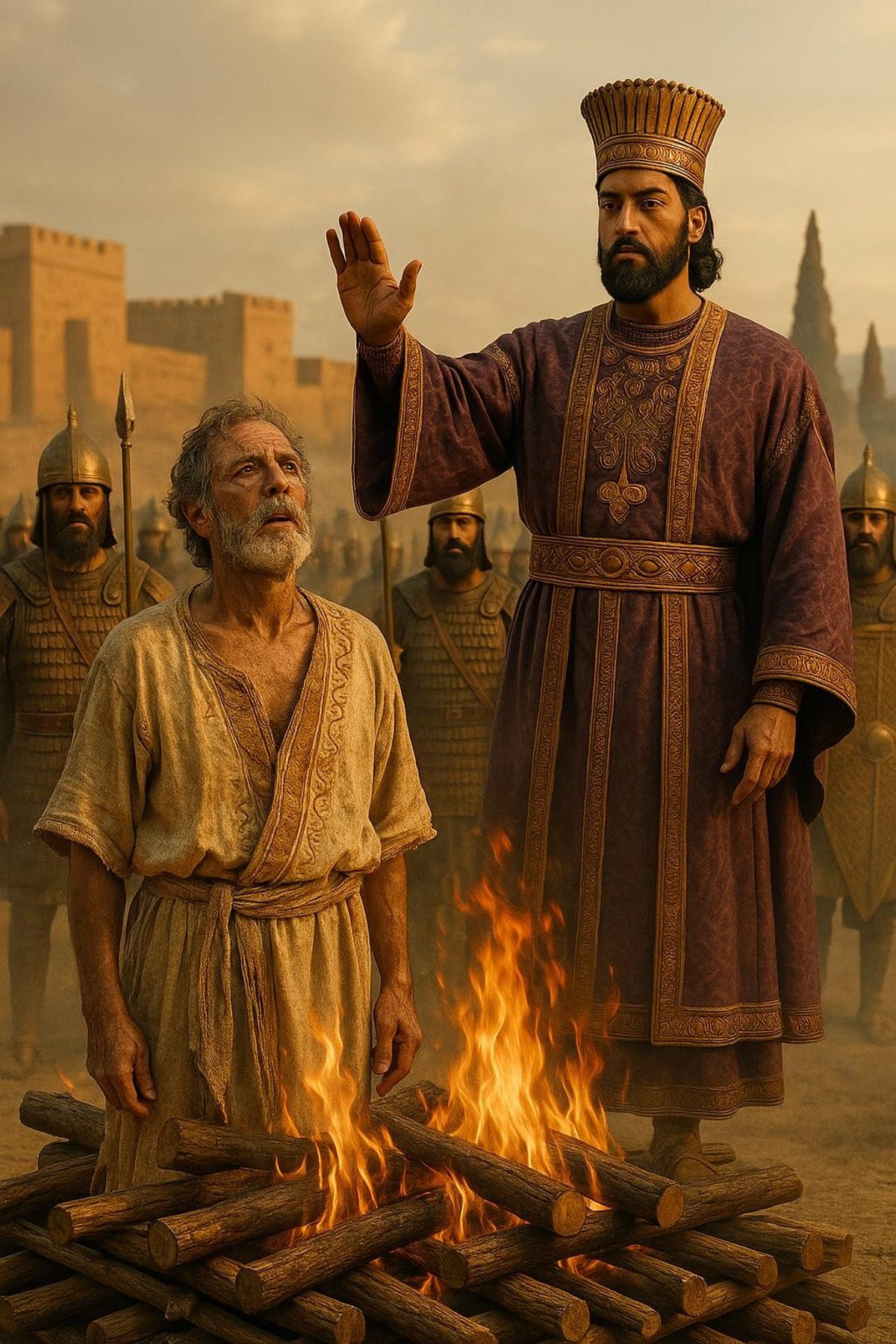
He was once the wealthiest king known to the ancient world. At that moment, though, he stood bound on a pyre, prepared to face the flames. The dramatic turn of fate that brought Croesus, King of Lydia, from grand opulence to imminent dread on the pyre was breathtaking, even in the annals of antiquity. In 547 BC, his domain had stretched across prosperous lands enriched by trade and conquest; now, he awaited death by fire, a stark victim of Cyrus the Great's expanding Persian Empire. The scene was poised for tragedy, yet it unfolded into an extraordinary episode of clemency that resonated throughout the ancient world.
The Fall from Grace
The saga of Croesus begins with his ascension to the throne of Lydia in 585 BC, following the death of his father, King Alyattes. His early reign was marked by prosperity and power, amplifying Lydia's sway over much of western Asia Minor. His edicts controlled crucial trade routes and his cities thrummed with economic activity; he even minted some of the earliest known coins, a testament to his innovative governance. Lydia flourished under his rule: wealth flowed abundantly as merchants traded goods, from the precious metals of the Lydian heartland to the renowned wines and olive oils that would later tantalize the Greek palate.
Yet, Croesus' ambition spurred him to look beyond mere affluence. He sought to extend his influence far and wide, targetting neighboring realms and forging strategic alliances. His alliances with Media, Egypt, Babylonia, and even the mighty Sparta seemed to cement his power, painting a portrait of a king wrapped steadily in an invincible network. However, this lattice of power could not withstand the tectonic shifts at play. In 550 BC, these alliances shook when Cyrus the Great toppled Croesus' brother-in-law, the Median king Astyages, swiftly absorbing Media into the rising Persian Empire.
Despite forewarnings, Croesus predicted a favorable outcome. Inspired by a prophecy from the Oracle of Delphi, a sovereign whose advice was steeped in legend, he believed a great empire would fall should he attack Persia. Tending to his blinding overconfidence, Croesus embarked on this ill-fated mission by attacking Pteria, a Phrygian satrapy of Persia. But Cyrus, a strategic genius, countered with guile and might, ultimately besieging Sardis, the Lydian capital. Croesus, expecting reinforcements never savored, crumbled as his proud kingdom yielded to Persian resolve. Atop the ruins of his empire, Croesus found himself watchful of the slow, indifferent advance of kindling flames meant to consume him along with his fallen pride.
Read next: Gobryas Opened the Gates. Cyrus Made a Promise.
A King's Redemption
As the flames flickered at Croesus' feet, the world held its breath. He reflected solemnly on the unpredictable whimsy of fortune—a life of gilded towers and servant wings brought abruptly down to ashes. According to Herodotus, in those final spurts of hopelessness, Croesus cried out the name "Solon" in a pained lament, invoking the Athenian lawgiver's counsel on the transitory nature of human prosperity: "Count no man happy until the end is known." By a stroke of wonder and perhaps destiny, the noon sun shaded from a visage of incompliance for a grander act of mercy.
Witnessing his rival's suffering, Cyrus paused. The Great King, known for his unyielding resolve, overcame his disposition with profound contemplation. Cyrus ordered the flames extinguished, demanding Croesus be freed from the consuming pyre. His troops obeying, the fire diminished to sullen embers, just as quickly as fatality had courted Croesus. A gasp of disbelief caught the wind, replaying the echoes of a new beginning.
Cyrus' clemency extended beyond life. He discerned wisdom beneath Croesus' crown once veiled in gold, appointing him as an advisor. This decision was an astute one—Cyrus found in Croesus not just a conquered foe, but a vessel of insight and pragmatism garnered from hard-lived experience and former power. Echoes of this astounding reprieve echoed far across lands and seas, punctuating ever deeper than the routed walls of Sardis. In this unlikely alliance, Cyrus fortified his ranks with a seasoned mind who knew the intricacies of governance and the labyrinth of human ambition.
The Timeless Lesson
Why would Cyrus the Great, emblematic of dominion and strategy, extend mercy to a fallen sovereign? The answer lies in an unexpected respect for fate's impartial hand. In sparing Croesus and weaving him into the tapestry of his empire, Cyrus demonstrated an understanding that history—much like fortune—spins on cycles of rise and ruin. Croesus, once resplendent, had simply played his turn on that axis.
This tale of kings, empires, and transcendental grace elucidates the intricate dance of power and consequence. It reminds us that even in a world where dominion is built upon the foundations of conquest, there remains a profound place for understanding, reverence for providence, and humanity. Croesus' story emerged not as a dirge of demise but as a chronicle where fortune, prowess, and mercy coalesce, forming a fascinating mosaic of history.
While today's empires and their leaders face different challenges and dynamics, the principles of leadership and learning from one's predecessors provide timeless guidance within the ever-turning pages of history. In the light and shadow of Croesus and Cyrus, we find more than mere tales; we glimpse a drama where mortality unlocks wisdom and where great power meets the grace to wield it with perspective.