Desmond Doss was a man of faith, not war. He stood on the battlefields of World War II armed with nothing more than a medic's kit and unwavering belief. Born to William Doss, a carpenter, and Bertha Doss in Lynchburg, Virginia on February 7, 1919, Desmond was the product of a devout Seventh-day Adventist upbringing. His mother taught him the tenets of their faith—Sabbath-keeping, nonviolence, and vegetarianism—principles that would define his life choices. As a young man, working at the Lynchburg Lumber Company to support his family during the Great Depression, Desmond learned the importance of hard work and sacrifice. But nothing could have prepared him for the trials he would face during the deadliest conflict in human history.
When America plunged into the turmoil of World War II, Desmond Doss faced a choice that tested his convictions. Employed as a joiner at a shipyard, Doss was offered a deferment due to his essential work. Yet, he declined, driven by a fierce patriotism and a desire to serve. On April 1, 1942, he was inducted into the Army at Camp Lee, Virginia, embarking on a journey fraught with challenges to both his physical endurance and moral fiber. Training at Fort Jackson, South Carolina, with the 77th Infantry Division, Doss's refusal to carry a weapon isolated him from his comrades and superiors alike. To him, touching a rifle was anathema to the principles instilled by his faith. His fellow soldiers branded him a coward, mocking him incessantly and viewing his pacifism with disdain.
Doss, however, would prove them all wrong, not through aggression, but through compassion and courage. Assigned as a medic to the 2nd Platoon, Company B, 1st Battalion of the 307th Infantry Regiment, he earned two Bronze Star Medals during combat operations in Guam and the Philippines in 1944. In the face of enemy fire, Doss exhibited exceptional bravery in aiding wounded soldiers, an early glimpse of his heroism that would reach its zenith in the Battle of Okinawa.
The Maeda Escarpment, infamously known as Hacksaw Ridge, loomed as an imposing, nearly 400-foot high cliff on the island of Okinawa. By April 1945, this strategic point had become a brutal flashpoint in the battle between Allied and Japanese forces. For Doss's unit, the ordeal at Hacksaw Ridge was harrowing; casualties were severe, and the assault seemed doomed. It was here, amidst the chaos of war, that Desmond Doss's actions would become the stuff of legend.
Read next: The Sultan Sent 40,000 Men to Take Malta. They Failed.
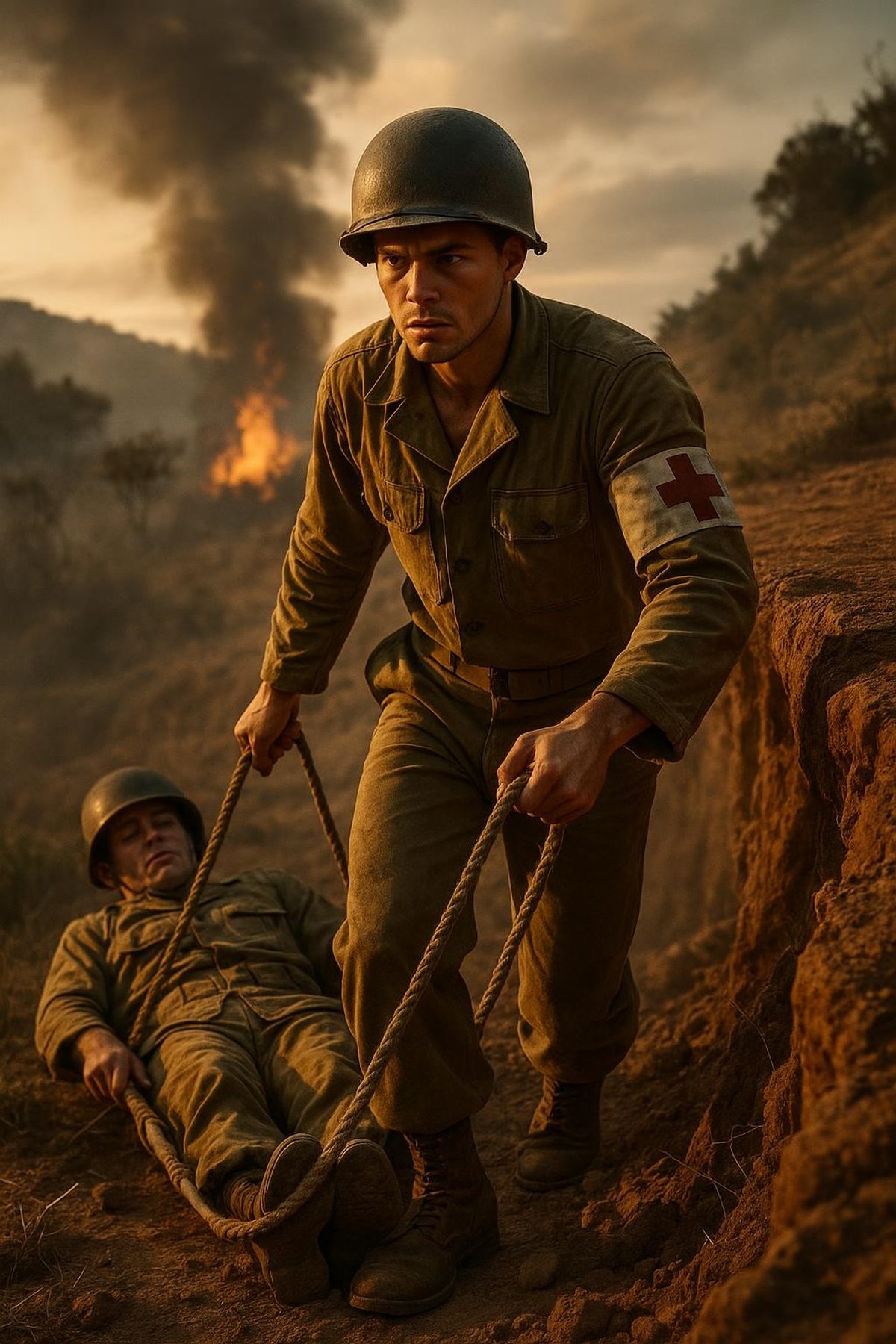
Over several days in May 1945, Doss performed acts of valor that transcended the horrors around him. With relentless artillery and gunfire raining down, he tended to fallen soldiers, bandaging wounds and offering words of solace. Yet, it was the rescue operation he conducted alone on May 5 that truly defied belief. As the battle intensified, many American soldiers were pinned down atop the escarpment, wounded and unable to descend. Doss, refusing to leave them behind, embarked on an extraordinary mission.
Using a simple rope sling, he began lowering injured men one by one down the treacherous cliff face. The operation stretched into hours, with Doss pausing only to utter a prayer: "Lord, let me get one more." In the darkness, surrounded by enemy threats, his work both assuaged and inspired. By the end of this audacious act, he had saved an estimated 75 to 100 men, his effort mirroring the Biblical acts of David prevailing against insurmountable odds. All this while sustaining his own injuries—an eventual sniper's bullet would fracture his left arm and grenade blasts would embed 17 shrapnel pieces in his limbs.
For his unparalleled bravery and selflessness at Hacksaw Ridge, Desmond Doss became the first conscientious objector to be awarded the Medal of Honor, receiving it on October 12, 1945. President Harry S. Truman himself presented the award, acknowledging that Doss’s version of courage shone as brightly as any soldier’s. Yet, the war exacted heavy tolls on Doss’s health, leaving him with a shattered arm and chronic tuberculosis contracted on the Pacific island of Leyte. His convalescence would stretch for years, eroding his once robust body until he was left with a single lung and diminished physical capacities.
Desmond Doss's life after the war remained intertwined with the faith that guided him through its darkest days. Despite his disabilities, he led a life marked by humility and gratitude, remaining in Lynchburg with his family. His story, though largely quiet in the years following the war, gained renewed attention through the 2004 documentary The Conscientious Objector and the 2016 film Hacksaw Ridge, which brought his remarkable story to a new generation.
In reflecting on his legacy, one cannot help but marvel at the profound contrast contained within his life—a tale of strife where one man found the resilience to fight not with weapons, but with steadfast love. His story forces us to reconsider what true heroism looks like in times of dire need. Doss’s life serves as a timeless reminder that courage is often quieter than we assume and that conviction can propel a single soul to transcend battlefield valiance, without a single shot fired.