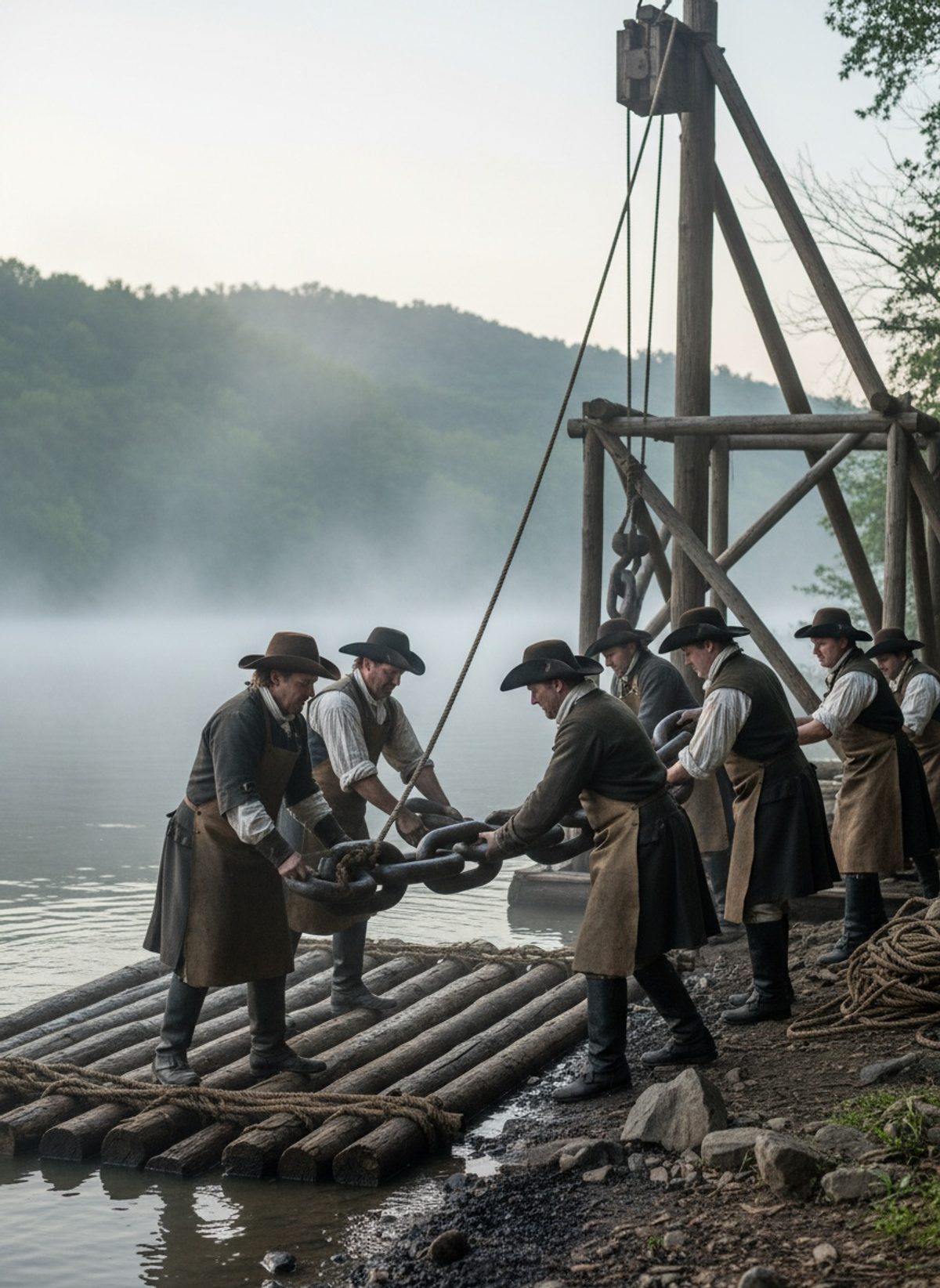
April 30, 1778. The morning fog lingered over the Hudson River, casting a veil over the valley's secret defender.
A Chain Forged in Defiance
As the American Revolutionary War raged through the latter half of the 18th century, a unique form of resistance took shape along the Hudson River. This rippling body of water, flowing southward with ceaseless constancy, became the unlikely battleground where engineering prowess stood as firm as the stoic cliffs framing its banks. In the spring of 1778, an audacious plan was conceived to halt the mighty British Royal Navy, regarded as the world's preeminent naval force.
American ingenuity met desperation head-on. Commanded by General George Washington and engineered under the stewardship of Captain Thomas Machin, colonial forces embarked on an unprecedented feat of logistics and metallurgy: forging a vast chain across the Hudson at West Point. Each link, crafted from iron, weighed between 100 and 180 pounds. Collectively, this immense chain stretched for a formidable 500 yards, linking Fortress West Point with the eastern banks of the river.
Yet, the chain was more than a simple barrier; it was a bold proclamation of autonomy, an ironclad defiance to Britain's naval supremacy. Designed to deter and damage enemy ships, the chain was anchored by massive wooden structures called boom logs. These hulking timbers, shrouded in the river’s mist, were a testament to the sheer laborious task shouldered by the American blacksmiths and engineers.
Read next: The Train Was Found by Chance. What Was Inside Shook Them
Particularly desperate to maintain control and communication along the Hudson River valley, American forces understood that this waterway was vital. It not only served as a natural border and strategic corridor but also symbolically divided rebellious New England from the mid-Atlantic colonies. Thus, the chain across the Hudson was more than just a physical obstruction—it embodied the budding nation's unity and resolve.
Defying the British Goliath
As the spring of 1778 thawed into a changeable summer, the presence of the chain hovered like an unspoken challenge to the British fleet. Throughout the war, British control of the Hudson was tantamount to bisecting and thereby nullifying the Rebel cause. However, the audacity of raising such a defiant barrier left a mark of ambivalence even among the British commanders. No British ship dared test the strength of the chain, a fact that remains not just a tactical puzzle but a psychological triumph for the Americans.
Despite meticulous surveillance and attempts to keep its construction secret, news of the chain's completion sent waves of concern rippling through the British ranks. Naval strategists recognized that the calculated risk of navigating treacherous waters beset by a potentially catastrophic barrier was too great. The river's natural currents themselves posed difficulties without an impassable chain looming beneath the surface—a naval minefield of ingenuity.
Instead of brute confrontation, the British fell back on alternative tactics—typifying a silent acknowledgment of the chain’s deterrent power. Spies reported on the chain’s daunting dimensions and deceptive simplicity. It was a megalith of maritime defense without a shot fired. The Royal Navy, wrapped in centuries of naval tradition and hubris, found itself thwarted—not by equal firepower, but by the unwavering commitment and creativity of a fledgling nation.
To many American soldiers and engineers, the chain became a potent symbol of technological innovation, despite their disadvantaged position. The sight of it, stretched across the river like a promise carved from iron, was a reminder that unconventional tactics could and would hold the line against the seemingly inevitable march of imperial power.
Legacy of a Silent Sentinel
As winter settled in over 1778, and with the war dragging into its gruesome stalemate, the chain stretched across waters that sang a silent, expectant tune. Ultimately, it never saw action; no epic naval engagement tested its links. Its mere presence was the victory—a testament to calculated risk, expert craftsmanship, and collective resolve.
Though the chain has long since vanished from the Hudson River's waters, its legacy lingers in the annals of unconventional military history. It captures a spirit of American ingenuity and resilience that persevered against the strictures of lofty colonial might. The untried chain marked a pivotal turn in the tactical chess game of the American Revolution—its muted success underscoring the potential of nascent nationhood to stand, stalwart amidst adversity.
As we trace the rare lineage of the so-called "Great Hudson Chain," its quiet triumph offers a poignant reflection on the power of symbolism in human conflict. More than metal links, it connected hearts and minds, bridging hope across turbulent waters. Facts once concealed by the depths of the river now serve as a reminder of the courage to innovate when all seemed lost—the chain’s enduring truth echoing far beyond its eventual, quiet disappearance.